
Singapore Condo Sinking Fund and Maintenance Fee Guide 2026: What Every Owner Needs to Know

Singapore Condo Sinking Fund and Maintenance Fee Guide 2026: What Every Owner Needs to Know

When Singaporeans talk about the monthly cost of owning a condominium, they usually quote the mortgage repayment. What often gets overlooked β€” until the first few months after moving in β€” are the maintenance fee and sinking fund levy: two mandatory monthly contributions that every strata-titled condo owner must pay to the Management Corporation Strata Title (MCST). Together, these can add S$300 to S$1,200 per month to the cost of condo ownership, and failing to pay them has real legal consequences. This guide explains exactly what these charges are, how they are set, what they pay for, and how to plan for them when buying a condo in Singapore.

Quick Answer β€” Condo Fees at a Glance

  • Maintenance fee: monthly contribution for day-to-day estate running costs (security, cleaning, utilities, landscaping).
  • Sinking fund levy: monthly contribution to a reserve for major capital expenditure (lift replacement, roof waterproofing, facade repainting).
  • Both are collected by the MCST, the legal body representing all owners in a strata development.
  • Contributions are set at the Annual General Meeting (AGM) based on unit share value β€” larger units pay more.
  • Typical total condo fee (maintenance + sinking fund): S$300–S$1,200/month, depending on development size, age, and facilities.
  • The sinking fund must be maintained at a minimum of 10% of the preceding year’s management fund under the BMSMA.
  • Non-payment can result in MCST filing a court order against the owner. There is no grace period in law.
  • Governed by the Building Maintenance and Strata Management Act (BMSMA), administered by the Commissioner of Buildings (COB) under HDB.

What Is the MCST and Who Sets the Fees?

Every strata-titled development in Singapore β€” from a two-unit walk-up to a 1,000-unit mega-project β€” is governed by a Management Corporation Strata Title (MCST). The MCST is a body corporate constituted automatically when the strata title plan is registered with the Singapore Land Authority (SLA). It has its own legal personality: it can sue, be sued, hold property, and enter contracts.

The MCST is governed by a Management Council, elected by subsidiary proprietors (owners) at the AGM. The Council sets annual budgets for two distinct funds: the Management Fund (covering day-to-day operations) and the Sinking Fund (covering capital expenditure). Individual owner contributions to each fund are proportional to their unit’s share value β€” an integer assigned to each lot at the time of development based on floor area and usage. A 1,500 sqft unit might have a share value of 10; a 600 sqft studio might have a share value of 5. Your monthly levy is therefore your unit’s share value divided by the total share values of all units in the development, multiplied by the total annual budget for that fund, divided by 12.

The legal framework governing all of this is the Building Maintenance and Strata Management Act (BMSMA), Cap. 30C. Key rules include: the sinking fund must hold at least 10% of the management fund budget; the MCST must prepare audited accounts annually; and owners who are in arrears can have their contribution recovered as a civil debt.

Feature Management Fund Sinking Fund
Purpose Day-to-day operations Long-term capital expenditure reserve
Examples of use Security, cleaning, gardening, utilities Lift replacement, waterproofing, facade repainting
BMSMA minimum No statutory minimum set Must equal at least 10% of management fund budget
Planning horizon Annual (reset each year) Cumulative β€” builds over time; does not reset
Typical monthly levy S$200–S$1,200 (varies by unit size) S$30–S$200 (10–15% of management fee)
Recoverable on sale? No β€” stays with MCST No β€” stays with MCST

Maintenance Fee β€” What It Covers

The maintenance fee (sometimes called the management fee or conservancy charge) finances the Management Fund, which covers the development’s recurring, day-to-day operating costs. These typically include:

Security services (24-hour guardpost, patrols, CCTV monitoring), cleaning and housekeeping of common areas, landscaping and horticultural maintenance, utility bills for common area lighting and lifts, pool and gymnasium upkeep (water treatment, equipment servicing), insurance for the building fabric and common property, property management agent fees, and routine maintenance and minor repairs. For luxury developments with concierge services, valet parking, or hotel-grade amenities, the management fund also covers these premium services β€” which is why fees in such projects can reach S$900+ per month for a large unit.

Monthly condo maintenance fee range by flat size Singapore 2026
Figure 1: Indicative monthly maintenance fee range by unit size β€” Singapore private condominium 2026. Actual amounts vary by development age, facilities, and MCST budget.
Unit Size Typical Monthly Maintenance Fee Key Variables
Studio / 1-bed (<500–700 sqft) S$150–S$380 Older projects, fewer facilities: lower end
2-bedroom (700–1,000 sqft) S$300–S$520 Most common resale condo bracket
3-bedroom (1,000–1,400 sqft) S$420–S$700 City-fringe projects with full facilities
4-bed / large unit (>1,400 sqft) S$580–S$950 CCR luxury projects at high end
Penthouse / duplex (>2,000 sqft) S$900–S$1,500+ Top-tier city projects, concierge, valet

Sinking Fund β€” What It Covers and Why It Matters

The sinking fund is a long-term capital reserve. Where the management fund covers ongoing operating costs, the sinking fund accumulates money for expenditure that is infrequent but extremely expensive β€” the kind of expenditure that cannot be funded from a single year’s management budget without creating a financial crisis for the MCST. Examples include: full lift replacement (typically every 20–25 years, S$200,000–S$500,000 per lift), external facade repainting (every 5–7 years for projects with extensive external surfaces), roof waterproofing membrane replacement, major mechanical and electrical (M&E) infrastructure overhaul, and swimming pool resurfacing.

Singapore condo MCST sinking fund expenditure breakdown pie chart 2026
Figure 2: Typical sinking fund expenditure allocation by category β€” Singapore MCST 2026. Proportions vary significantly by development age and building system profile.

The BMSMA requires the sinking fund to be maintained at a minimum of 10% of the preceding year’s management fund amount. In practice, well-managed MCSTs maintain a sinking fund that is a multiple of this minimum β€” particularly for older developments approaching major capital expenditure cycles. A prudent MCST will commission a 5-year capital expenditure plan and set sinking fund contributions accordingly. Buyers of older condos (15+ years old) should always ask for the current sinking fund balance and the 5-year capex plan before purchasing, as a depleted sinking fund may result in a special levy β€” a one-time extraordinary contribution demanded of all owners to fund urgent repairs.

Worked Example β€” Monthly Fees for a 3-Bedroom Condo in Clementi

Mr and Mrs Tan are purchasing a 1,100 sqft 3-bedroom resale condominium in Clementi (District 5) for S$1,580,000. The development has 320 units, was built in 2008, and has a shared value allocation of 8 for their unit. Total share values across all units sum to 2,240. The MCST’s annual budgets are: Management Fund S$1,680,000; Sinking Fund S$210,000.

Item Calculation Monthly Amount
Management Fund contribution (8 Γ· 2,240) Γ— S$1,680,000 Γ· 12 S$500
Sinking Fund contribution (8 Γ· 2,240) Γ— S$210,000 Γ· 12 S$62.50
Total monthly MCST levy S$562.50

On top of this, the Tans’ estimated monthly mortgage repayment on a bank loan of S$1,185,000 (75% LTV) at 3.5% over 25 years is approximately S$5,926. Their total monthly ownership cost is therefore approximately S$6,488. When running TDSR calculations, the bank will factor in the maintenance fee as a financial commitment β€” check with your mortgage adviser on how this is treated.

Total Monthly Ownership Cost β€” Mortgage, Maintenance and Sinking Fund

Total monthly condo ownership cost Singapore 2026 β€” mortgage plus maintenance fee plus sinking fund
Figure 3: Estimated total monthly cost of owning a condo at three market segments β€” Singapore 2026. Mortgage assumes 75% LTV, 3.5% p.a., 25-year tenure.

What Happens If You Don’t Pay?

MCST contributions are not optional. Under Section 40 of the BMSMA, unpaid contributions (whether management fund or sinking fund) are a debt recoverable by the MCST in the same way as any civil debt. The MCST can file a Magistrate’s Court claim for outstanding amounts and, if judgment is obtained, apply for enforcement including attachment of the owner’s bank accounts or garnishment of rental income. The MCST also has the right to charge interest on late contributions at a rate fixed in its by-laws (commonly 10–12% per annum).

For landlords renting out their unit, unpaid MCST contributions remain the owner’s liability β€” not the tenant’s. If a seller has outstanding arrears at the point of property transfer, the arrears must be settled before the strata certificate of title is transferred. In practice, the conveyancing lawyers for both sides will conduct an MCST search to confirm that no arrears exist before completion.

Checking Sinking Fund Health Before You Buy

Before committing to a resale condo purchase, particularly in an older development, always request the following from the seller’s lawyers or directly from the MCST:

The current sinking fund balance (a healthy reserve is generally more than 3Γ— the annual sinking fund budget); the 5-year capital expenditure plan (if available β€” well-run MCSTs have one); any pending special levies that have been voted on at an AGM but not yet collected; and the MCST financial statements for the past two years. A development with a healthy sinking fund and a documented capital plan is significantly lower risk than one that is underfunded and approaching major lift or roof works. In the latter case, you may be buying into an imminent S$10,000–S$50,000 special levy per unit.

What This Means for Condo Buyers in 2026

Condo maintenance fees have risen materially over the past three years, driven by higher labour costs for security and cleaning personnel, increased utility tariffs, and the generally higher cost of building materials for maintenance works. Industry data suggests average maintenance fees in mass-market condos have increased by 10–20% since 2022. For buyers underwriting their total monthly cost of ownership, this trend means that the maintenance fee is no longer a rounding error β€” it is a genuine budget line item that deserves the same scrutiny as the mortgage rate.

For investment buyers, maintenance fees directly affect net rental yield. A S$4,500/month rental on a unit with S$600/month in MCST fees represents a net operating yield (before mortgage) of about 3.2% on a S$1.5 million purchase β€” meaningful compression compared to the gross yield of 3.6%. Understanding and modelling the net yield after maintenance and sinking fund is essential for any investment analysis.

What Might Come Next

The COB has been increasingly attentive to poorly managed MCSTs. In 2024, the Building and Construction Authority (BCA) and COB jointly issued updated guidance on sinking fund adequacy, pushing MCSTs toward more rigorous 5-year planning. There is also ongoing discussion in the property management industry about whether the statutory minimum sinking fund (10% of management fund) is adequate for older developments β€” some practitioners argue it should be raised to 15–20% for projects over 20 years old. If such a change were legislated, monthly sinking fund levies would rise accordingly. Buyers of properties approaching their 15–20 year mark should factor in this regulatory risk.

Frequently Asked Questions

Can the management fee change from year to year?

Yes. The MCST Council proposes the annual budget at each AGM, and subsidiary proprietors vote on it. If costs have risen β€” for example, because security guard wages have increased or a landscaping contract was renewed at a higher rate β€” the management fee will be adjusted upward. Conversely, if the MCST finds cost savings, fees can decrease. In practice, fees rarely decrease; they tend to rise gradually with inflation. Buyers should ask for the last three years of AGM minutes to understand the fee trajectory of any development they are considering purchasing.

What is a special levy and when can the MCST charge one?

A special levy is an extraordinary, one-time contribution that the MCST can demand from all owners to fund urgent capital expenditure that cannot be covered by the existing sinking fund balance. Special levies require approval by a resolution at a general meeting (either an AGM or an Extraordinary General Meeting). They are most common in older developments where the sinking fund is under-provisioned and a major repair (such as lift replacement or waterproofing) is overdue. Special levies can range from S$5,000 to S$50,000 per unit depending on the size of the development and the scope of work. For this reason, checking the sinking fund balance before purchasing is critical.

Do maintenance fees apply to Executive Condominiums (ECs)?

Yes. Executive Condominiums are privately managed after the 10-year mark and are subject to the same BMSMA rules as private condominiums. During the initial period when HDB retains certain oversight, the management corporation is still constituted and maintenance fees apply from the date of key collection. EC buyers should budget for maintenance fees in the same way as any private condo buyer. EC maintenance fees are often somewhat lower than comparable private condos because ECs are typically built without the premium facilities found in luxury private developments, but the difference is not dramatic for mass-market comparisons.

Can landlords pass maintenance fees on to tenants?

In Singapore’s private residential tenancy market, there is no legal prohibition on a landlord including maintenance fees in the rent (i.e., charging a gross rent inclusive of the condo fee). In practice, however, most residential leases are structured on a net basis β€” the landlord pays the MCST contributions from the rental income and quotes the rent as an all-in figure. Some tenancy agreements explicitly state that maintenance fees are the landlord’s responsibility. Whatever the arrangement, the legal obligation to pay the MCST remains with the owner β€” the MCST cannot pursue the tenant for arrears.

How does share value affect my monthly levy?

Share value is a fixed integer assigned to each lot in the strata title plan at the time of development. It is broadly proportional to floor area but is also influenced by unit type and usage. A larger unit will have a higher share value and therefore pay a proportionally higher monthly levy. Share value cannot be changed by the MCST β€” it is set in the strata plan lodged with SLA and can only be altered by a unanimous resolution of all subsidiary proprietors followed by an amendment to the strata plan. Before buying, you can find out a unit’s share value by requesting the strata title plan from the developer, property agent, or MCST.

Is the sinking fund transferable when I sell?

No. The sinking fund belongs to the MCST, not to any individual owner. When you sell your unit, the accumulated sinking fund contributions you have made over the years remain with the MCST for the benefit of the development as a whole. You do not receive a refund of your share of the sinking fund balance on completion of sale. This is one reason why buying into a development with a healthy, well-funded sinking fund is in your interest even if you plan to sell within a few years β€” the sinking fund supports the quality of the common property, which in turn supports property values.

Where can I find out the exact maintenance fee before I buy?

For new launch condominiums, the developer is required to provide an estimated monthly maintenance fee in the sales documentation. For resale condos, the actual fee is best confirmed by requesting a copy of the latest MCST notice of contribution (which sets out the monthly levy per share value) or by asking the seller’s lawyer to conduct an MCST search. The MCST search will confirm the contribution rate, any arrears on the specific unit, and the sinking fund balance. This search is a standard step in any Singapore property conveyancing and costs approximately S$150–S$200.

Related Articles

Disclaimer: This article is for general informational and educational purposes only and does not constitute legal, financial, or property management advice. MCST contribution rates, sinking fund balances, and BMSMA requirements are subject to change and vary by development. Always verify actual maintenance fees with the relevant MCST, confirm current statutory requirements with the Commissioner of Buildings (HDB Strata Management portal), and obtain independent legal and financial advice before purchasing any property. LovelyHomes is not a licensed property management, legal, or financial advisory firm.

Buyer’s Stamp Duty Singapore 2026: Complete Guide to BSD Rates, Calculation and Remissions

Buyer’s Stamp Duty Singapore 2026: Complete Guide to BSD Rates, Calculation and Remissions

Buyer’s Stamp Duty (BSD) is the foundational property transaction tax that every buyer in Singapore must pay, regardless of nationality, residency status, or how many properties they own. Unlike the Additional Buyer’s Stamp Duty (ABSD) β€” which targets second-and-subsequent-property buyers and foreigners β€” BSD is universal. Whether you are a first-time Singapore Citizen buying a public housing flat or a foreign investor acquiring a luxury penthouse, BSD applies equally. Get it wrong in your budget, and you will face an unexpected six-figure bill at the point of signing.

This guide covers everything you need to know about BSD in 2026: the current rates, exactly how the duty is calculated, what is included in the taxable base, how it differs from ABSD, and the complete picture of stamp duty costs for different buyer profiles. All rates reflect the framework introduced on 15 February 2023 for residential property and remain in force as at the date of publication. For official confirmation, always consult the IRAS Stamp Duty for Property page.

Quick Answer β€” BSD at a Glance

  • BSD applies to every buyer β€” Citizens, PRs, foreigners, companies, and trusts alike.
  • Residential rates: 1% β†’ 2% β†’ 3% β†’ 4% β†’ 5% β†’ 6% in progressive tiers (w.e.f. 15 Feb 2023).
  • Non-residential rates: 1% β†’ 2% β†’ 3% (simpler three-tier structure, w.e.f. 20 Feb 2018).
  • Taxable base is the higher of the purchase price or the property’s open market value.
  • BSD must be paid within 14 days of signing the Option to Purchase (OTP) or Sale & Purchase Agreement.
  • BSD for a S$1.5 million condo: S$44,600 (effective rate: 2.97%).
  • BSD for a S$3 million condo: S$109,600 (effective rate: 3.65%).
  • BSD is administered by the Inland Revenue Authority of Singapore (IRAS).

What Is BSD and Why Does It Exist?

Buyer’s Stamp Duty is a documentary tax levied on instruments related to the purchase of property in Singapore. It has existed in Singapore law since the country was a British colony and is codified in the Stamp Duties Act (Cap. 312), administered by IRAS. In contrast to ABSD β€” which was introduced in December 2011 purely as a demand-management cooling measure β€” BSD is a revenue instrument: it is part of Singapore’s general tax base and applies to virtually all property acquisitions, not just speculative or investment-driven ones.

BSD was most recently restructured for residential property on 15 February 2023, when the Government added two new upper tiers (5% and 6%) targeting high-value transactions above S$1.5 million and S$3 million respectively. Prior to that, the top residential rate was 4%. The change was targeted at luxury-end transactions and was announced alongside the same cooling-measure package that raised ABSD rates significantly. You can read about the full cooling-measures context in our ABSD Singapore 2026 Complete Guide.

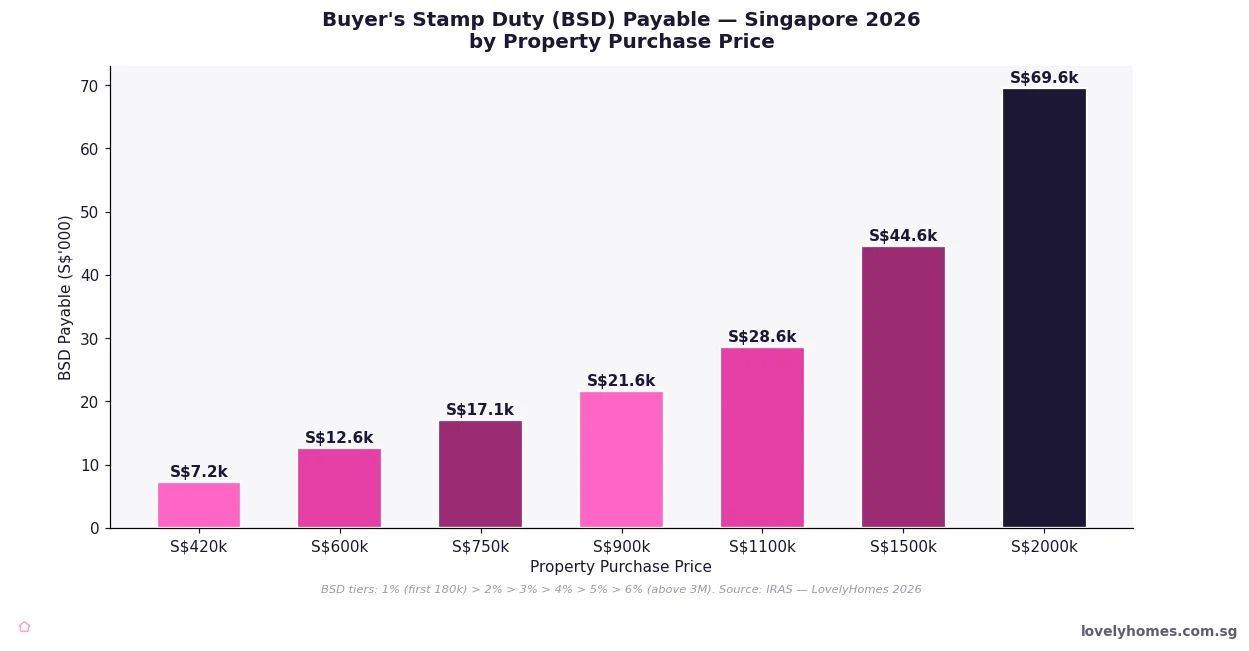
BSD Rates for Residential Property in Singapore (2026)

The current residential BSD rate schedule is progressive, meaning each tier applies only to the portion of the purchase price (or market value, if higher) that falls within that band. The table below sets out the tiers in full.

Singapore BSD rate by price tier 2026 bar chart β€” 1% to 6% progressive
Figure 1: BSD rate by purchase-price tier for residential property β€” effective 15 February 2023. Source: IRAS Singapore.
Purchase Price (or Market Value) Tier BSD Rate Maximum BSD from This Tier
First S$180,000 1% S$1,800
Next S$180,000 2% S$3,600
Next S$640,000 3% S$19,200
Next S$500,000 4% S$20,000
Next S$1,500,000 5% S$75,000
Amount exceeding S$3,000,000 6% Uncapped

Source: IRAS Singapore. Rates effective 15 February 2023.

The cumulative BSD cap for a S$3 million property β€” the last tier before the 6% rate kicks in β€” is S$109,600. For every dollar above S$3 million, the marginal BSD rate is 6%. A S$5 million property, for instance, attracts BSD of S$109,600 + 6% Γ— S$2,000,000 = S$229,600.

BSD for Non-Residential Property (Industrial, Commercial, Mixed-Use)

Non-residential property β€” offices, shops, industrial units, mixed-use strata titles, and HDB shophouses β€” attracts a simpler three-tier BSD structure that has been in place since 20 February 2018.

Purchase Price Tier BSD Rate
First S$180,000 1%
Next S$180,000 2%
Amount exceeding S$360,000 3%

Non-residential BSD is therefore considerably less progressive than its residential counterpart. A S$2 million commercial unit attracts BSD of: 1% Γ— S$180,000 + 2% Γ— S$180,000 + 3% Γ— S$1,640,000 = S$1,800 + S$3,600 + S$49,200 = S$54,600 β€” compared to S$64,600 for a residential property at the same price. Notably, non-residential property is exempt from ABSD, making it an important consideration for investors who have already consumed their ABSD-free residential quota.

How BSD Is Calculated β€” Step by Step

BSD is calculated on a progressive basis, applying each tier’s rate only to the portion of value that falls within that band. The taxable base is the higher of the agreed purchase price and the property’s open market value as assessed by IRAS. In practice, for arm’s-length transactions, these figures are usually the same. Where a buyer acquires at below market value β€” for example, from a related party β€” IRAS will assess BSD on the market value.

BSD payable and effective rate at key purchase prices Singapore 2026
Figure 2: BSD payable (bars, left axis) and effective BSD rate (line, right axis) at six key purchase prices β€” Singapore residential property 2026.

The chart above illustrates a key feature of BSD’s progressive structure: the effective rate (total BSD as a percentage of purchase price) rises gradually but never reaches the 6% marginal rate. Even at S$5 million, the effective rate is approximately 4.6%. This distinguishes BSD from ABSD, where β€” for a foreigner β€” the entire purchase price is taxed at a flat 60%.

Worked Example β€” S$1,580,000 Resale Condominium

Mr and Mrs Lim are Singapore Citizens purchasing a resale 3-bedroom condominium in Clementi for S$1,580,000 as their first property. Here is the full BSD calculation:

Price Tier Tier Limit Rate BSD for This Tier
First S$180,000 1% S$1,800
Second S$180,000 2% S$3,600
Third S$640,000 3% S$19,200
Fourth S$500,000 4% S$20,000
Fifth S$80,000 (remaining) 5% S$4,000
Total BSD S$1,580,000 Effective 3.04% S$48,600

Since this is the Lims’ first residential property and both are Singapore Citizens, their ABSD is S$0. Their total stamp duty outlay is therefore S$48,600. This must be paid within 14 days of exercising the OTP. BSD is typically paid via IRAS’s myTax Portal (e-Stamping). Their lawyer will ordinarily manage this on their behalf as part of the conveyancing process.

If this were instead the Lims’ second residential property, they would also owe ABSD at 20% Γ— S$1,580,000 = S$316,000, bringing total stamp duty to S$364,600. The BSD component is identical regardless of how many properties they own.

BSD vs ABSD β€” Understanding the Key Difference

BSD and ABSD are two distinct taxes that can apply simultaneously to the same transaction. The confusion between them is understandable β€” both are calculated as a percentage of the purchase price and both are paid to IRAS β€” but they serve entirely different purposes and have very different rate structures.

BSD versus ABSD comparison Singapore citizen buying second property 2026 bar chart
Figure 3: BSD (universal) vs ABSD at 20% (SC buying a second property) at key purchase prices β€” Singapore 2026.
Feature Buyer’s Stamp Duty (BSD) Additional Buyer’s Stamp Duty (ABSD)
Who pays? All buyers Selected profiles only (see ABSD guide)
Policy purpose Revenue instrument (general tax) Demand-management cooling measure
Rate structure Progressive (1–6%) Flat rate on full purchase price (0–65%)
Maximum rate 6% (marginal, above S$3M) 65% (entities & trusts)
Remissions available? Very limited (developer builds only) Yes β€” married SC/SPR upgrader, developers, etc.
Applies to HDB? Yes Yes (but HDB buyers are usually SC 1st-timers at 0%)
Non-residential? Yes (1%/2%/3% structure) No β€” ABSD does not apply to non-residential

The practical upshot: for most Singapore Citizens buying their first property, BSD is the only stamp duty they pay. For all other buyer profiles β€” PRs, foreigners, second-time and subsequent Singapore Citizen buyers, and entities β€” both BSD and ABSD apply simultaneously. To model your full stamp duty liability, use our ABSD Complete Guide, which includes full worked scenarios for every buyer profile.

Total Stamp Duty by Buyer Profile β€” S$1.5 Million Residential Property

Buyer Profile BSD ABSD Rate ABSD Amount Total Stamp Duty
SC β€” 1st property S$44,600 0% S$0 S$44,600
SC β€” 2nd property S$44,600 20% S$300,000 S$344,600
SC β€” 3rd+ property S$44,600 30% S$450,000 S$494,600
SPR β€” 1st property S$44,600 5% S$75,000 S$119,600
SPR β€” 2nd+ property S$44,600 30% S$450,000 S$494,600
Foreigner β€” any property S$44,600 60% S$900,000 S$944,600
Entity / Trust S$44,600 65% S$975,000 S$1,019,600

BSD = S$44,600 on S$1.5M (1%Γ—S$180k + 2%Γ—S$180k + 3%Γ—S$640k + 4%Γ—S$500k). ABSD rates: 27 April 2023 framework. SC = Singapore Citizen; SPR = Singapore Permanent Resident.

When and How to Pay BSD

BSD must be paid within 14 days of signing the instrument that triggers the liability. For private residential property, the trigger is typically the Option to Purchase (OTP) or, if no OTP is issued, the Sale and Purchase Agreement (S&P). For HDB flats, the trigger is the signing of the HDB Agreement for Lease.

Payment is made through IRAS’s e-Stamping Portal (accessible via myTax Portal). In practice, your conveyancing lawyer will handle the stamping on your behalf as part of the standard legal process. The stamp certificate is generated electronically and must be produced at completion. Late payment attracts penalties of up to 4Γ— the duty payable under Section 46 of the Stamp Duties Act.

BSD Remissions and Exemptions

Unlike ABSD, BSD has very limited remission provisions. The most relevant situations where BSD may not apply in full are:

Developer remissions for building residential property: Property developers who purchase residential land or existing residential property for the purpose of constructing and selling new residential units may apply to IRAS for BSD remission. This is a specific commercial exception designed to avoid double taxation in the development chain β€” it does not apply to individual buyers.

Transfers between spouses and immediate family members: The Stamp Duties Act provides for concessionary treatment in limited intra-family transfers, but these are narrow and do not eliminate BSD β€” they may affect the valuation base or trigger date. Consult a property lawyer before relying on any such arrangement.

HDB Resale Levy and BSD interaction: BSD applies normally to HDB resale flat purchases. There is no interaction between the HDB Resale Levy and BSD β€” they are entirely separate obligations.

In short: for the vast majority of buyers, there are no BSD remissions. Budget for BSD in full.

What BSD Means for Buyers in 2026

BSD’s restructuring in February 2023 materially increased the cost of high-value acquisitions. A buyer of a S$3 million property now pays S$109,600 in BSD alone β€” up from S$74,600 under the pre-February 2023 structure, a S$35,000 increase. For S$5 million properties, the increase is S$65,000. These are meaningful sums that affect both the budgeting and the financing of such transactions.

In the broader context of property affordability, BSD at the sub-S$1.5 million residential price range β€” where most HDB upgraders and first-time private property buyers transact β€” is relatively modest: S$44,600 on S$1.5 million is 2.97% of the purchase price. The real pinch of Singapore’s stamp duty system comes from ABSD, not BSD. For buyers planning their first property purchase with CPF Housing Grants and a bank loan, BSD is a known, budgetable cost that fits within standard conveyancing estimates.

Singapore’s BSD structure compares favourably with many comparable jurisdictions. Hong Kong charges a flat-rate stamp duty of up to 15% for non-first-time buyers. Australia’s stamp duty is state-based and can reach 5–6% of property value at lower price points. Singapore’s progressive structure, where the 6% rate only applies to the marginal amount above S$3 million, is notably more buyer-friendly at the S$1–2 million range where most transactions occur.

What Might Come Next

BSD rates for residential property have been adjusted three times in the past decade (2018, 2021, and 2023). Each adjustment has moved in one direction: upward, particularly at the high end of the market. If the Government continues its stated objective of moderating luxury segment demand and narrowing the wealth-effects gap between high-end and mass-market property, further BSD increases above S$3 million cannot be ruled out.

Conversely, at the sub-S$1.5 million end β€” where most owner-occupier transactions occur β€” there is no political appetite to raise BSD, given the Government’s ongoing commitment to ensuring that public and private housing remains accessible to ordinary Singaporeans. Any future BSD changes are therefore likely to be targeted at the top of the market only. As always, changes to stamp duty rates take effect immediately on the date of announcement and apply to all OTPs granted on or after that date.

Frequently Asked Questions

Does BSD apply to HDB flat purchases?

Yes. BSD applies to all residential property purchases in Singapore, including HDB resale flats, BTO flats (on the Agreement for Lease), and Executive Condominium units. There is no HDB exemption from BSD. For a typical 4-room resale flat at S$550,000, BSD would be: 1%Γ—S$180k + 2%Γ—S$180k + 3%Γ—S$190k = S$1,800 + S$3,600 + S$5,700 = S$11,100.

Is BSD the same as ABSD?

No. They are two separate taxes paid to IRAS on the same transaction. BSD is universal (all buyers, all properties) and progressive (1–6%). ABSD is a surcharge that applies only to selected buyer profiles β€” foreigners, entities, PRs buying a first property, and all buyers from their second property onward β€” and is charged as a flat rate on the entire purchase price. You always pay BSD; you only pay ABSD if your buyer profile attracts it. See our ABSD Singapore 2026 Guide for the full rate schedule.

Can BSD be paid using CPF?

Yes, BSD can be paid from your CPF Ordinary Account (OA) for HDB flat purchases. For private residential property, CPF OA funds can also be used to pay BSD, but only after meeting the CPF Minimum Sum requirements and subject to CPF withdrawal limits. In practice, many buyers use cash for stamp duties to preserve their CPF balance for the monthly mortgage servicing β€” consult your financial planner or mortgage adviser on the optimal approach.

What happens if BSD is paid late?

Under Section 46 of the Stamp Duties Act, late payment penalties are substantial. The penalty is a multiple of the duty payable, depending on the length of the delay: one to three times the duty for delays up to six months, and up to four times for longer delays. In extreme cases, IRAS has the power to seek a court order to enforce payment. In practice, your conveyancing lawyer will ensure that BSD is stamped within the 14-day window. Late stamping almost always results from buyers attempting to handle the stamping themselves without legal assistance.

Does BSD apply to the purchase of a share in a property?

Yes. Where a buyer acquires a fractional share in a property β€” for example, a 50% interest in a jointly owned private property β€” BSD is calculated on the proportionate market value of the property that corresponds to the share being acquired. The progressive BSD tiers apply to the full market value of the underlying property first, and the resulting duty is then apportioned to the share acquired. This means the effective BSD rate on a 50% share of a S$2 million property is calculated as if the full S$2 million were the taxable base, then halved β€” not calculated on S$1 million at a lower tier. IRAS guidance on this is set out in their e-Stamping FAQ.

Is BSD refundable if the sale falls through?

BSD that has been paid on a stamped instrument is generally not refundable if the sale subsequently fails to complete. However, if the instrument itself is rescinded before it takes legal effect β€” for example, if the OTP lapses without exercise β€” and the buyer can demonstrate to IRAS that no property changed hands, a refund application under Section 22 of the Stamp Duties Act may be possible. The application must be made within six months of the date of the instrument. IRAS assesses each case on its facts. Always take legal advice before assuming a refund is available.

Do foreign buyers in Singapore pay more BSD than locals?

No. BSD rates are identical for all buyers regardless of nationality or residency status. A Singapore Citizen and a foreign national buying the same S$2 million property both pay exactly the same BSD β€” S$64,600. The difference in overall stamp duty cost arises entirely from ABSD, which for a foreigner is 60% of the purchase price (S$1,200,000 on a S$2M purchase) versus 0% for a Singapore Citizen buying their first home. This is why total stamp duty for a foreigner buying a S$2 million property (S$1,264,600) is dramatically higher than for a first-time SC buyer (S$64,600).

Related Articles

Disclaimer: This article is for general informational purposes only and does not constitute tax, legal, or financial advice. BSD rates and payment rules are governed by the Stamp Duties Act and IRAS administrative guidelines, which may be amended at any time. Always refer to the IRAS official website for the most current rates and verify your stamp duty liability with a licensed conveyancing lawyer or property tax adviser before transacting. LovelyHomes is not a licensed tax or legal advisory firm.

Singapore ABSD Remission and Refund Guide 2026: SC Couple Scheme, 6-Month Window and Clawback Rules

Singapore ABSD Remission and Refund Guide 2026: SC Couple Scheme, 6-Month Window and Clawback Rules

Quick Answer: ABSD Remission & Refund Singapore 2026 β€” Key Takeaways

  • The ABSD remission scheme for Singapore Citizen (SC) married couples allows a full refund of the 20% ABSD paid on a second residential property purchase β€” provided both spouses are SC and the existing property is sold within 6 months of the new purchase’s completion date.
  • Remission is not automatic: you must apply to IRAS within the 6-month window. IRAS does not proactively initiate the refund.
  • If the 6-month window is missed, IRAS will clawback the full ABSD plus interest at 5% per annum from the date of the original transaction.
  • ABSD must be paid upfront within 14 days of exercising the OTP β€” the remission is a refund after the fact, not a waiver at the point of purchase.
  • The remission applies to the first joint property purchase by a SC married couple where both spouses are SC and neither has previously owned another residential property in Singapore simultaneously.
  • For SPR married couples buying their first joint property, a separate 5% ABSD remission applies with no sale requirement.
  • Developers buying residential land for development qualify for a partial ABSD remission if all units are sold within 5 years; the unsold-unit penalty is significant.
  • ABSD remission is separate from BSD β€” Buyer’s Stamp Duty is never remitted and is always a sunk cost of purchase.
  • Careful timing of the HDB sale is essential: sellers must not delay their HDB OTP exercise if they wish to stay within the 6-month window.

What Is ABSD Remission and Who Administers It?

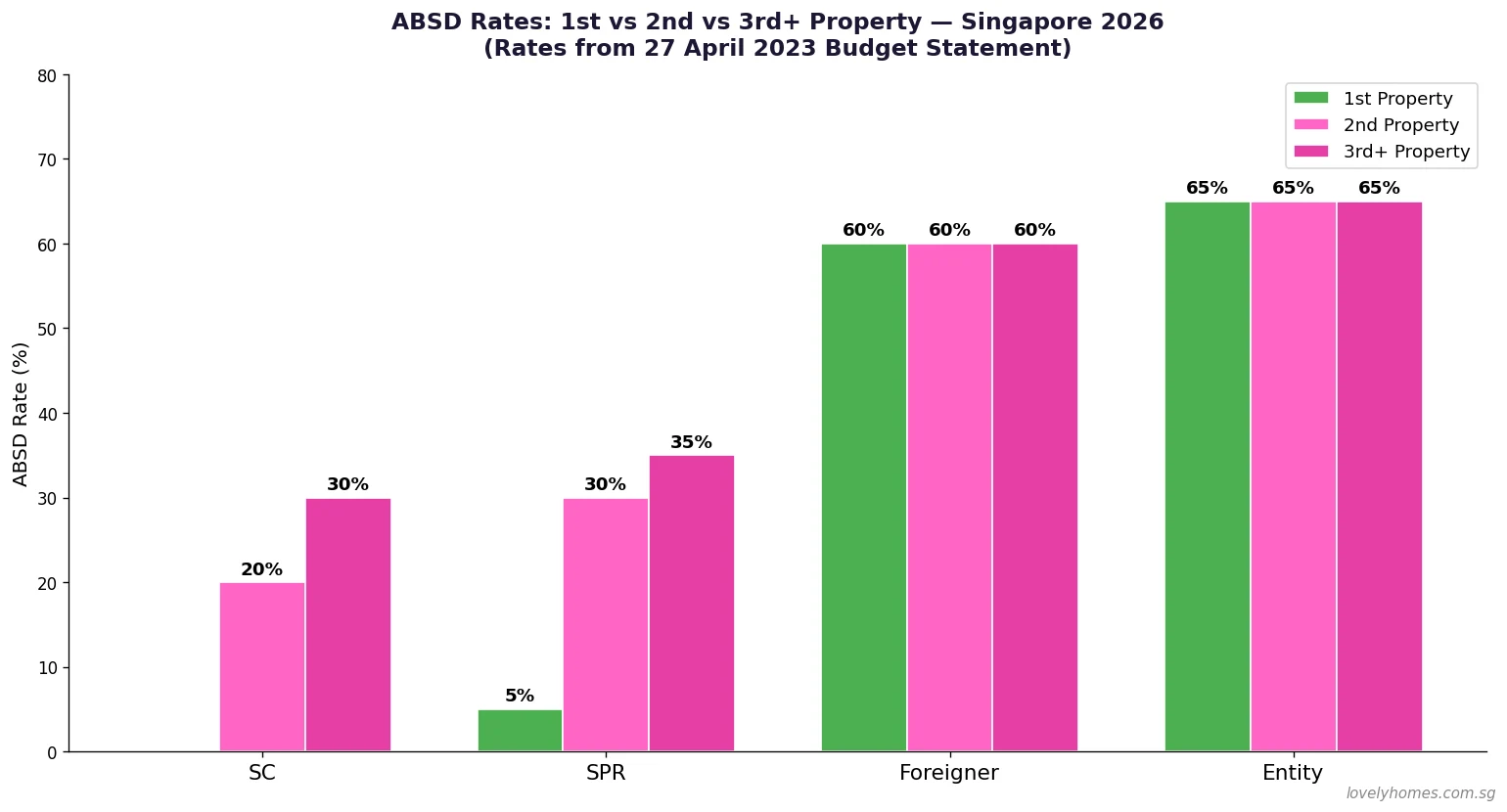
Additional Buyer’s Stamp Duty (ABSD) is levied by the Inland Revenue Authority of Singapore (IRAS) on residential property purchases in Singapore, on top of the standard Buyer’s Stamp Duty (BSD). The ABSD rates introduced in April 2023 are among the highest in Singapore’s property history β€” 20% for Singapore Citizens buying a second property, 30% for SC buying a third or subsequent property, and 60% for foreign buyers on any purchase. These rates were designed explicitly to curb speculative activity and cool an overheated market.

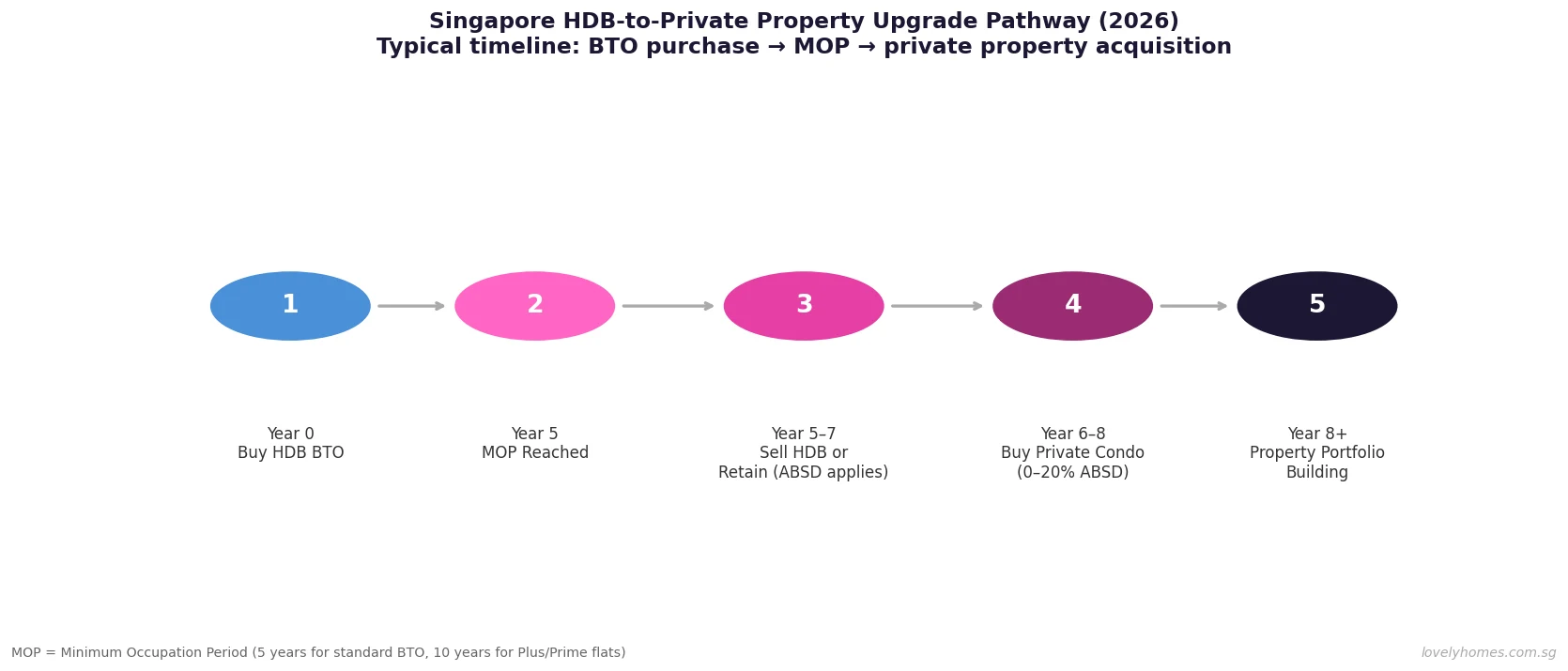
However, recognising that many SC married couples engage in sequential upgrading β€” selling their HDB flat and buying a private condominium as a genuine housing upgrade rather than an investment β€” the government provides a remission (refund) mechanism for a specific, tightly defined buyer profile. This remission does not reduce the ABSD rate payable at purchase; instead, the full ABSD must be paid upfront, and a refund application is made after the old property is sold within the prescribed window.

ABSD remission policy is set by the Ministry of Finance (MOF) and administered by IRAS. Changes to remission criteria require an MOF announcement, usually as part of the broader set of property cooling measure adjustments. The current remission framework has been in force since the April 2023 cooling measure revision.

Eligibility Matrix: Who Qualifies for ABSD Remission?

ABSD remission eligibility matrix by buyer profile Singapore 2026
Figure 1: ABSD Remission Eligibility by Buyer Profile β€” as of June 2026. Source: IRAS.

The eligibility criteria are deliberately narrow. The SC married couple remission is the most widely applicable scenario and applies to upgraders transitioning from their HDB flat to a private condominium. Both spouses must be Singapore Citizens (not Permanent Residents, not foreigners) at the time of the new purchase, the new purchase must be their first jointly-owned residential property together (neither spouse may hold another residential property at the time of purchase), and the existing property β€” typically an HDB flat β€” must be sold and the sale completed within 6 months of the new property’s purchase completion date.

Critically, the “completion date” for a new launch condominium is the Temporary Occupation Permit (TOP) date, not the date the OTP was exercised or the Sales and Purchase Agreement (SPA) was signed. For resale private properties, completion is typically 10–12 weeks after OTP exercise. This distinction matters greatly for the 6-month window calculation: an SC couple who exercises an OTP on an under-construction new launch today does not begin their 6-month countdown until the project obtains TOP β€” which could be 3 to 5 years away. This is a significant planning advantage for new-launch buyers compared to resale buyers.

How Much Is the ABSD Remission Worth?

ABSD remission amounts at various property purchase prices Singapore SC couple 2026
Figure 2: ABSD Remission Value for SC Married Couple at the 20% Rate β€” Across Various Purchase Prices.

At the current 20% ABSD rate for SC buying a second property, the remission amounts are material β€” often exceeding the total legal, agent, and renovation costs of the purchase combined. A couple buying a S$1.5 million condominium faces S$300,000 in upfront ABSD, all of which can be recovered if the HDB flat is sold in time. At S$2 million, the recoverable ABSD is S$400,000. These are not marginal amounts: they represent a fundamental difference in the affordability and financial feasibility of the upgrade.

It is worth noting that ABSD cannot be paid from CPF β€” it must be paid in cash. This means a couple must have S$300,000 to S$600,000 or more in liquid cash available at the time of purchase (before the remission is received). For many upgrading households, this is the single biggest financial planning challenge of the entire transaction. Some couples structure a bridging loan to cover the ABSD temporarily, which is repaid once the HDB flat is sold and the remission is received. The cost of the bridging loan β€” typically at prime rate or slightly above, for 3–6 months β€” is a relatively small price for preserving the remission eligibility.

The 6-Month Window: How It Works and the Clawback Risk

ABSD SC couple remission step by step timeline 6 month clawback window Singapore
Figure 3: ABSD SC Married Couple Remission β€” Step-by-Step Timeline and the 6-Month Clawback Window.

The 6-month window begins on the completion date of the new property purchase, not from the OTP date or the SPA signing date. For a private condominium under construction, this is the TOP date. For a resale condominium, it is the completion of the property transfer β€” typically 10–12 weeks after OTP exercise. The existing property sale must be completed within this 6-month window, not merely contracted or in progress. A scenario where the HDB OTP is exercised on Month 5 but the HDB sale only completes on Month 7 would fail the test.

If the 6-month window is missed β€” whether due to a buyer falling through on the HDB flat, a delayed completion, or simply poor timeline management β€” IRAS will issue an assessment for the full ABSD plus interest at 5% per annum from the date of the new property’s stamp duty payment. On a S$300,000 ABSD amount, 5% interest is S$15,000 per year. If the miss is discovered and collected 18 months later, the clawback amount would be approximately S$322,500. There is no grace period and no appeal mechanism short of demonstrating exceptional extenuating circumstances, which IRAS assesses on a case-by-case basis with a high bar for approval.

ABSD Remission at a Glance: Summary Table

Parameter Details
Who qualifies (main scheme) Singapore Citizen married couples β€” both spouses must be SC; first joint property purchase
ABSD rate paid upfront 20% (SC 2nd property) β€” must be paid in cash within 14 days of OTP exercise
Remission quantum Full 20% of purchase price refunded if conditions met
Condition β€” existing property Existing HDB flat or private residential property must be fully sold and completed
Deadline to sell Within 6 months of new property completion date (TOP for new launches; legal completion for resale)
How to apply IRAS e-Stamping portal β€” submit remission application with documentary proof of sale
Refund timeline Typically 3–4 weeks after IRAS approves the application
Clawback if missed Full ABSD + 5% per annum interest from date of original stamp duty payment
SPR couple (1st joint) 5% ABSD remission β€” no sale condition; applies to first joint purchase where neither holds residential property
Can CPF be used for ABSD? No β€” ABSD must be paid in cash; CPF cannot be used for ABSD
Does BSD get remitted? No β€” BSD is always payable and is not remitted under any scheme

Worked Example: The Ng Family SC Couple Upgrade

Scenario: SC couple selling Sengkang HDB and buying a Tampines resale 3BR condo

Mr and Mrs Ng are Singapore Citizens, married, joint owners of a 5-room HDB flat in Sengkang (Market Value: S$720,000, mortgage outstanding: S$180,000, CPF drawn: S$350,000 + S$65,000 accrued interest = S$415,000). MOP cleared. They wish to upgrade to a 3-bedroom resale condominium in Tampines priced at S$1,600,000.

ABSD calculation:
Purchase price: S$1,600,000
ABSD rate (SC 2nd property): 20%
ABSD payable: S$320,000 (cash, within 14 days of OTP)
BSD: S$44,600 (can use CPF)
Legal fees: ~S$3,500
Agent commission: ~S$16,800 (if using buyer’s agent at 1%+GST)

Cash flow at purchase:
Down payment (25% of S$1.6M): S$400,000 (5% cash = S$80,000 + 20% CPF/cash = S$320,000)
ABSD: S$320,000 cash
BSD (can use CPF): S$44,600
Legal + misc: ~S$20,300
Total cash required before remission: ~S$420,300

HDB sale proceeds (to fund the purchase):
Sale price: S$720,000
Less: outstanding mortgage S$180,000
Less: CPF refund (principal + accrued interest) S$415,000
Less: legal fees + agent commission: ~S$14,800
Net cash from HDB sale: β‰ˆS$110,200

Remission strategy:
The Ngs complete the condominium purchase on 15 July 2026. They have until 15 January 2027 (6 months) to complete the HDB flat sale. They list the HDB at S$720,000 immediately, receive an OTP from a buyer in August 2026, and the sale completes on 15 October 2026 β€” well within the 6-month window. They apply to IRAS for remission in November 2026 and receive the S$320,000 refund by mid-December 2026.

Net position after remission:
ABSD refunded: S$320,000
Net cash outlay (BSD + legal + agent): ~S$63,100
CPF refund reinvested to CPF OA: S$415,000 (can be redrawn for new condo mortgage servicing)
This is a financially viable upgrade β€” the key risk is the 6-month sale timeline.

What This Means for Upgraders: Practical Takeaways

For the vast majority of HDB upgraders β€” SC couples who have cleared their MOP and wish to own a private condominium β€” the ABSD remission scheme is what makes the upgrade financially viable. Without it, the 20% ABSD on a S$1.5 million–S$2 million condominium would represent a permanent, irrecoverable cost of S$300,000 to S$400,000, which would push many upgrades into the realm of financial imprudence. With the remission, the upgrade structure works β€” but only if the timing is managed with precision.

The most important practical point is that the HDB sale should not wait until the condominium purchase completes. Upgraders who procrastinate on listing their HDB flat β€” waiting to see if the condominium purchase proceeds, or delaying to maximise HDB rental income β€” run a real risk of missing the 6-month window. In a slower resale market, a flat may take 2–4 months to find a buyer and another 8–10 weeks to complete. That is already 5–6 months consumed. There is very little margin for slippage.

The comparison with HDB upgraders buying new launch condominiums is instructive: new launch buyers typically have 3–5 years before TOP, giving them ample time to sell their HDB flat β€” often at the most favourable market moment. Resale condominium buyers, by contrast, must manage the HDB sale on a much tighter 6-month clock.

What Might Come Next: Remission Policy Outlook

The ABSD remission framework is a carve-out within the broader ABSD system that the Ministry of Finance has maintained consistently since ABSD’s introduction in 2011, though the qualifying conditions and rates have evolved alongside each cooling measure adjustment. There is no current indication that the SC married couple remission will be abolished β€” it serves an important social function by supporting genuine upgrading rather than speculative multi-property accumulation. However, the remission conditions could tighten further if the government observes systematic abuse or if the market overheats again.

A potential policy direction that has occasionally been discussed in market commentary is the application of ABSD to new launch OTP exercise dates rather than TOP dates, which would eliminate the time advantage new launch buyers currently have over resale buyers in managing the 6-month HDB sale window. If implemented, this would be a material tightening that would force many upgraders to sell their HDB flat before the condominium purchase β€” reversing the current sequencing that most buyers prefer.

Frequently Asked Questions

Can I use CPF to pay the ABSD before receiving the remission?

No. ABSD must be paid entirely in cash β€” CPF Ordinary Account funds cannot be used to pay ABSD under any circumstances. This is a hard rule set by IRAS and CPF Board. Only Buyer’s Stamp Duty (BSD) and the property purchase price can be funded using CPF. If you do not have sufficient cash for the ABSD upfront, you may need to explore a bridging loan to cover the amount temporarily, which is repaid once the HDB sale completes and the ABSD remission is received. Always consult a bank or licensed financial adviser about bridging loan options and costs before proceeding.

Does the ABSD remission apply if my spouse is a Singapore Permanent Resident, not a citizen?

No. The SC married couple ABSD remission requires both spouses to be Singapore Citizens at the time of the new property purchase. If one spouse is an SPR and the other is an SC, the SC-couple remission does not apply. In this scenario, the combined SC+SPR buyer profile attracts a 30% ABSD on the second property (or the applicable rate based on the profile with the higher ABSD obligation), and no remission is available for the difference above the SPR rate. SPR married couples buying their first joint residential property can qualify for a separate full remission of their 5% ABSD β€” but this applies only to SPR+SPR couples on a genuinely first joint purchase where neither holds another residential property.

What if my HDB flat sale falls through after I have already purchased the condominium β€” can I extend the 6-month window?

IRAS does not provide an automatic extension of the 6-month window due to a failed HDB sale. However, IRAS may consider an extension in exceptional and documented circumstances β€” for example, if the buyer of the HDB flat absconds or commits a fundamental breach, causing the sale to abort, and the seller (you) acted in good faith to find an alternative buyer promptly. These situations are assessed individually and are not guaranteed. If a buyer falls through, you should immediately relist the flat and notify your conveyancer and IRAS in writing. In a difficult HDB resale market or if the flat is in an over-quota block (EIP), the risk of a failed sale is higher β€” factor this into your planning before exercising the condominium OTP.

The new launch condominium I bought has been delayed past its expected TOP. Does this affect my 6-month window?

For new launch condominiums, the 6-month remission window begins at the actual TOP date, not the projected or contractual TOP date. If TOP is delayed by 6 or 12 months, your 6-month window shifts accordingly β€” you have more time to sell your HDB flat. This is generally advantageous: if your HDB flat has already been sold before TOP (as many prudent upgraders do), the delay merely means you wait longer in rental or temporary accommodation before moving into the new property. However, if you have not yet sold the HDB flat and are waiting for clarity on TOP before acting, a TOP delay can compress the effective timeline between TOP and your actual start of marketing, so do not wait for the very last moment.

Is there an ABSD remission for Singapore Citizens who are not married β€” for example, singles or divorced individuals?

No. The full ABSD remission for a second residential property is only available to married Singapore Citizen couples. Single SC individuals, divorced SC individuals, and cohabiting SC couples (unmarried) do not qualify for the remission and must pay the full 20% ABSD on a second property purchase without any refund mechanism. This is a deliberate policy choice β€” the remission is designed to support the family unit’s housing upgrade, not individual investment. Singles who wish to own a private condominium after selling their HDB flat may consider selling first and then buying as a first-time private property buyer with no existing HDB β€” this eliminates the ABSD entirely rather than triggering and then seeking remission.

What documents do I need to apply for the ABSD remission, and how do I submit them?

The ABSD remission application is submitted through IRAS’s e-Stamping portal (mytax.iras.gov.sg). You will need: (a) the stamp duty reference number from the original ABSD payment; (b) a copy of the signed HDB resale completion documents or the private property sale and purchase agreement with evidence of completion (typically a letter from your solicitor confirming that the sale has been completed); (c) evidence that the selling party is the same person/persons who purchased the new property (NRIC details); and (d) your marriage certificate, if not already on record with IRAS. Your conveyancer or property lawyer can typically prepare and submit the remission application as part of the conveyancing engagement β€” confirm with them early in the process so they are ready to file as soon as the HDB sale completes.

Can the ABSD remission be used if the new property is bought in one spouse’s sole name, not jointly?

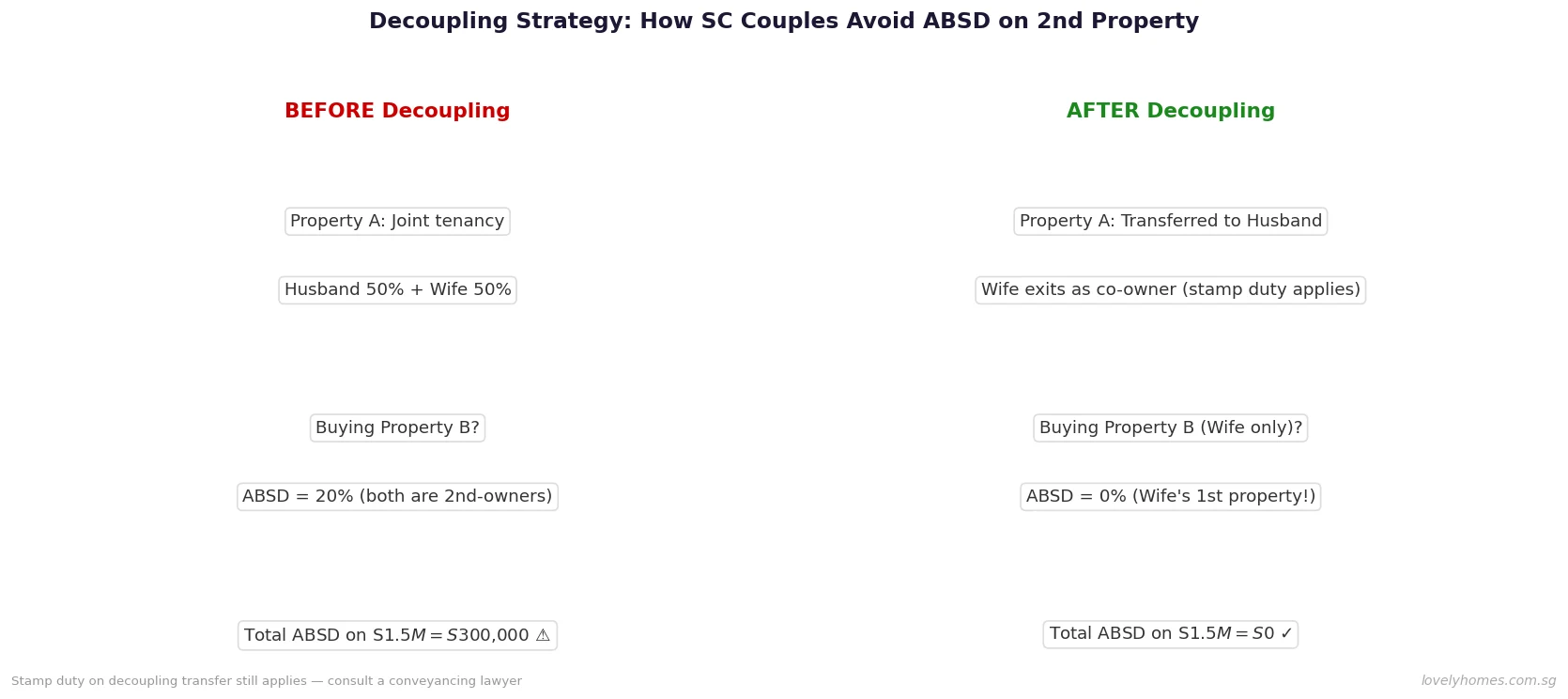
This is a nuanced point. The SC married couple remission applies to purchases made in the joint names of both spouses. If the new condominium is purchased in the sole name of one spouse only, the SC married couple scheme may not apply β€” the buying spouse is effectively treated as an individual, and whether the purchase constitutes a “second property” depends on whether that spouse already holds other residential property. If the buying spouse has never owned a residential property before (having sold their share in the HDB flat prior to purchase, for example), they may qualify as a first-time buyer with 0% ABSD β€” this is the “decoupling” strategy. Decoupling and ABSD remission are alternative approaches to the same upgrading problem; they are not typically combined in the same transaction. Consult a licensed conveyancer before choosing a structure.

Disclaimer: This article is for general informational purposes only and does not constitute tax, legal, or financial advice. ABSD rates, remission conditions, and application procedures are subject to change by the Ministry of Finance (MOF) and IRAS. Always verify current rates and eligibility conditions at iras.gov.sg before making any property purchase or sale decision. Consult a licensed conveyancer, qualified financial adviser, or tax professional before proceeding with any transaction involving ABSD. The worked examples in this article are illustrative only and may not reflect your specific financial circumstances.

Singapore HDB Ethnic Integration Policy Guide 2026: EIP Quotas, Resale Impact and Buyer Strategy

Singapore HDB Ethnic Integration Policy Guide 2026: EIP Quotas, Resale Impact and Buyer Strategy

Quick Answer: HDB EIP Singapore 2026 β€” Key Takeaways

  • The Ethnic Integration Policy (EIP) was introduced by HDB in 1989 to prevent racial enclaves from forming in Singapore’s public housing estates.
  • EIP sets neighbourhood and block quotas for each ethnic group: Chinese 84%/87%, Malay 22%/25%, Indian & Others 12%/15%.
  • EIP applies only to HDB resale flats β€” it does not apply to new BTO flats, private property, or HDB rental flats.
  • If a block or neighbourhood has already reached the quota for your ethnic group, you cannot buy a resale flat there β€” regardless of any other eligibility criteria.
  • Sellers in over-quota blocks face a restricted buyer pool: they can only sell to buyers whose ethnic group still has quota headroom, which can affect pricing and time on market.
  • Always check the HDB Resale Portal before making any offer β€” EIP status is block-specific and changes as transactions are registered.
  • EIP constraints are tightening in mature estates such as Bishan, Bukit Timah, Marine Parade, and Toa Payoh as proportions converge.
  • Indian & Others buyers face the tightest cap (12% neighbourhood / 15% block) and are most frequently constrained in desirable central-region towns.
  • Understanding EIP before shortlisting flats can save weeks of wasted negotiation and prevent abortive OTP costs.

What Is the Ethnic Integration Policy (EIP) and Why Does It Exist?

Singapore’s HDB towns are not only housing estates β€” they are, by deliberate government design, microcosms of the nation’s multiracial society. The Ethnic Integration Policy, administered by the Housing and Development Board (HDB) since 1 March 1989, is the mechanism that ensures Singapore’s public housing estates remain ethnically diverse rather than gradually concentrating into racial enclaves.

Before EIP, Singapore had begun to experience informal ethnic clustering in older estates. Certain mature towns developed notably higher concentrations of particular ethnic groups through natural social networks and community preferences. The government, recognising that segregated neighbourhoods could erode social cohesion β€” a cornerstone of Singapore’s national identity β€” introduced EIP to cap each ethnic group’s share at both the block and neighbourhood level, locking in a composition broadly reflective of Singapore’s national demographic make-up.

The rationale is straightforward: when neighbours share staircases, lifts, and void decks with people of different backgrounds, cross-cultural interaction occurs organically. EIP is the structural guarantee of that interaction. It operates not through direct regulation of individual choice β€” Singaporeans can still prefer certain towns, floor levels, or orientations β€” but by imposing a ceiling on the cumulative ethnic composition of any given block or neighbourhood.

How EIP Quotas Work: Neighbourhood and Block Levels

EIP operates at two simultaneous levels, and both must be satisfied for any resale transaction to proceed.

HDB EIP neighbourhood and block quota table by ethnicity Singapore 2026
Figure 1: HDB EIP Neighbourhood and Block Quota Summary β€” as of June 2026. Source: HDB.

The neighbourhood quota reflects the ethnic composition of an entire planning area or neighbourhood zone (typically a cluster of several blocks). The block quota is more granular β€” it governs the ethnic proportion within a single HDB block. Because ethnic distributions are rarely uniform across a neighbourhood, a specific block may hit its ethnic ceiling even when the surrounding neighbourhood still has headroom. This means a buyer can be blocked at the block level even if the neighbourhood quota is technically not yet exhausted.

Crucially, these quotas are based on the resident population, not floor area. Each time a resale transaction is completed and a new household registers with HDB, the ethnic composition of that block and neighbourhood is recalculated. The thresholds β€” Chinese 84%/87%, Malay 22%/25%, Indian & Others 12%/15% β€” were originally calibrated to Singapore’s 1989 census ethnic composition and have remained substantially unchanged, though HDB reviews them periodically.

One important clarification: these quotas apply to the buyer’s ethnicity as declared on their NRIC, not to the seller’s ethnicity. A Chinese seller in a block that has reached its Chinese quota can only sell to a non-Chinese buyer β€” specifically, a Malay or Indian & Others buyer whose group still has remaining quota in that block. This restriction flips the usual power dynamic: in some over-quota blocks, sellers effectively have a constrained buyer pool regardless of the flat’s quality or market price.

EIP and Buyers: What to Check Before You Bid

For buyers, EIP is the first filter to apply β€” before engaging any conveyancer, before negotiating price, and certainly before exercising an Option to Purchase (OTP). The HDB Resale Portal (resale.hdb.gov.sg) provides a real-time EIP check for any block address. Buyers enter the block address and their NRIC ethnicity, and the system returns a pass or fail result. This check takes under a minute and is freely available to the public.

HDB EIP block quota constraint trend 2021 to Q1 2026 rising pressure by ethnicity
Figure 2: Rising EIP Block-Quota Constraints Across HDB Towns (2021–Q1 2026). More towns now have over-quota blocks in every ethnic category.

The trend in Figure 2 is instructive: the proportion of HDB towns with at least one over-quota block has risen steadily across all three ethnic categories since 2021. This is partly a function of natural demographic equilibration β€” as resale market activity in mature estates normalises ethnic proportions toward the cap β€” and partly driven by the prolonged resale boom since 2021. Higher transaction volumes accelerate quota convergence. Indian & Others buyers, working with the tightest caps, face the fastest-tightening constraints in central-region towns.

The practical implication is that buyers from minority groups should widen their shortlist geographically or be prepared to act quickly when a suitable flat in a quota-compliant block appears. It also means that a flat you viewed and loved on a Saturday may no longer be accessible by the following Wednesday if another transaction in that block tips it over the quota.

EIP and Sellers: Restricted Pools and Pricing Implications

For sellers, the EIP dynamic is less immediately visible but equally significant. If the block has reached or is near its quota for the seller’s ethnic group, the universe of eligible buyers shrinks to only those whose ethnic group still has headroom. In practice, this means a Chinese owner in a block already at 87% Chinese cannot sell to another Chinese buyer. The flat must be sold to a Malay or Indian & Others purchaser β€” and their demand in that specific block, at that price point, may be materially thinner.

HDB EIP quota pressure by town in Singapore Q1 2026 highest constraint towns
Figure 3: HDB Towns with Highest Estimated EIP Block Quota Pressure (Q1 2026). Mature central-region estates face the greatest constraint burden.

Towns with the highest EIP pressure (Figure 3) β€” including Bishan, Bukit Timah, Marine Parade, and Toa Payoh β€” are, notably, some of Singapore’s most sought-after mature estates with strong historical price appreciation. Sellers in these towns who happen to own flats in over-quota blocks may find that a smaller buyer pool translates to longer time-on-market and a need to price more competitively to attract the eligible ethnic minority. This can depress achieved prices relative to neighbouring quota-compliant blocks in the same town.

Conversely, sellers in blocks that remain quota-compliant β€” particularly in estates with robust Chinese demand β€” face no restriction on their buyer pool and can generally command fuller market prices. This creates an intra-town pricing differential that is sometimes overlooked by buyers and sellers alike.

EIP Rules at a Glance: Summary Table

Rule / Parameter Details
Administered by Housing and Development Board (HDB)
Introduced 1 March 1989
Applies to HDB resale flat transactions (not BTO launches, not private property)
Chinese quota 84% (neighbourhood) / 87% (block)
Malay quota 22% (neighbourhood) / 25% (block)
Indian & Others quota 12% (neighbourhood) / 15% (block)
Determined by Buyer’s declared ethnicity on NRIC
Both levels must pass Yes β€” neighbourhood AND block quota checked simultaneously
How to check HDB Resale Portal (resale.hdb.gov.sg) β€” free, real-time, block-specific
Consequence of breach Transaction cannot proceed; no OTP can be exercised
Applies to SPR buyers Yes β€” Singapore Permanent Residents declared on their Blue IC are subject to EIP

Worked Example: The Tan Family’s EIP Navigation

Scenario: SC Indian couple upgrading to a 4-room resale flat in Queenstown

Mr and Mrs Selvam are Singapore Citizens (Indian ethnicity, NRIC declared). They have completed their HDB MOP on their 3-room Yishun flat and wish to upgrade to a 4-room resale flat in Queenstown (Queen’s Close / Tanglin Halt area) for the schools and proximity to work. Budget: S$700,000–S$750,000.

Step 1 β€” EIP Pre-check: They identify three blocks in the area. Using the HDB Resale Portal, they check each block against their Indian & Others ethnicity:

  • Block A, Tanglin Halt Road β€” FAIL: Indian & Others block quota at 15% (over-quota). Cannot proceed.
  • Block B, Commonwealth Drive β€” PASS: Indian & Others at 11%, headroom remains. Can proceed.
  • Block C, Holland Avenue β€” FAIL: Neighbourhood quota at 12% ceiling. Cannot proceed.

Step 2 β€” Focus on Block B: A 4-room flat in Block B is listed at S$730,000. Valuation commissioned by HDB: S$718,000. Cash Over Valuation (COV): S$12,000 (must be paid in cash, cannot use CPF).

Step 3 β€” Cost breakdown:
BSD on S$730,000: First S$180,000 @ 1% = S$1,800 + Next S$180,000 @ 2% = S$3,600 + Remaining S$370,000 @ 3% = S$11,100 = S$16,500
ABSD: S$0 (SC couple buying first property as Indian & Others is not subject to ABSD on 1st purchase)
HDB resale admin fee: S$80 (for flat application)
Legal conveyancing: ~S$2,500
COV: S$12,000 (cash)
Total cash outlay (excluding down payment and loan): ~S$31,080

Outcome: By running the EIP check before negotiating, the Selvams avoided two abortive OTP exercises and focused their offer on the only compliant block. They secured the flat and received the HDB Flat Eligibility (HFE) letter confirming they meet all requirements including EIP.

Why EIP Matters: Social Engineering That Shapes Your Investment

EIP is one of the most distinctive features of Singapore’s housing system β€” a policy with no direct parallel in Hong Kong, South Korea, or Australia’s public housing sectors, all of which have faced varying degrees of ethnic concentration in social housing. Singapore’s approach is deliberately top-down: rather than leaving ethnic integration to market forces or individual goodwill, the government mandated it structurally.

From an investment standpoint, EIP creates a two-tier reality within the resale market. Quota-compliant blocks command the full market price because the buyer pool is unrestricted. Over-quota blocks may see price suppression β€” not because the flat is inferior, but because the eligible buyer pool is structurally smaller. Buyers who can only consider certain ethnic-group quotas must be particularly attentive to this dynamic, as it affects not only their own purchase but their eventual exit when they resell.

For upgraders from HDB to private property, EIP does not apply to the private transaction. However, the HDB flat they sell must comply with EIP β€” if they are selling from an over-quota block, they must find a buyer from the eligible ethnic group, which can extend the sale timeline and affect whether they can meet the 6-month window for ABSD remission on their subsequent private purchase.

What Might Come Next: The EIP in a Tightening Market

EIP quotas have remained largely static since 1989, calibrated to demographic proportions that have since shifted β€” Singapore’s Indian and Other Minority population share has grown modestly, while the Malay share has remained relatively stable. There is periodic academic and policy debate about whether the thresholds should be recalibrated to reflect updated census data, but HDB has not announced any revision as of June 2026.

As the resale market continues to transact at elevated volumes β€” driven by BTO supply shortfalls and strong demand from upgraders β€” EIP constraints in mature estates are likely to tighten further before any policy adjustment. Buyers in minority ethnic groups planning purchases in desirable central-region towns should factor in longer search timelines and a readiness to move quickly when compliant blocks become available. Those in the Chinese majority group face less immediate concern but should remain aware of the policy’s seller-side implications when they eventually exit their flats.

Frequently Asked Questions

Does EIP apply when I buy a new BTO flat directly from HDB?

No. EIP applies only to HDB resale transactions between private parties in the open market. When you purchase a new BTO flat directly from HDB at a launch exercise, HDB controls the allocation and manages ethnic integration through its own internal allocation criteria. You do not need to check EIP quotas for BTO applications. EIP becomes relevant only if you later sell your flat on the resale market, or if you are buying a resale flat from another owner.

Can I appeal to HDB if I fail the EIP check for a block I want?

There is no formal appeal mechanism to override an EIP failure for a specific block. The quotas are administered by HDB as hard limits β€” if the block or neighbourhood is over-quota for your ethnic group, the transaction simply cannot proceed in that block. Your practical options are: (a) search for another flat in a different block in the same town that is quota-compliant; (b) expand your search to a different town where quota headroom exists for your ethnic group; or (c) wait for an existing household in the over-quota block to sell and move out, which marginally reduces the ethnic proportion and may eventually restore headroom. HDB does not grant exceptions to EIP quotas for individual buyers.

Does EIP affect Singapore Permanent Residents (SPRs) buying HDB resale flats?

Yes. Singapore Permanent Residents are subject to the same EIP quotas as Singapore Citizens. HDB uses the ethnicity declared on the SPR’s Blue Identity Card (NRIC) to assess which ethnic group the buyer falls under for quota purposes. SPR buyers must satisfy both neighbourhood and block EIP quotas, in addition to the separate SPR eligibility rules for HDB resale flats (SPRs must form a family nucleus, must have held SPR status for at least 3 years, and are subject to their own resale eligibility conditions). Foreigners without SPR status cannot purchase HDB resale flats at all and are therefore unaffected by EIP.

What happens if EIP is breached after a sale β€” for example, if I make an error in my ethnicity declaration?

Making a false ethnic declaration to circumvent EIP is a serious offence under HDB’s framework and can constitute fraud. If HDB discovers that a buyer misrepresented their ethnicity β€” for example, declaring a different ethnic identity than that shown on their NRIC β€” HDB has the power to compulsorily acquire the flat at a price lower than market value, cancel the resale approval, or take other enforcement action. Buyers should use only the ethnicity as declared on their NRIC, even if they are mixed-race or identify differently culturally. Mixed-race buyers typically use the ethnicity registered with ICA on their NRIC, which may be either parent’s ethnicity depending on the registration at birth.

I am an Indian buyer. Can I buy a resale flat in a block where the Chinese quota is not yet reached, even if the Indian quota is full?

No. Your EIP eligibility is assessed based on your own ethnic group’s quota, not other groups’ quotas. If the Indian & Others block quota has been reached (15%), you cannot purchase that flat β€” regardless of whether the Chinese or Malay quotas still have headroom. The quotas function independently: each ethnic group’s proportion is measured against its own ceiling. The fact that another ethnic group still has room in the block does not create eligibility for an Indian & Others buyer whose group’s quota is full.

Does the EIP restriction affect landed HDB housing, such as terrace or semi-detached HDB properties?

HDB landed housing (such as the older HDB terrace houses in estates like Toa Payoh and Queenstown) is subject to EIP in the same way as HDB flats, as they are resale transactions on the open market. However, there is very limited HDB landed stock, and most of it is in mature estates where quota pressures can be acute. If you are considering an HDB landed property, you must run the same EIP check on the HDB Resale Portal. Note that HDB landed housing transactions are subject to all the usual HDB resale eligibility rules, MOP requirements, and HFE letter requirements in addition to EIP.

If I am selling an HDB flat in an over-quota block, how do I find eligible buyers efficiently?

The most effective approach is to advertise the listing with the EIP status disclosed upfront β€” noting which ethnic group(s) can purchase the flat β€” so that only eligible buyers engage with your listing. This saves time for both parties and reduces abortive OTP risks. Because the eligible buyer pool is smaller, you may need to price the flat more competitively or allow a longer marketing period. Note that while CEA-registered salespersons can help you market the flat, you remain responsible for ensuring EIP compliance β€” the HDB system will reject a resale application that fails the EIP check regardless of what has been agreed between buyer and seller. Always verify the buyer’s ethnicity against the current EIP status on the Resale Portal before exercising the OTP.

Disclaimer: This article is for general informational purposes only and does not constitute legal, financial, or property advice. EIP quotas are subject to change by HDB and should be verified directly at the HDB Resale Portal (resale.hdb.gov.sg) before any transaction. Always consult a licensed conveyancer, HDB-registered salesperson, or qualified financial adviser before making any property purchase or sale decision. Figures and estimates in this article are based on publicly available HDB data as of June 2026.

Singapore Property Agent Commission Guide 2026

Singapore Property Agent Commission Guide 2026

⚡ Quick Answer: Property Agent Commission Singapore 2026

  • Agent commission is negotiable β€” there are no legally fixed rates in Singapore. Industry benchmarks exist but are not mandated.
  • HDB resale sellers typically pay 1%–2%; HDB resale buyers typically pay 0%–1% of purchase price, plus 9% GST.
  • Private property sellers typically pay 1%–2%; private property buyers typically pay 0%–1%, plus 9% GST.
  • New launch condo buyers pay nothing β€” the developer pays the buyer’s agent commission directly (typically 1%–3% of purchase price).
  • Rental transactions: landlords and tenants each typically pay half a month’s rent for leases under 24 months; one month’s rent for longer leases.
  • All agents must be CEA-licensed and must sign a Client’s Agreement (CA) with you before conducting any work on your behalf β€” mandated under the Estate Agents Act.
  • Verify your agent at cea.gov.sg before signing anything. An unlicensed “agent” cannot legally claim commission and may expose you to fraud risk.

Property Agent Commission in Singapore: Who Pays What and Why

In Singapore’s property market, agent commission is one of the largest transaction costs after stamp duties β€” yet it remains one of the least understood. Unlike stamp duty, which is set by law and published in IRAS schedules, agent commission has no statutory fixed rate. The Council for Estate Agencies (CEA), which regulates all property agents under the Estate Agents Act (Cap. 95A), has never mandated a specific commission percentage. Instead, it publishes broad guidelines and requires that all commissions be agreed in writing via a Client’s Agreement before an agent begins work.

This means that the rates you see quoted β€” 1% for HDB buyers, 2% for private sellers β€” are industry convention rather than law. In practice, they are widely observed but negotiable, particularly for high-value transactions or where a single agent represents both buyer and seller (co-broking arrangements).

Understanding the standard rates, who pays whom, and what the commission covers can help you plan your transaction budget accurately and negotiate confidently.

Singapore property agent commission rates 2026 β€” all transaction types including HDB, private condo, and rental
Figure 1: Industry benchmark commission rates by transaction type. All rates are subject to negotiation and exclusive of 9% GST. New launch buyer commission is paid by the developer, not the buyer. Source: CEA guidelines; LovelyHomes research.

Commission Rates by Transaction Type

HDB resale transactions: For buyers, the industry benchmark is 0% to 1% of the purchase price; many HDB buyers negotiate the buyer-side commission down or even to zero, since developers do not incentivise buyer agents the way new-launch projects do. For sellers, the benchmark is 1% to 2%. A seller paying 2% on an S$620,000 HDB flat will pay S$12,400 plus 9% GST = S$13,516.

Private residential (resale condominiums, apartments, landed): For buyers, 0%–1% is typical. For sellers, 1%–2% is typical. Co-broking is standard β€” each agent receives their respective commission from their own client. At S$2,000,000, a seller paying 2% pays S$43,600 inclusive of GST.

New launch condominiums: Buyers pay nothing β€” developer commission structures compensate the buyer’s agent directly, typically at 1%–3% of the purchase price depending on developer marketing budget. This is why agents are often more enthusiastic about showing new launches than resale properties. The commission comes from the developer’s marketing spend, which is embedded in the developer’s pricing model.

Rental transactions: The standard for leases of 24 months or less is one month’s rent split equally between the landlord’s agent and the tenant’s agent (0.5 months each, plus GST). For leases longer than 24 months, the benchmark rises to one month’s rent each. Short-term rentals or corporate leases may attract different structures negotiated case by case.

GST note: Property agents are GST-registered if their annual turnover exceeds the GST registration threshold. As of 1 January 2024, GST is charged at 9%. Always confirm whether a quoted commission is inclusive or exclusive of GST.

Singapore property agent commission in dollars 2026 β€” at different price points, 1% vs 2% plus 9% GST
Figure 2: Commission payable in absolute dollar terms (inclusive of 9% GST) at 1% and 2% for a range of property prices. The left bar in each pair is 1% (buyer-side benchmark); the right bar is 2% (seller-side upper benchmark). Source: LovelyHomes calculation.

Commission Summary Table

Transaction Type Buyer Pays Seller / Landlord Pays Basis Notes
HDB resale flat 0%–1% of purchase price 1%–2% of sale price % of transacted price Both + 9% GST. Negotiable.
Private condo / apartment resale 0%–1% of purchase price 1%–2% of sale price % of transacted price Both + 9% GST. Negotiable.
Landed property resale 0%–1% of purchase price 1%–2% of sale price % of transacted price Both + 9% GST. Negotiable.
New launch condominium Nil (paid by developer) Developer pays buyer agent 1%–3% Developer marketing budget Buyer incurs no direct commission cost.
Residential rental (≤24 mths) 0.5 mth rent + GST 0.5 mth rent + GST Per-lease Split 50/50 between landlord agent and tenant agent.
Residential rental (>24 mths) 1 mth rent + GST 1 mth rent + GST Per-lease Higher commission for longer commitments.

CEA Licensing and the Client’s Agreement

Every person conducting estate agency work in Singapore must hold a valid salesperson registration or estate agency licence issued by the Council for Estate Agencies (CEA), established under the Estate Agents Act 2010. The CEA maintains a public register at cea.gov.sg where anyone can look up an agent’s registration number, licence status, agency affiliation, and disciplinary history.

Before an agent may commence any work on your behalf β€” searching for properties, arranging viewings, submitting offers β€” they are required by the CEA Code of Practice to provide and have you sign a Client’s Agreement (CA). The CA specifies the scope of work, the agreed commission rate, and the duration of the engagement. Signing the CA creates a binding contract. Without a signed CA, any commission claim by the agent is difficult to enforce.

If an agent pressures you to make an offer or view properties without first providing a CA, this is a CEA breach and a red flag. You should decline and find another agent.

CEA agent verification 6-step process β€” how to check a Singapore property agent is licensed in 2026
Figure 3: Six-step process for verifying a property agent via the CEA Public Register. Red flags in the final column indicate situations where you should cease dealings immediately. Source: CEA Estate Agents Act Cap 95A; LovelyHomes.

Worked Example: The Nair Family Sells Their D15 Condo

Mr and Mrs Nair decide to sell their freehold 3-bedroom condominium in District 15 (East Coast area). The property is listed at S$2,200,000 and eventually transacts at S$2,150,000.

They engage a seller’s agent at a negotiated commission of 1.5% (rather than the 2% upper benchmark), inclusive of marketing costs. Their buyer transacts through a separate buyer’s agent at 1% (paid by the buyer).

Commission calculation for the Nairs (sellers): S$2,150,000 × 1.5% = S$32,250. Add 9% GST = S$32,250 × 1.09 = S$35,152.50.

Commission calculation for the buyer: S$2,150,000 × 1% = S$21,500. Add 9% GST = S$21,500 × 1.09 = S$23,435.

The Nairs save S$10,750 pre-GST by negotiating from 2% to 1.5%. The saving is meaningful β€” equivalent to roughly one additional monthly mortgage payment.

Negotiation tip: Commission is most negotiable when (a) the property is priced competitively and likely to move quickly, (b) you offer exclusivity to one agent rather than engaging multiple agents simultaneously, or (c) you are conducting both a sale and purchase simultaneously through the same agency. Use these levers before signing the Client’s Agreement.

Why Agent Commission Matters: Singapore in Context

At first glance, 1%–2% might sound modest. But on a S$2,000,000 private condominium, the combined buyer and seller commission (at 1% + 2%) totals S$60,000 before GST β€” S$65,400 inclusive of GST. That is a material transaction cost, often comparable to two to three months of gross household income for many Singapore buyers.

Unlike in some markets where buyer agents are paid from a shared commission pool, Singapore’s market structure is transparent: each side typically pays their own agent. This reduces conflicts of interest but means buyers who forgo representation on new launches (where they pay nothing for a buyer’s agent) are effectively subsidising the developer’s marketing cost through the purchase price.

The CEA has discussed introducing more formal commission disclosure requirements in recent consultations, though no regulatory change had been announced as at June 2026. Buyers and sellers should nonetheless insist on a written, signed Client’s Agreement specifying the exact commission before any agent commences work on their behalf.

What Might Change in Agent Commission Rules

The CEA periodically reviews its Code of Practice for professional standards. Industry observers have noted ongoing discussion about whether a formal commission disclosure framework β€” similar to what exists in Australia β€” should be introduced to increase transparency. As at June 2026, commission rates remain entirely negotiable with no mandatory disclosure beyond what must appear in the Client’s Agreement. Buyers should monitor CEA announcements for any changes to co-broking standards or commission disclosure obligations.

Frequently Asked Questions

Is agent commission legally fixed in Singapore?

No. The Council for Estate Agencies (CEA) does not prescribe fixed commission rates. What it mandates is that any agreed commission must be documented in a signed Client’s Agreement before the agent commences work. The rates quoted throughout this article β€” 1%, 2%, half a month’s rent β€” are industry conventions that have become widely expected but are legally negotiable. An agent cannot demand a specific rate; the rate is whatever you and the agent agree and document.

Do I need a buyer’s agent when buying a new launch condo?

No, you do not β€” but having one costs you nothing because the developer pays the buyer’s agent commission directly. A buyer’s agent for a new launch can help you compare projects, assess floor plans, check price comparables, and advise on unit selection without charging you any fee. Using a buyer’s agent for new launches is therefore generally rational from a cost perspective.

Can one agent represent both buyer and seller (dual representation)?

Yes, but with restrictions. The CEA code permits an agent to act for both parties in a transaction (known as dual representation or co-broking by the same agent), but the agent must inform both parties, obtain their written consent, and act fairly to both sides. In practice, many experienced buyers and sellers prefer independent agents to avoid any conflict of interest. If a single agent represents both sides, it is common for the commission arrangement to be negotiated down to reflect the reduced workload.

What is the CEA Client’s Agreement and is it compulsory?

The Client’s Agreement (CA) is a written contract between you and your agent that specifies the scope of work (e.g., marketing your property, sourcing a tenant), the agreed commission, the duration of the engagement, and the agent’s obligations under the CEA Code of Practice. Signing the CA is compulsory under CEA rules before the agent may commence any estate agency activity on your behalf. Without a signed CA, the agent cannot legally enforce a commission claim if the transaction is completed.

What if I find a buyer myself β€” do I still owe commission?

It depends on your Client’s Agreement. If you signed an exclusive CA with an agent for a specified period, and you introduce a buyer yourself during that exclusive period, the agent may still be entitled to commission under the terms of the agreement. If you have a non-exclusive CA, and you find a buyer independently without the agent’s involvement, you may be able to argue no commission is owed β€” but the exact terms of your signed CA govern. Always read the CA carefully before signing, particularly the exclusivity clause.

How do I check if my agent is properly licensed?

Visit the CEA Public Register at cea.gov.sg/public-register and search by the agent’s name or registration number (which all agents are required to display on namecards, marketing materials, and messaging). Verify the status shows “Active”, check the estate agency affiliation matches what the agent told you, and review any disciplinary records. This takes under two minutes and is strongly recommended before signing any agreement.

Is agent commission subject to GST?

Yes, for GST-registered agents. As of 1 January 2024, GST in Singapore is charged at 9%. If your agent or their agency is GST-registered (mandatory once their annual turnover exceeds S$1 million), they will charge GST on top of the agreed commission. This means a 2% commission on a S$1,500,000 property becomes S$30,000 + 9% GST = S$32,700. Always clarify whether quoted commission rates are inclusive or exclusive of GST before signing the Client’s Agreement.

Related Articles


Disclaimer: This article is for general informational purposes only and does not constitute professional real estate, financial, or legal advice. Commission rates are industry benchmarks and are subject to negotiation. All agents must be CEA-licensed; verify at cea.gov.sg. For official guidance on estate agency regulation, refer to the Council for Estate Agencies at cea.gov.sg and the IRAS GST guidelines at iras.gov.sg.

Translate »