Pinetree Hill

Pinetree Hill


Pine Grove · District 21

Pinetree Hill松林山

An elevated sanctuary in District 21’s exclusive Mount Sinai / Pandan Valley enclave — 520 homes set within 88% lush landscape, by UOL Group and Singapore Land.
22 Jul 2023
Launched
31 Dec 2027
Expected TOP
99 Years
Leasehold Tenure
From S$1.30M
Indicative Price

520
Residential Units
99 Years
Leasehold Tenure
31 Dec 2027
Expected TOP
Dover MRT
15-min walk · East-West Line
88%
Landscape · 12% built-up

Why Pinetree Hill

Pinetree Hill is an elevated sanctuary nestled within one of Singapore’s most exclusive private residential enclaves — Mount Sinai / Pandan Valley in District 21. Developed by UOL Group and Singapore Land Group (United Venture Development No. 5 Pte Ltd), the 520-unit twin-tower scheme sits at 41 and 43 Pine Grove with panoramic outlooks toward Bukit Timah Nature Reserve to the north and the city skyline to the south-east.

What sets Pinetree Hill apart isn’t any single feature — it’s the convergence of four rarely-combined advantages: only 12% of the 24,313 sqm site is built up (with the remaining 88% dedicated to landscape and facilities), Henry Park Primary and Pei Tong Primary School are within a 1 km radius, Dover MRT (East-West Line) is a 15-minute walk away, and the upcoming Cross Island Line interchange at Clementi MRT will add a future corridor across the island.

Designed by ADDP Architects with Coen Design International as landscape architect, Pinetree Hill is targeting BCA Green Mark Gold Plus certification and is scheduled for TOP on 31 December 2027.

Pillar 01

Magnificent panoramic views

Towers at the top of Pine Grove deliver unobstructed outlooks — Bukit Timah Nature Reserve to the north and the Singapore city skyline to the south-east — from the bedroom storeys upward.

Pillar 02

Exclusive D21 enclave

Mount Sinai / Pandan Valley is one of the quietest landed-style private residential pockets in Singapore. Clementi Forest and the upcoming Clementi Nature Trail are at the doorstep.

Pillar 03

Strong school catchment

Henry Park Primary and Pei Tong Primary within 1 km. Methodist Girls’ School, Nan Hua High, NUS High, Anglo-Chinese JC, Singapore Polytechnic, Ngee Ann Polytechnic and NUS all in the wider belt.

Project At-a-Glance

Developer United Venture Development (No. 5) Pte Ltd
JV — UOL Group and Singapore Land Group
Address 41 and 43 Pine Grove · Singapore
District 21 · Mount Sinai / Pandan Valley
Tenure 99-year leasehold from 26 May 2022
Site Area approx. 24,313 sqm (~261,711 sqft)
Plot Ratio 2.1
Blocks and Storeys 2 blocks · 24 storeys each
Total Units 520 across 10 unit types
Site Coverage 12% built-up · 88% landscape and facilities
Expected TOP 31 December 2027
Launch Date 22 July 2023
Architect ADDP Architects LLP
Landscape Architect Coen Design International
Interior Design Index Design Pte Ltd
Civil and Structural Engineer P&T Consultants Pte Ltd
Mechanical and Electrical Engineer BSC Consultants Pte Ltd
Quantity Surveyor KPK Quantity Surveyors
Sustainability BCA Green Mark Gold Plus (target)

Unit Mix and Sizes

Type Size (sqft) Units % of Total
1-Bedroom + Study 538 22 4.2%
2-Bedroom 700 – 850 45 8.7%
2-Bedroom Premium 764 – 915 113 21.7%
2-Bedroom Premium + Study 797 68 13.1%
3-Bedroom 969 – 1,173 68 13.1%
3-Bedroom Premium + Study 1,216 – 1,421 91 17.5%
4-Bedroom Deluxe (Private Lift) 1,292 – 1,485 45 8.7%
4-Bedroom Premium (Private Lift) 1,464 – 1,668 45 8.7%
5-Bedroom Premium (Private Lift) 1,733 22 4.2%
Penthouse 2,874 1 0.2%
Total 538 – 2,874 520 100%
Site footprint: only 12% of the 24,313 sqm site is built-up — the remaining 88% is dedicated to lush landscaping and facilities. Private Lift units: 4-Bedroom Deluxe / Premium and 5-Bedroom Premium come with private-lift access.

Indicative Pricing

1-Bedroom + Study from
S$1.30M
2-Bedroom from
S$1.65M
2-Bedroom Premium from
S$1.90M
3-Bedroom from
S$2.30M
4-Bedroom (PL) from
S$3.10M
5-Bedroom (PL) from
S$4.20M
PSF benchmark: launch from approx. S$2,400 psf, averaging ~S$2,460 psf at first weekend (Jul 2023). Subsequent phases priced at developer discretion. Overall range: S$1.3M – S$5.5M+. Indicative only and subject to developer confirmation at booking.

Why Buyers Are Watching

  1. 1Twin-tower exclusivity in D21 — Just 520 units across 2 × 24-storey towers in one of Singapore’s most exclusive private residential enclaves — Mount Sinai / Pandan Valley.
  2. 2Magnificent panoramic views — 13 of the 18 stacks orient toward unobstructed greenery — Bukit Timah Nature Reserve to the north and the city skyline to the south-east from upper floors.
  3. 388% landscape, 12% built-up — Only 12% of the 24,313 sqm site is built-up. The remaining 88% is dedicated to landscape and resort-style facilities — Floating Pavilion, Vertical Oasis Waterwall, Flower Swathe and Sky Terraces.
  4. 4Top-tier school catchment — Henry Park Primary and Pei Tong Primary within 1 km. Methodist Girls’, Nan Hua High, NUS High, Anglo-Chinese JC and NUS in the wider belt.
  5. 5Dover MRT in 15 minutes’ walk — East-West Line. One stop to Clementi (interchange to the future Cross Island Line) and to Buona Vista (interchange to the Circle Line).
  6. 6Near vibrant business hubs — Within 10 minutes’ drive to one-north Business Park, Singapore Science Park I & II and the upcoming Dover Knowledge District.
  7. 7UOL × Singapore Land trust — Two of Singapore’s most established listed developers — track record across The Watergardens at Canberra, AMO Residence, Avenue South Residence and Newport Residences.
  8. 8Targeted Green Mark Gold Plus — Lower lifetime energy and water consumption — and a hedge against future sustainability levies on older stock.

Location and Connectivity

Transport
Dover MRT (EW22)
15-minute sheltered walk to Dover MRT on the East-West Line. One stop to Clementi (future Cross Island Line) and Buona Vista (Circle Line interchange).
Nature
Clementi Forest
One of Singapore’s last remaining secondary forests — ~85 ha of trail, fern and waterway right at the doorstep, plus the upcoming Clementi Nature Trail.
Retail
Mall Belt
Jelita Shopping Centre, Clementi Mall, Holland Village, The Star Vista, Rochester Mall, Dempsey Hill and Orchard Road — 5 to 15 minutes’ drive.
Highways
AYE and PIE
Direct access to Holland Road, Clementi Road, Ayer Rajah Expressway (AYE) and Pan-Island Expressway (PIE) — ~10 minutes to one-north and Science Park.
Pinetree Hill location map
Source: developer brief, URA OneMap. Indicative reference map only.

Schools Nearby

Pre-school EtonHouse Pre-School @ Mountbatten · Brighton Montessori @ Mount Sinai · The Little Skool-House @ One-North
Primary (within 1 km) Henry Park Primary School ⭐ · Pei Tong Primary School
Primary (within 2 km) Fairfield Methodist Primary · Clementi Primary · New Town Primary
Secondary Methodist Girls’ School (Independent) · Nan Hua High School · Fairfield Methodist (Sec) · Clementi Town Secondary
Tertiary NUS High School of Mathematics and Science · Anglo-Chinese Junior College · Singapore Polytechnic · Ngee Ann Polytechnic · National University of Singapore

Lifestyle and Amenities

Nature on Your Doorstep

Clementi Forest, the upcoming Clementi Nature Trail and Bukit Timah Nature Reserve — three of Singapore’s most-loved green corridors all within walking or short cycling distance.

Dining Belt

Holland Village’s cafes and bistros, Dempsey Hill, Rochester Mall and the perennial favourites at Pasir Panjang and West Coast — all within a short drive.

Shopping

Jelita Shopping Centre, Clementi Mall, The Star Vista, Holland Road Shopping Centre and Tiong Bahru Plaza — a complete retail belt across the wider south-west.

Work and Innovation

One-north Business Park, Singapore Science Park I & II, the Mediapolis cluster and the upcoming Dover Knowledge District — Singapore’s largest concentration of biomedical, infocomm and research jobs all within 10 minutes’ drive.

Wellness and Recreation

On-site Floating Pavilion, Vertical Oasis Waterwall, Flower Swathe Garden, Sky Terraces and a hydrotherapy pool — plus the running and cycling routes through Clementi Forest.

Community

Quiet, low-density landed-style enclave shared with The Reserve Residences (TOP 2027) and Pinetree Condominium — a community with a strong owner-occupier profile.

Site Plan

Pinetree Hill site plan

Site plan · indicative only · subject to developer confirmation

Floor Plans (Selected)

A representative plan from each major bedroom type. Download the full PDF below for every stack-by-stack layout, including the 4-Bedroom Premium, 5-Bedroom Premium (Private Lift) and the Penthouse.

Pinetree Hill 1 Bedroom plus Study floor plan

1 Bedroom + Study · 50 sqm / 538 sqft
Pinetree Hill 2 Bedroom floor plan

2 Bedroom · 65 – 79 sqm / 700 – 850 sqft
Pinetree Hill 3 Bedroom floor plan

3 Bedroom · 90 – 109 sqm / 969 – 1,173 sqft
Pinetree Hill 4 Bedroom Deluxe Private Lift floor plan

4 Bedroom Deluxe (Private Lift) · 120 – 138 sqm / 1,292 – 1,485 sqft
Full Floor Plans PDF
All stack-by-stack floor plans, balcony dimensions and AC ledges.

Download PDF

Elevation and Stack Chart

Pinetree Hill elevation and stack chart

Elevation and unit-mix chart · 520 units across 2 × 24-storey blocks

Facilities (30+)

Floating PavilionVertical Oasis WaterwallFlower SwatheSky Terraces50m Lap PoolFamily PoolKid’s PoolHydrotherapy PoolPool DeckPool PavilionSun LoungersAqua BedsTennis CourtOutdoor GymIndoor GymYoga LawnWellness DeckSteam RoomSaunaDining PavilionFunction RoomClubhouse LoungeBBQ PavilionTeppanyaki PavilionReading PavilionChildren’s PlayAdventure PlayPet GardenReflexology PathForest WalkArrival CourtCarpark

Gallery

Developer and Consultant Team

UOL Group and Singapore Land Group — a JV via United Venture Development (No. 5) Pte Ltd

Pinetree Hill is jointly developed by UOL Group Limited and Singapore Land Group, two of Singapore’s most established listed developers, through their JV vehicle United Venture Development (No. 5) Pte Ltd. UOL is the developer behind The Watergardens at Canberra, AMO Residence, Avenue South Residence, Clavon, The Tre Ver, Principal Garden and Botanique at Bartley. Singapore Land Group brings the long stewardship of Marina Square, Singapore Land Tower and the Tomlinson Heights luxury heritage. The JV bid S$671.5 million (approx. S$1,318 psf ppr) for the 24,313 sqm Pine Grove Government Land Sales (GLS) site at the May 2022 tender close.

Architect ADDP Architects LLP
Civil and Structural Engineer P&T Consultants Pte Ltd
Mechanical and Electrical Engineer BSC Consultants Pte Ltd
Quantity Surveyor KPK Quantity Surveyors
Landscape Architect Coen Design International
Project Interior Design Index Design Pte Ltd

Sustainability and Specifications

Pinetree Hill is targeted at BCA Green Mark Gold Plus — and pairs that certification with a 12% built-up footprint that leaves the remaining 88% of site area as landscape and shaded amenity zones.

  • BCA Green Mark Gold Plus (target) — Singapore’s standard for resource-efficient residential design
  • 88% landscape coverage across the 24,313 sqm site — only 12% is built-up
  • Native and adaptive species at the perimeter forest fringe — designed to reinforce the green corridor toward Clementi Forest
  • Pneumatic Waste Collection System (PWCS) — hygienic, low-noise refuse removal without traditional bin chutes
  • EV charging-ready infrastructure across the basement carpark
  • Smart-home enabled — concierge app, smart lock, smart air-con and smart-light controls

Project Timeline

26 May 2022
99-year lease commencement
22 Jul 2023
Sales launch
2024 – 2026
Ongoing sales phases
2025 – 2027
Main construction
31 Dec 2027
Expected TOP and vacant possession

Project Factsheet

A shareable 2-page PDF snapshot of everything on this page — bring it to viewings, forward it to family.

Download the Full Sales Pack

PDF · 2 pages

Pinetree Hill Factsheet

2-page LovelyHomes project factsheet — share with family, bring to viewings.

Download Factsheet

PDF · floor plans

Available Floor Plans

Available source floor-plan PDF compiled from representative clean floor-plan images.

Download Floor Plans

Image · location map

Location Map

High-resolution location map — MRT, schools, amenities.

Download Map

Frequently Asked Questions

Where is Pinetree Hill located?
Pinetree Hill is located along Pine Grove (41 and 43) in Singapore’s District 21, in the exclusive Mount Sinai / Pandan Valley enclave on the south-west of the island. The development sits a 15-minute walk from Dover MRT (East-West Line) and is across from Clementi Forest.
Who is the developer?
Pinetree Hill is jointly developed by UOL Group Limited and Singapore Land Group through their joint-venture vehicle United Venture Development (No. 5) Pte Ltd. The JV won the Pine Grove Government Land Sales tender with a bid of S$671.5 million (approximately S$1,318 psf ppr).
When is Pinetree Hill expected to be completed?
Pinetree Hill’s expected Temporary Occupation Permit (TOP) date is 31 December 2027. The 99-year leasehold tenure commenced on 26 May 2022.
What unit types are available?
The 520 units span ten types: 1-Bedroom + Study (538 sqft), 2-Bedroom (700 – 850 sqft), 2-Bedroom Premium (764 – 915 sqft), 2-Bedroom Premium + Study (797 sqft), 3-Bedroom (969 – 1,173 sqft), 3-Bedroom Premium + Study (1,216 – 1,421 sqft), 4-Bedroom Deluxe Private Lift (1,292 – 1,485 sqft), 4-Bedroom Premium Private Lift (1,464 – 1,668 sqft), 5-Bedroom Premium Private Lift (1,733 sqft) and 1 Penthouse at 2,874 sqft.
What are indicative prices at Pinetree Hill?
Indicative starting prices are from S$1.30M for a 1-Bedroom + Study, S$1.65M for a 2-Bedroom, S$1.90M for a 2-Bedroom Premium, S$2.30M for a 3-Bedroom, S$3.10M for a 4-Bedroom Private Lift and S$4.20M for a 5-Bedroom Private Lift. Launch psf was approximately S$2,400 starting and S$2,460 average at the July 2023 launch weekend. Subsequent phases are at developer discretion. All figures are indicative and subject to developer confirmation at booking.
How close is Dover MRT?
Dover MRT (East-West Line, station EW22) is approximately a 15-minute walk from Pinetree Hill via sheltered linkways along Pine Grove and North Buona Vista Road. One MRT stop east takes you to Buona Vista (Circle Line interchange) and one stop west to Clementi (future Cross Island Line interchange).
Is Pinetree Hill freehold or leasehold?
Pinetree Hill is a 99-year leasehold development. The lease commenced on 26 May 2022, so a buyer in 2026 takes on a long fresh lease.
Which primary schools are within 1 km?
Henry Park Primary School and Pei Tong Primary School are both within 1 km of Pinetree Hill. Within 2 km you also have Fairfield Methodist Primary, Clementi Primary and New Town Primary. Methodist Girls’ School, Nan Hua High, NUS High and Anglo-Chinese JC are all in the wider belt.
How many units have unblocked views?
Pinetree Hill is built on elevated ground in the exclusive Pandan Valley / Mount Sinai enclave, with low-density landed homes on most surrounding plots. As a result, the upper-floor units in both towers enjoy long-range views — Bukit Timah Nature Reserve to the north and the city skyline to the south-east. The exact stack-by-stack outlook is in the developer brief.
What makes Pinetree Hill different from other new launches?
Pinetree Hill combines four rarely-co-located advantages: an exclusive D21 enclave that has historically been low-density landed, panoramic views to Bukit Timah Nature Reserve and the city skyline, a prime school catchment (Henry Park and Pei Tong within 1 km, plus MGS, Nan Hua, NUS High and ACJC in the wider belt), and only 12% built-up site coverage with 88% dedicated to landscape and resort-style facilities. The development is targeting BCA Green Mark Gold Plus.

Ready to see Pinetree Hill in person?

Speak to our LovelyHomes concierge on WhatsApp for the latest unit availability, e-brochures and showflat bookings. We’ll connect you with the developer’s in-house team, not an agency.

Message on WhatsApp

Related Buying Guides

Stamp Duty

ABSD Singapore 2026: The Complete Guide

Rates, surcharges and remissions for citizens, PRs and foreigners buying a second (or first) home.

Stamp Duty

Buyer’s Stamp Duty (BSD) Singapore 2026

Current BSD rates, worked examples and a calculator for residential purchases.

Financing

Home Loan Singapore 2026: HDB vs Bank

LTV, SORA, fixed vs floating and how to structure your financing package.

Step-by-Step

First-Time Home Buyer Walkthrough

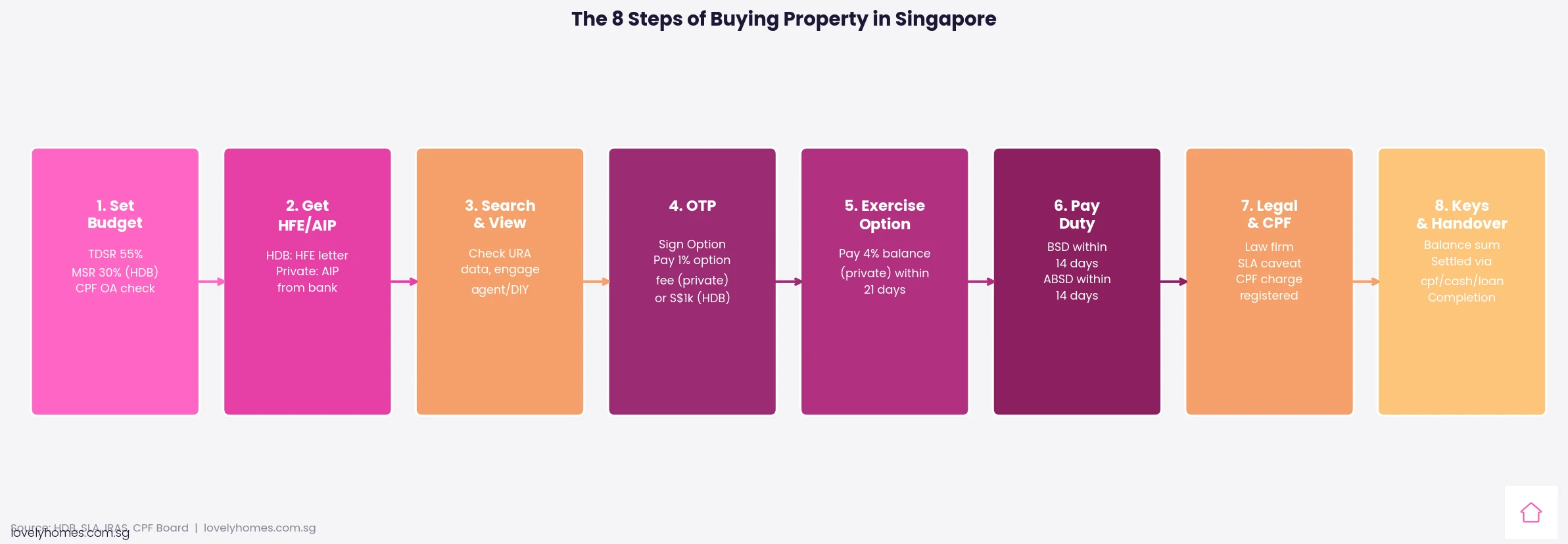
From option fee to collection of keys — every step in the Singapore buying process.

Location

CCR vs RCR vs OCR Explained

Which region does Pinetree Hill sit in, and what that means for capital appreciation.

Policy

Cooling Measures Timeline 2009–2026

Every major round of Singapore property cooling measures and what they did to prices.

Disclaimer. Prices, unit mix, specifications, site plans, floor plans and facility lists on this page are indicative only and subject to change by the developer without notice. All information has been compiled from developer sales material (brochures, project briefs and sales kits) and verified as at 26 April 2026. LovelyHomes.com.sg is not the project developer. Prospective buyers should consult an accredited salesperson and the developer’s official sales kit before committing to any purchase. Artist impressions are for illustrative purposes only and may differ from the final built product.


Miltonia Close EC: Hoi Hup Wins Yishun’s First New EC Site in 5 Years at S$732 psf ppr

Miltonia Close EC: Hoi Hup Wins Yishun’s First New EC Site in 5 Years at S$732 psf ppr

Hoi Hup Realty has won the government land sale tender for the Miltonia Close Executive Condominium site in Yishun with a top bid of S$340.9 million, equivalent to S$732 per square foot per plot ratio (psf ppr). The Housing Development Board tender, which closed on 14 April 2026, drew three bids — a notably restrained field that reflects measured developer appetite for EC sites in the North amid a growing pipeline. The site is Yishun’s first new EC land release in five years and will yield approximately 430 residential units adjacent to Orchid Country Club and within close distance of Khatib MRT station on the North-South Line.

Quick Answer — Miltonia Close EC Tender at a Glance

  • Site: Miltonia Close, Yishun, District 27 — adjacent to Orchid Country Club
  • Winner: Hoi Hup Realty Pte Ltd
  • Winning bid: S$340.9 million / S$732 psf ppr
  • Bids received: 3 (muted field, reflecting EC pipeline in the North)
  • Estimated units: approximately 430 residential units
  • Site area: ~15,451 sqm (~166,293 sqft); tenure 99-year leasehold
  • Nearest MRT: Khatib MRT (North-South Line), approximately 800m
  • Estimated launch price: S$1,550–1,750 psf (analyst projections)
  • Significance: first EC site tendered in Yishun since 2021; Hoi Hup was also developer of Yishun’s Provence Residence EC

The Miltonia Close Site: Yishun Returns to the EC Map

Yishun was historically a prolific EC estate — Bellewoods, Brownstone, and Provence Residence were all delivered within a decade. The last Yishun EC GLS was awarded in 2021 (Provence Residence, by Hoi Hup and Sunway), which sold out at launch and achieved strong secondary-market resale premiums. The five-year gap between Provence Residence and Miltonia Close reflects a period of EC supply concentration in Tengah, Tampines, and Bukit Batok, leaving Yishun without a fresh EC offering. The HDB’s decision to release Miltonia Close now aligns with the depletion of Provence Residence’s Available Unit inventory and the upcoming MOP eligibility of earlier Yishun ECs, which typically generates demand from buyers looking to upgrade within the same area.

The site’s adjacency to Orchid Country Club — a private membership club with golf facilities, food and beverage, and recreational amenities — is a distinguishing characteristic that Hoi Hup will likely leverage heavily in its marketing. The 800-metre walk to Khatib MRT is a reasonable connectivity score for an EC (most EC buyers tend to be car-owning households, and the MRT is a secondary amenity rather than a primary draw). The broader Yishun New Town environment offers HDB resident amenities, Yishun Park, the Lower Seletar Reservoir waterway park, and proximity to Khoo Teck Puat Hospital.

Why Only Three Bids? Reading the EC Land Market

The three-bid field at Miltonia Close contrasts with the six bids received for Dover Drive GLS and reflects structural differences between the EC and private residential markets. EC buyers are subject to the Enhanced Income Ceiling of S$16,000 per month (effective 1 January 2025, administered by the HDB), meaning the buyer pool is capped at middle-income Singaporean families — a narrower market than private condos. Additionally, EC developers must meet the Minimum Occupation Period rules (MOP of 5 years before full privatisation), constrain unit sizes (typically 90–140 sqm), and comply with HDB eligibility rules that limit the applicant pool to Singapore Citizens and Permanent Residents meeting nationality and family nucleus requirements.

The growing EC supply pipeline in the North is also relevant. The Woodlands Drive 17 EC site (awarded 2025 at S$794 psf ppr), the Otto Place EC in Tengah, and Novo Place EC in Plantation Close all compete for the same HDB upgrader demographic as Miltonia Close. Developers are managing their EC land bank carefully to avoid cannibalising their own upcoming launches.

EC GLS tender land rates comparison Miltonia Close Yishun 2026 Singapore executive condo
Figure 1: EC GLS tender land rates for recent awards. Miltonia Close at S$732 psf ppr sits 7.8% below Woodlands Drive 17 (S$794) — a calibrated bid reflecting the more limited EC catchment at the current North Singapore pipeline stage.

Summary Table: Miltonia Close EC vs Recent EC Land Awards

Site Award Year psf ppr Units Location
Copen Grand (Tengah) 2021 S$603 639 D24 Tengah
Tenet (Tampines St 62) 2021 S$659 618 D18 Tampines
Altura (Bukit Batok) 2022 S$662 360 D23 Bukit Batok
Woodlands Drive 17 2025 S$794 ~500 D25 Woodlands
Miltonia Close 2026 S$732 ~430 D27 Yishun

What to Expect: Launch Price, Timeline, and Who Should Watch

At S$732 psf ppr, Hoi Hup will need to price the eventual development at approximately S$1,550–1,750 psf to achieve a viable development margin. This puts Miltonia Close above the S$1,400–1,500 psf entry point of earlier Yishun ECs (Provence Residence launched at S$1,216–1,476 psf in 2021) and roughly in line with or slightly above the S$1,550–1,700 psf range of recent Tengah and Tampines ECs. At those prices, a 3-bedroom unit of approximately 990 sqft would be priced at S$1.54M–S$1.73M — within reach of a Singapore Citizen household earning S$12,000–S$16,000 per month under the EC income ceiling.

The project is expected to launch for preview in 2027–2028, after detailed planning, architectural finalisation, and the usual 18–24 month pre-sale preparation period. HDB-upgrader households in Yishun, Ang Mo Kio, and Sembawang who are approaching or past their MOP in 2026–2028 are the natural buyer pool, alongside dual-income young families seeking the EC subsidy pathway as an entry into private-style living.

Frequently Asked Questions

Who can buy the Miltonia Close EC?

Executive Condominiums are a public-private hybrid housing type administered by the HDB. To purchase a new EC, buyers must meet the following eligibility criteria: at least one applicant must be a Singapore Citizen; the household must form an eligible family nucleus (married or engaged couple, parent-and-child, or sibling scheme); the gross monthly household income must not exceed S$16,000 (Enhanced Income Ceiling effective 1 January 2025); neither applicant should currently own or have disposed of a private property within 30 months of the EC application; and applicants who have previously received a CPF Housing Grant must have met their resale levy obligations. PRs applying together with a Singapore Citizen partner may buy a new EC under the Second Timer scheme subject to additional conditions.

What is the difference between an EC and a private condo at Miltonia Close?

The key difference is that ECs carry HDB-equivalent restrictions for the first 5 years after completion (Minimum Occupation Period), during which the unit cannot be sold on the open market. From year 6 to year 10, the EC can be resold but only to Singapore Citizens or PRs. After 10 years from the date of issue of the Temporary Occupation Permit, the EC becomes fully privatised and can be sold to anyone — including foreigners — on the same terms as a private condominium. In terms of facilities, ECs and private condos are virtually identical: both have pools, gymnasiums, clubhouses, and security. The primary buyer benefit of the EC is the lower purchase price, supported by the HDB grant eligibility (CPF Housing Grant of up to S$30,000 for first-timer families) and the developer’s lower land cost compared to a full private site.

Is Miltonia Close EC a good investment?

EC investments have historically delivered strong returns to buyers who enter at launch price, hold through the 5-year MOP, and sell in the 5–10 year window when demand from upgraders and investors peaks. Fully privatised ECs have commanded resale prices at or above comparable private condos in the same district in several cycles. Miltonia Close’s investment case rests on the Yishun supply shortage (no new EC in 5 years), the Orchid Country Club lifestyle adjacency, proximity to Lower Seletar Reservoir park, and the potential uplift from the Johor Bahru RTS Link driving rental demand at Khatib and Yishun MRT. However, as with any property investment, outcomes depend on macroeconomic conditions, mortgage rates, future supply, and policy changes. This article does not constitute investment advice. Always conduct your own due diligence and consult a licensed financial adviser.

Related Articles

Disclaimer

This article is based on publicly available information from the Housing Development Board (HDB) and industry sources. Estimated launch prices are analyst projections, not developer representations. EC eligibility rules and income ceilings are set by the HDB and subject to change. This article does not constitute investment, financial, or legal advice. Consult a licensed property professional before making any purchase decision.


Dover Drive GLS: Forsea-Qingjian JV Sets New RCR Record at S$1,556 psf ppr

Dover Drive GLS: Forsea-Qingjian JV Sets New RCR Record at S$1,556 psf ppr

A joint venture comprising Forsea Holdings, Qingjian Realty, and Jianan Capital has set a new Rest of Central Region benchmark for Government Land Sales tender land rates, winning the Dover Drive GLS site with a top bid of S$951 million — equivalent to S$1,556 per square foot per plot ratio (psf ppr). The tender closed on 26 March 2026, drawing six bidders, with the Forsea-Qingjian-Jianan consortium’s offer exceeding the second-highest bid by approximately 8%. The result, confirmed by the Urban Redevelopment Authority, eclipses the previous RCR high and signals sustained developer confidence in Singapore’s mid-market residential sector despite elevated Additional Buyer’s Stamp Duty rates and rising construction costs.

Quick Answer — Dover Drive GLS at a Glance

  • Winner: Forsea Holdings, Qingjian Realty and Jianan Capital JV
  • Winning bid: S$951 million / S$1,556 psf ppr — new RCR record
  • Site: Dover Drive, Bukit Timah Turf City precinct, ~19,041 sqm, 99-year leasehold
  • Yield: approximately 330 residential units and 1,400 sqm of commercial space
  • Location: District 10, within 500m of Sixth Avenue MRT (Downtown Line)
  • Estimated launch price: industry analysts project S$2,800–3,100 psf for the future development
  • Previous RCR GLS benchmark: Kallang Close at S$1,415 psf ppr (7 April 2026)
  • Context: Bukit Timah Turf City is a major URA Master Plan 2025 precinct transforming the site of the former horse-racing turf city into a new residential neighbourhood

The Dover Drive Site: Location and Planning Context

The Dover Drive GLS site sits within the Bukit Timah Turf City precinct — a large-scale urban transformation project that the Urban Redevelopment Authority unveiled in Draft Master Plan 2025 consultations as a model for car-lite, transit-oriented residential development. The precinct occupies the site of the former Singapore Turf Club racing grounds in the Bukit Timah corridor, and the URA has earmarked it for a mix of private residential, retail, and community uses connected by a green pedestrian spine. The Dover Drive parcel is the first residential GLS site to be tendered from this precinct, making it a landmark bid not just for its price but for the signal it sends about developer and market confidence in the entire transformation zone.

The site is approximately 400 metres from Sixth Avenue MRT station on the Downtown Line (DTL), and approximately 1.1 kilometres from the King Albert Park MRT. The immediate neighbourhood is characterised by D10 landed housing estates and older low-density condominiums; the arrival of a new high-density residential development will be a significant change in the character of the streetscape. The 330-unit yield, spread across a 19,041 sqm site at a 2.8 plot ratio, implies a mid-rise or high-rise configuration suited to the premium nature of the D10 location.

Why S$1,556 psf ppr Is a Record — and What It Means

The RCR land rate record matters because it directly constrains the launch price of the future development. Developers typically need to achieve a residential selling price equivalent to approximately 1.5–1.8 times the land rate (after accounting for construction costs, development charges, interest carry, and profit margin) to achieve a viable return. At S$1,556 psf ppr, the arithmetic points to a launch price of approximately S$2,800–3,100 psf — which would make the future Dover Drive development the most expensive new launch in the Rest of Central Region to date, eclipsing current RCR benchmarks set by projects like Riviere (Jiak Kim Street, by Frasers) at S$2,500–2,700 psf.

RCR GLS tender land rate comparison Dover Drive sets new benchmark 1556 psf ppr Singapore 2026
Figure 1: Selected Rest of Central Region GLS tender land rate awards. Dover Drive (2026) at S$1,556 psf ppr establishes a clear new high-water mark for RCR residential land pricing in Singapore.

For buyers already in the market, the Dover Drive result is a read-through signal: it implies that new launches in the broader RCR — particularly near Sixth Avenue, Holland Village, and the Bukit Timah corridor — will be repriced at higher launch PSFs to maintain developer returns relative to elevated land costs. Resale condos in the immediate catchment (Sixth Avenue, Nexus, One Holland Village) are likely to experience upward valuation pressure as the future Dover Drive development sets new comparable prices.

The Developer Consortium: Forsea, Qingjian, Jianan

Forsea Holdings is the Singapore development arm of Far East Consortium International, a Hong Kong-listed conglomerate with hospitality and residential development assets across Asia, the United Kingdom, and Australia. Qingjian Realty is the Singapore subsidiary of Qingjian Group, a major Chinese state-owned construction conglomerate that has been active in Singapore’s EC and private residential market since the 2010s — notable prior projects include Bellewoods EC and Jadescape. Jianan Capital is a Chinese-backed investment vehicle that has participated in recent Singapore GLS tenders. The consortium structure — a combination of Hong Kong regional capital, mainland Chinese construction expertise, and Singapore market knowledge — reflects the continuing interest of overseas capital in Singapore’s relatively stable and transparent property market despite the foreign buyer ABSD headwind at the consumer level.

Summary Table: Dover Drive GLS Key Facts

Parameter Detail
Site address Dover Drive, Bukit Timah Turf City, District 10
Site area ~19,041.6 sqm (~204,974 sqft)
Tenure 99-year leasehold
Gross plot ratio 2.8 (residential) + 1,400 sqm commercial
Estimated units ~330 residential units
Winning bid S$951 million (S$1,556 psf ppr)
Number of bids 6 bids submitted
Developer Forsea Holdings × Qingjian Realty × Jianan Capital JV
Nearest MRT Sixth Avenue MRT (DTL), ~400m
Estimated launch psf S$2,800–3,100 psf (analyst estimates; subject to market conditions)

What This Means for Buyers and the Broader Market

The Dover Drive result arrives in a market context where URA’s Q1 2026 full statistics (released 25 April 2026) confirmed that private residential prices rose 0.9% quarter on quarter — healthy but below the 2021–2022 exuberance that triggered the April 2023 ABSD measures. Six bids is a reasonably competitive field, suggesting developers see long-run demand support in the D10 corridor sufficient to justify a S$951M land cost commitment. However, the sharp premium over the Kallang Close benchmark (itself set just three weeks before at S$1,415 psf ppr) indicates that specific site attributes — the Turf City transformation narrative, the D10 address, the Sixth Avenue MRT proximity — are being capitalised aggressively by the winning consortium.

For buyers monitoring the pipeline, the Dover Drive development is likely 3–4 years from launch (land award to launch typically takes 2–3 years for detailed planning, construction commencement, and preview preparation). It will not affect near-term new launch supply but will establish pricing anchors for the Bukit Timah Turf City precinct for future releases. The broader Turf City masterplan includes multiple residential, commercial, and community sites; the success of the Dover Drive tender is likely to encourage the URA to accelerate the release of subsequent Turf City parcels in the 2H2026 GLS programme.

Frequently Asked Questions

What is psf ppr and why does it matter for buyers?

PSF ppr stands for “per square foot per plot ratio” — it is the standard unit used to compare Government Land Sales tender prices across different sites that have different sizes and allowed development intensities. A site sold at S$1,556 psf ppr with a plot ratio of 2.8 implies a total development quantum that the developer must recoup through unit sales. For buyers, the psf ppr is the primary input to estimating the future launch price: developers typically need to price units at 1.5–1.8 times the land rate (plus development charges and construction costs) to make a viable return. A record psf ppr therefore almost always translates to a record launch price for the eventual development.

What will the new Dover Drive development be called and when will it launch?

As of April 2026, the development name has not been announced. The Forsea-Qingjian-Jianan consortium will need to complete detailed design, obtain regulatory approvals, and commence construction before a preview can be held. Based on the typical Singapore development timeline (land award to preview: approximately 2–3 years), the Dover Drive project is not expected to launch until 2028–2029 at the earliest. When it does launch, it will be marketed under the Turf City precinct identity that the URA has established for the broader development zone.

Does the Dover Drive result mean D10 property prices will rise?

The Dover Drive land sale is a leading indicator that suggests future new launch prices in the D10–D11 Bukit Timah corridor will be set at or above S$2,800–3,100 psf. For existing resale condos in the immediate catchment — particularly projects near Sixth Avenue, Shelford, and Farrer — this creates upward comparable pricing pressure when valuers and agents reference the forthcoming new launch as a benchmark. Whether this translates to immediate resale price increases depends on transaction volumes, seller motivation, and interest rate conditions, but historically the announcement of a high-price GLS award in a precinct has led to a 3–6% improvement in nearby resale asking prices within 6–12 months of the award.

Related Articles

Disclaimer

This article is based on publicly available information from the Urban Redevelopment Authority (URA) and industry sources. Estimated launch prices and yield figures are analyst projections and do not constitute investment advice. Property values may rise or fall. Consult a licensed property professional before making any property decision. ABSD and stamp duty rates are subject to change; verify with IRAS.


Thomson-East Coast Line Property Guide Singapore 2026: Best Districts & Investment Opportunities

Thomson-East Coast Line Property Guide Singapore 2026: Best Districts & Investment Opportunities

The Thomson-East Coast Line property guide Singapore 2026 is your complete reference for buying, investing, or upgrading along Singapore’s newest MRT trunk line. The TEL, operated by SMRT under the Land Transport Authority’s network, is the first line to run from the deep north of Singapore — Woodlands North — all the way to the eastern seaboard at Sungei Bedok, connecting eight of Singapore’s twenty-eight districts in a single continuous line. For property buyers, the TEL represents both a connectivity premium already priced into northern and eastern districts and a genuine price-growth runway in catchment areas where development is still maturing.

Quick Answer — TEL Property in 2026 at a Glance

  • The TEL runs 43 stations across 5 phases; all phases are operational as of November 2024
  • North segment (D25–D26): entry prices from S$1.2M–S$1.8M for 1–2 bedroom condos; gross yields 3.8–4.3%
  • Prime central segment (D10–D11): average transaction prices S$2,900–S$3,800 psf; yields compress to 2.5–3.2%
  • East Coast segment (D15–D16): sweet spot for yield investors — S$2,200–S$2,600 psf with yields 3.5–4.0%
  • Three active new launches along the TEL corridor in 2026: Springleaf Residence (D26), UPPERHOUSE (D10), and the Kallang Close GLS
  • The TEL’s opening in D15 (Katong, Marine Parade, Tanjong Rhu) added a 6–12% price premium to catchment condos within 500m, per URA caveat analysis
  • Investors should note: TEL East Coast properties fall under the Rest of Central Region (RCR) and Core Central Region (CCR) frameworks for ABSD and LTV calculations
  • The Tanjong Rhu GLS site (D15) — first new land release in the area in 28 years — signals major upcoming supply in a historically undersupplied waterfront node

What Is the Thomson-East Coast Line?

The Thomson-East Coast Line is the sixth MRT line on Singapore’s Mass Rapid Transit network. Planned by the Land Transport Authority and built in five phases, the TEL broke ground in 2015 and reached full network connection in November 2024 when the final phase linking Bedok South to Sungei Bedok opened, completing the 43-station, approximately 43-kilometre corridor. Unlike older lines that were retrofitted through existing urban fabric, the TEL was master-planned as a north-south-east spine: it reaches previously MRT-unserved residential catchments in Woodlands, Upper Thomson, and the East Coast, while also adding new stations in the premium central districts of Stevens, Napier, and Orchard Boulevard.

The LTA’s long-term transport planning has established a clear correlation between MRT station proximity and private residential price premiums. Researchers at the National University of Singapore’s Institute of Real Estate and Urban Studies have documented average premiums of 5–15% for private properties within 500 metres of a station, with new lines generating the strongest uplift in the two to three years around opening. The TEL’s staged opening created sequential pricing events across its catchments, and property investors who tracked the LTA’s construction timeline were able to position ahead of each phase.

The TEL in Five Segments: A Property Investor’s Map

For analytical purposes, the TEL’s 43 stations divide into five investment segments, each with distinct supply, pricing, and yield characteristics.

Median condo prices psf by TEL station catchment Singapore 2026 Q1 URA caveats
Figure 1: Indicative median condo transaction prices (S$ psf) by key TEL station catchment area, based on URA caveat data for Q1 2026. The gradient from north (D25–D26) to central CCR reflects Singapore’s established price geography.

Segment 1 — The North (D25–D26): Woodlands to Springleaf

The northern anchor of the TEL serves Woodlands (D25) and Upper Thomson/Mandai (D26). This is the most affordable segment on the line, with median condo transaction prices in the S$1,300–S$1,800 psf range as of Q1 2026 (URA caveats). The key residential projects here are Woodlands-area condos such as The Woodleigh Residences and Canberra Crescent developments, alongside the more recent Springleaf Residence at Upper Thomson. Springleaf Residence — a Wing Tai Holdings and Hong Leong Holdings joint venture — launched at an average S$2,175 psf and achieved 92% sold at launch, validating strong homebuyer demand in the D26 corridor.

Investment fundamentals for the north segment: rental yields are the highest on the TEL, typically 3.8–4.3% gross for 1-bedroom and 2-bedroom units, driven by the presence of international school catchments (Woodlands International School, Singapore Sports School), and the Woodlands Regional Centre transformation under URA’s long-range master plan. Entry prices for 1-bedroom units start from approximately S$850,000–S$1,000,000, making this the most accessible entry point on the line for investors under S$1M. The Woodlands–Johor Bahru RTS Link, due to complete in end-2026, is an additional demand catalyst: cross-border workers commuting from Singapore to the Johor Bahru Bukit Chagar terminus will increasingly seek rental accommodation at or near Woodlands MRT.

Segment 2 — Upper Thomson to Caldecott (D20, D11): The Middle Ground

Between Springleaf and the Orchard stretch, the TEL passes through Upper Thomson Road, the Caldecott interchange (linking to the Circle Line), and Stevens (linking to the Downtown Line). This segment includes Districts 20, 11, and the western edge of D10. Caldecott and Stevens are immediately adjacent to premium private residential estates including Bukit Timah, Holland Road, and the Nassim/Tanglin clusters — traditionally among the most expensive residential districts in Singapore.

The Stevens station, in particular, serves as a gateway to the Good Class Bungalow belt in D10 and the UOL-SingLand UPPERHOUSE at Orchard Boulevard development (101 units, 99-year leasehold, average S$3,350 psf, launched 2024). The connectivity addition of the TEL here — bringing a direct one-seat ride from Stevens all the way to Marina Bay and the East Coast — solidified premium pricing in a corridor that was already well-served by car ownership. For buyers, the TEL has made D10–D11 properties accessible to a broader pool of non-car-owning tenants, improving rental sustainability for high-end CCR units.

Segment 3 — The CCR Core (D01–D10): Orchard to Marina Bay

The TEL’s central stations — Napier, Orchard Boulevard, Great World, Havelock, Outram Park (interchange), Maxwell, Shenton Way, and Marina Bay — traverse the very heart of Singapore’s Core Central Region. Median transaction prices in this segment range from S$2,900 psf (Havelock/Great World catchment) to S$3,800 psf (Orchard Boulevard environs), with top CCR addresses in Orchard exceeding S$4,500 psf. The key driver here is not yield — gross rental yields compress to 2.4–3.0% as capital values are elevated — but capital preservation and long-run appreciation in freehold or near-freehold assets.

The CCR core is where the ABSD differential matters most acutely. Foreigners buying in this segment pay 60% ABSD, which has materially shifted the buyer mix since April 2023 towards Singapore Citizens and PRs on investment purchases. URA Q1 2026 caveats show that CCR transactions remain below their 2021–2022 peak volumes, but median prices have held firm, suggesting that existing CCR owners are not distressed and are holding for long-term appreciation rather than selling at discounts.

Segment 4 — East Coast (D15): Katong to Marine Terrace

The TEL’s East Coast segment — from Tanjong Rhu to Marine Parade and Siglap — is arguably the most exciting investment corridor on the line in 2026. This is a historically low-supply, high-demand residential area. The East Coast has long commanded rental and lifestyle premiums driven by the concentration of international schools (SAS, CIS, UWCSEA East, EtonHouse), the East Coast Park, and a café-and-food-culture character that attracts young expatriate and local professional tenants. Before the TEL, the area had no MRT connectivity at all — residents relied entirely on buses and private transport. The arrival of Katong Park, Marine Parade, and Marine Terrace stations in 2023 was transformative.

URA caveat analysis shows that East Coast condos within 500 metres of the new TEL stations transacted at S$2,400–S$2,700 psf in Q1 2026, representing a 6–12% premium over comparable units further from the stations. Gross rental yields for 1-bedroom units in Katong and Marine Parade run at 3.5–4.1%, benefitting from high expatriate rental demand. The 2025 Tanjong Rhu GLS — the first government land sale in the area in 28 years — will eventually add supply, but the timeline to completion is 3–5 years, leaving the existing stock to absorb near-term rental demand.

Segment 5 — Far East (D16): Bedok to Sungei Bedok

The terminal segment, from Bedok South through Siglap, Bayshore, and Sungei Bedok, represents the TEL’s newest frontier. Bayshore Road — the subject of a significant GLS tender launched by the URA in March 2026, with a S$1.9–2.1B bid estimate and a 1,280-unit mixed-use integrated development — will be the anchor new launch for this segment. This site has MRT integration built into the development brief, meaning future residents will have a covered walk directly from their lobby to Bedok South MRT. The catchment here currently trades at S$1,900–S$2,300 psf, offering the best price-to-TEL-connectivity value on the entire line for medium-term investors who are comfortable with a 2–3 year supply wait.

TEL segment comparison price psf versus gross rental yield Singapore condo 2026
Figure 2: TEL segment comparison — average price psf against gross rental yield and indicative 1-bedroom entry price (Q1 2026). The north and east segments offer the superior yield profile; the CCR core delivers capital preservation and prestige.

Summary Table: TEL Segments at a Glance

Segment Districts Median psf (Q1 2026) Gross Yield Entry 1BR (~S$) Best For
North (Woodlands–Springleaf) D25–D26 S$1,300–1,800 3.8–4.3% S$850K–1.0M Yield-focused; RTS uplift play
Mid-North (Thomson–Caldecott) D20–D11 S$2,050–2,400 3.0–3.5% S$1.2M–1.5M Balanced; school proximity
CCR Core (Orchard–Marina Bay) D01–D10 S$3,000–3,800 2.5–3.0% S$2.2M–3.5M Capital preservation; prestige
East Coast (Katong–Marine Parade) D15 S$2,400–2,700 3.5–4.1% S$1.5M–1.8M Expat rental; lifestyle premium
Far East (Bayshore–Sungei Bedok) D16 S$1,900–2,300 3.6–4.0% S$1.1M–1.4M Medium-term upside; Bayshore GLS

Worked Example: Comparing Two TEL Investment Scenarios

To illustrate how the TEL’s price geography affects investor outcomes, consider two hypothetical purchasers buying in April 2026, each with a S$1.8M budget for a 2-bedroom investment unit (Singapore Citizen, first private property, no ABSD).

Option A — East Coast (D15), near Marine Parade MRT: 2BR, 700 sqft at S$2,500 psf = S$1.75M. BSD payable to IRAS: ~S$55,600. Monthly mortgage (75% LTV, S$1.31M at SORA+0.75% = ~3.70%, 25 years): ~S$6,720. Monthly rental income at 3.7% gross yield: ~S$5,390. Net monthly cash flow (before management fee, property tax, sinking fund): −S$1,330 per month. Capital appreciation target: 4–6% per annum over a 7-year hold. Total return (conservative 4% p.a. appreciation + cumulative rental income): estimated IRR of approximately 8–10% over a 7-year hold.

Option B — North (D26), near Springleaf MRT: 2BR, 800 sqft at S$1,850 psf = S$1.48M. BSD payable to IRAS: ~S$43,000. Monthly mortgage (75% LTV, S$1.11M at 3.70%, 25 years): ~S$5,700. Monthly rental at 4.1% gross: ~S$5,060. Net cash flow: −S$640 per month (significantly better than Option A). Capital appreciation at a more conservative 3% p.a. over 7 years. IRR: approximately 7–9%, with a stronger monthly cash flow during the hold period. Option B also leaves S$320K of the budget unused, which could service emergencies or fund a second property later.

Neither option is inherently superior — the trade-off is between location prestige and rental resilience (Option A) versus cash-flow comfort and lower entry risk (Option B). Both outperform a typical fixed deposit or Singapore Savings Bond over a 7-year horizon on a total return basis, based on current market data.

New launch condos along Thomson-East Coast Line TEL pipeline 2026 2027 Singapore
Figure 3: Key new launch projects along the TEL corridor — indicative launch dates and entry pricing. The pipeline includes both live launches and upcoming sites from the Government Land Sales programme.

Why the TEL Matters for Property Investors in 2026

Singapore’s MRT network has historically been the single most reliable infrastructure driver of residential price premiums. The TEL is unique in that it opened across a decade (2019–2024), meaning different catchments are at very different stages of the price-uplift cycle. The north segment is still absorbing the connectivity premium as the Johor Bahru RTS Link nears completion; the East Coast is in the early-mid stage of its premium maturation; and the CCR core stations are fully priced in. For investors, the implication is clear: the North and East Coast segments still offer the better forward-looking return profile relative to entry price.

URA’s Q1 2026 full statistics (released 25 April 2026) showed that private residential prices rose 0.9% quarter on quarter, with the Rest of Central Region — which encompasses much of the East Coast TEL corridor — outperforming the Core Central Region in transaction volume. This divergence suggests that RCR properties, including East Coast condos, are currently absorbing more buyer demand than the premium CCR market, consistent with a pricing cycle where affordability-conscious buyers are moving down the price curve from CCR into RCR catchments along connective infrastructure like the TEL.

What Might Come Next Along the TEL

Looking forward, three developments warrant investor attention. First, the Bayshore Drive GLS (URA tender, closing July 2026) will be the defining new launch for the Far East segment. With 1,280 units and an MRT-integrated brief, the eventual project will set a new price benchmark for D16, potentially pushing neighbouring resale values upward in anticipation. Second, the Tanjong Rhu GLS — where the site was awarded in late 2025 — will bring the first new private development to the Tanjong Rhu waterfront in three decades; market estimates place the launch price at S$3,200–3,500 psf, consistent with D15 premium waterfront comparable transactions. Third, URA’s ongoing Draft Master Plan 2025 consultations include proposals to intensify the East Coast Park corridor and the Katong precinct, which, if implemented, could further bolster lifestyle premiums in the Marine Parade and Siglap catchments.

Frequently Asked Questions

Which TEL station has the best investment value in 2026?

For yield-focused investors, the Upper Thomson and Springleaf catchments (D26) currently offer the best combination of gross yield (3.8–4.3%), reasonable entry price (from S$1.2M for 2BR), and near-term demand catalysts from the Johor Bahru RTS Link. For capital appreciation, Marine Parade and Katong Park (D15) are the standout stations — still absorbing the TEL connectivity premium with a supply shortage that will persist until the Tanjong Rhu GLS project completes circa 2029–2030. For lifestyle owner-occupiers, Stevens and Orchard Boulevard (D10) offer unsurpassed centrality and school proximity at a premium entry point.

How much of a premium do TEL station properties command over non-MRT units?

Research from the Institute of Real Estate and Urban Studies at NUS estimates that properties within 500 metres of a new MRT station command a 5–15% price premium over comparable properties 800–1,500 metres away, with the premium being largest in the first two to three years after the station opens and in areas with low existing MRT coverage (such as the East Coast before the TEL). Properties integrated directly with a station (ground-level covered link) command a further 3–7% premium, per URA caveat analysis. For the East Coast segment, which had zero prior MRT coverage, the observed premium has been at the higher end of the 8–12% range for 500m-radius properties.

Are there new launch condos available along the TEL right now?

As of April 2026, active new launches along the TEL corridor include Springleaf Residence (D26, near Springleaf MRT, 473 units, 92% sold at launch at ~S$2,175 psf by Wing Tai and Hong Leong Holdings) and UPPERHOUSE at Orchard Boulevard (D10, near Orchard Boulevard MRT, 171 units at ~S$3,350 psf by UOL and Singapore Land Group). The Kallang Close GLS site (near Bendemeer MRT, an adjacent north-south TEL interchange station) is expected to launch circa 2027–2028 at S$2,900–3,100 psf by Frasers Property and Mitsubishi Estate. For the East Coast, the Tanjong Rhu waterfront site is in development and expected to preview approximately 2027.

How does ABSD apply to TEL property purchases by foreigners?

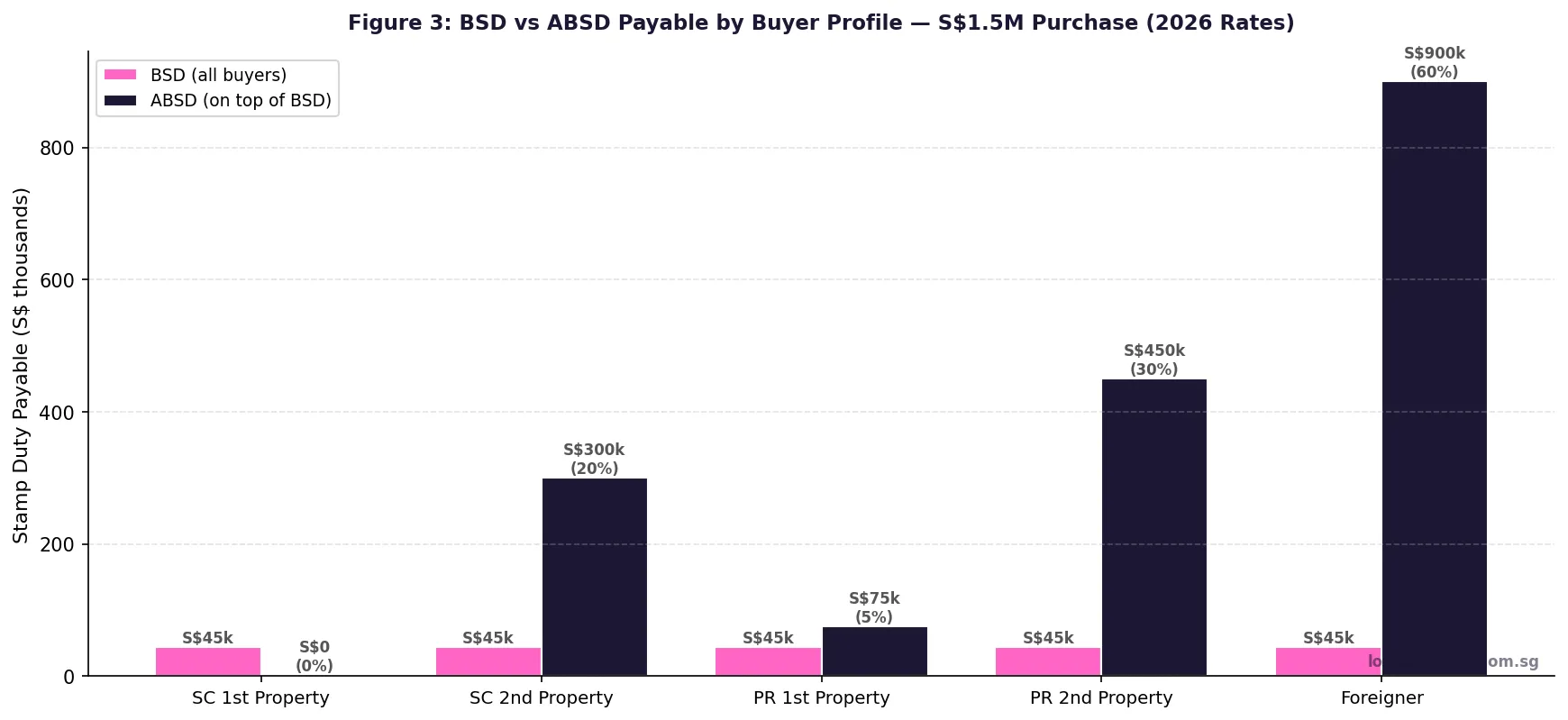
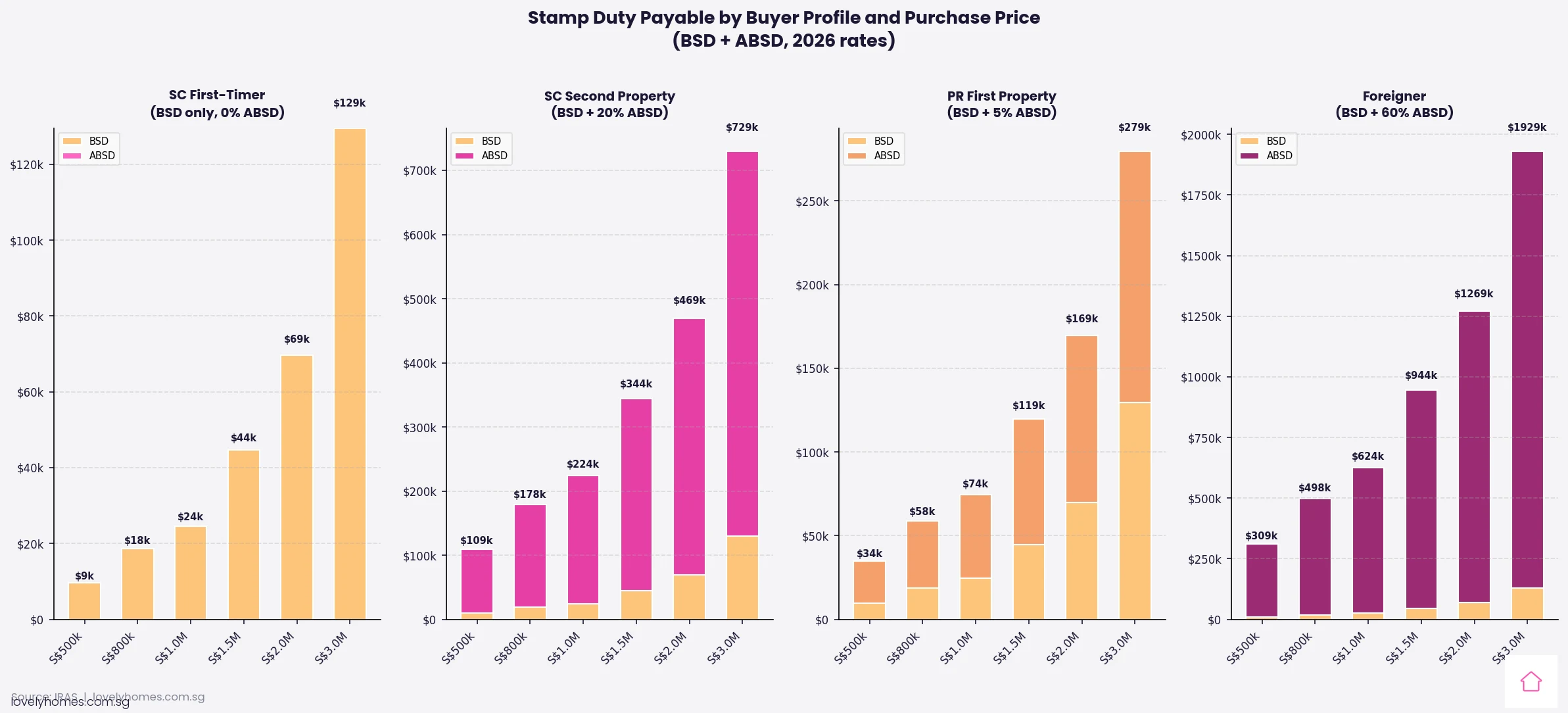
Foreigners purchasing any residential property in Singapore — including condos along the TEL — pay 60% ABSD on the full purchase price, regardless of whether it is their first or subsequent property. This applies equally to CCR Orchard Boulevard units and to more affordable East Coast apartments. The 60% rate, introduced in April 2023, has effectively priced most foreign investors out of the Singapore residential market. Singapore Permanent Residents buying their first private property pay 5% ABSD; their second residential property attracts 30% ABSD. Singapore Citizens pay 0% on a first private purchase and 20% on a second. All ABSD is administered by the Inland Revenue Authority of Singapore and is payable within 14 days of exercising the Option to Purchase.

What is the Johor Bahru RTS Link and why does it matter for TEL D25–D26 properties?

The Rapid Transit System (RTS) Link is a cross-border rail connection between Woodlands North MRT (the TEL’s northernmost station) and Bukit Chagar in Johor Bahru, Malaysia, scheduled for completion in late 2026. The RTS Link will allow commuters to travel between Singapore and Johor Bahru in approximately 5 minutes by rail, replacing a congested road crossing that currently takes 30–90 minutes in peak hours. For property investors, the RTS Link is a demand multiplier: Singaporeans working in Johor Bahru’s rapidly developing Iskandar Malaysia economic region, as well as Malaysians working in Singapore who choose to commute rather than rent, both anchor rental demand at or near Woodlands North and Woodlands MRT. Industry data suggests rental demand for 1BR and 2BR units within a 10-minute walk of Woodlands MRT could increase 15–25% once the RTS Link is fully operational.

How do I find resale condos near a specific TEL station?

The most reliable data source for resale condo transactions near any TEL station is the Urban Redevelopment Authority’s real estate information system at URA REIS. You can search by postal district or project name to see actual caveated transaction prices, floor area, and date of transaction. For a broader property search including current listings, URA’s public portal at ura.gov.sg provides planning information and the latest approved development details for each district. Cross-referencing URA caveats with listing prices gives you a reliable indication of the price gap (or premium) being applied by sellers in each catchment.

Related Articles

Disclaimer

This article is for general informational purposes only and does not constitute financial, legal, or property investment advice. All price per square foot figures, yield estimates, and transaction data referenced are indicative, based on publicly available URA caveat records and industry analysis, and are subject to change. Property values may go up or down. ABSD and stamp duty rates are administered by IRAS and are subject to revision. Consult a licensed property professional and a qualified financial adviser before making any investment decision.


HDB Upgrader Guide Singapore 2026: How to Move from HDB to Private Property

HDB Upgrader Guide Singapore 2026: How to Move from HDB to Private Property

The HDB upgrader guide Singapore 2026 is your complete, step-by-step resource for navigating the most financially significant move many Singaporeans will ever make: selling your Housing Development Board flat and purchasing a private condominium. Whether you are a Singapore Citizen approaching Minimum Occupation Period, or a permanent resident re-evaluating your property portfolio, understanding the full financial, regulatory, and timing picture is essential before you commit to either transaction.

Quick Answer — HDB Upgrade at a Glance

  • You must meet a Minimum Occupation Period (MOP) of 5 years before selling your HDB flat (resale) or renting it out entirely
  • Singapore Citizens buying a private condo while retaining their HDB pay 20% ABSD on the private property purchase
  • The sell-first strategy eliminates ABSD and is used by the majority of upgraders; the buy-first strategy preserves housing continuity but incurs ABSD upfront
  • Minimum cash component for a private condo: 5% of purchase price (beyond what CPF can cover)
  • Your Total Debt Servicing Ratio (TDSR) must not exceed 55% of gross monthly income on all loans combined
  • CPF Ordinary Account savings used for the HDB must be refunded with accrued interest of 2.5% per annum upon sale
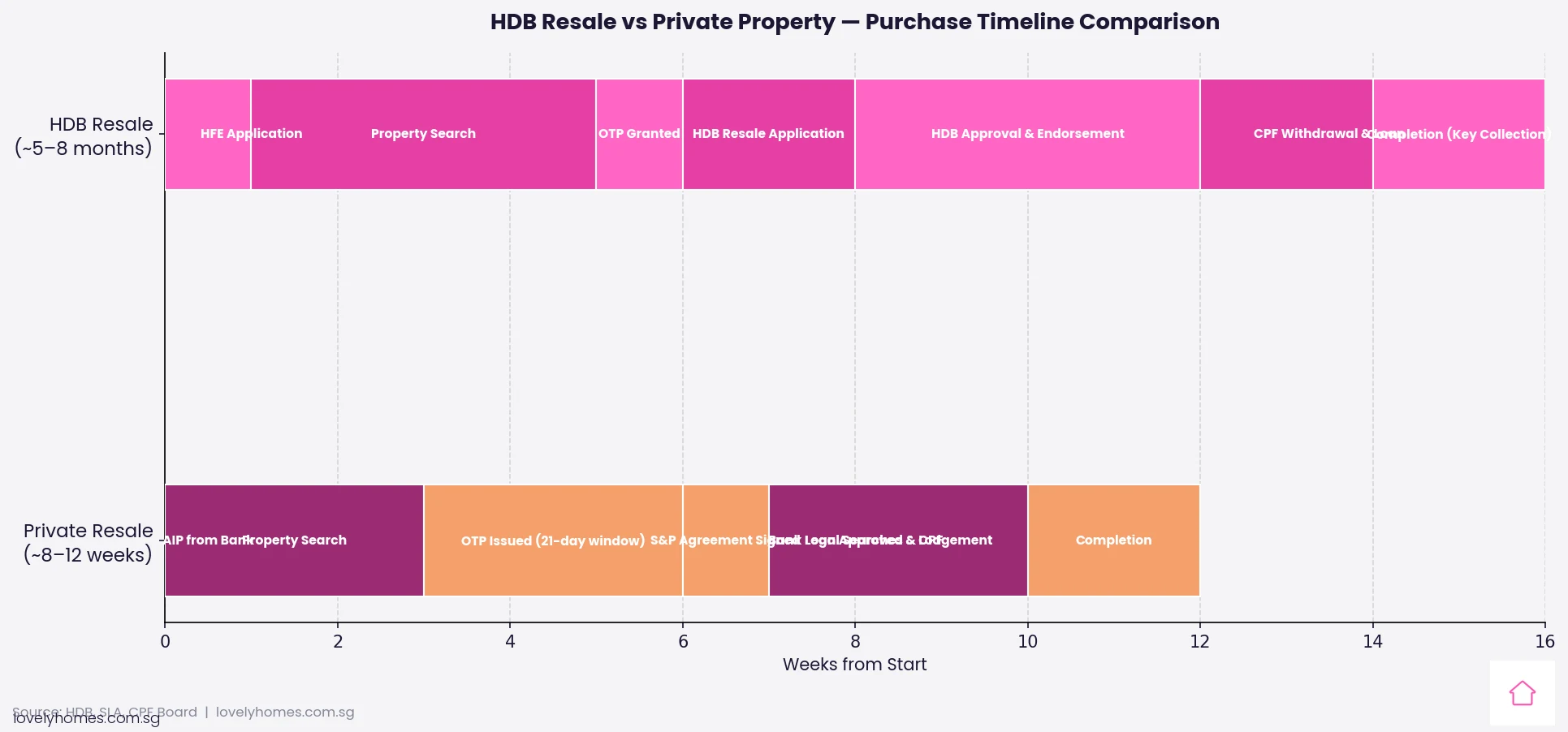
  • Full upgrade process (sell HDB + buy private): 7–9 months on a sell-first strategy; legal completion to collect keys adds 3–5 months for new launches
  • A Singapore Citizen household with S$800K HDB equity upgrading to a S$1.5M condo typically needs S$350K–$420K in additional cash/CPF

What Is the HDB-to-Private Upgrade Path?

Singapore’s dual-tier housing market — public HDB flats and private residential properties — creates a well-trodden upgrade path that the Housing Development Board and Urban Redevelopment Authority have both shaped through policy. An HDB flat is built on land sold to the HDB by the State under a 99-year lease; the HDB flat grant system, CPF usage rules, and MOP together form a structured subsidy framework designed to support first-time homeownership. The private condominium market, regulated separately by the URA, operates without the same direct subsidies, but also without income ceilings, nationality restrictions (for citizens and PRs), or MOP constraints once purchased.

The “HDB upgrade” is the act of monetising the subsidised first-home equity — essentially converting the benefit of below-market pricing and CPF grants into cash proceeds — and reinvesting those proceeds into the private market. The CPF Housing Grant for resale HDB flats, administered by the Housing Development Board, can total up to S$80,000 for eligible first-time buyer households; this grant accrues interest at 2.5% per annum and must be returned to CPF upon sale. Upgraders therefore need to account for this accrued interest deduction before calculating usable equity.

MOP: When Can You Sell?

The Minimum Occupation Period is the single most important gating rule. Under HDB regulations, resale HDB flat owners must physically occupy the flat for five years from the date of possession (for resale) or five years from the date of key collection (for new BTO flats purchased directly from the HDB). During the MOP you cannot sell your flat on the open market, rent out the entire flat, or own any private residential property in Singapore.

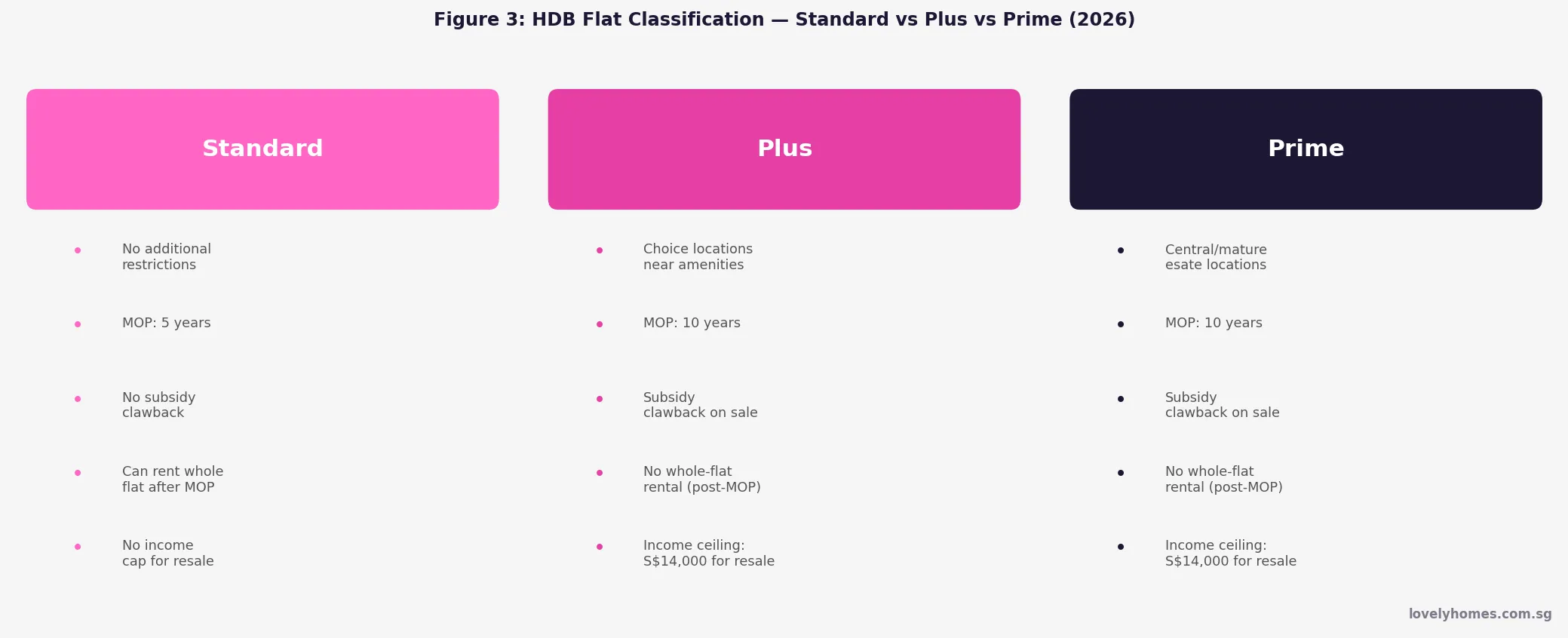
The five-year MOP was first introduced in 2010 and has remained stable since. For Prime Location Public Housing (PLH) flats announced from October 2021, the MOP is 10 years — a significant constraint for buyers in mature estates like Bishan, Queenstown, or the Pearl’s Hill development announced by MND in March 2026. Always verify the applicable MOP from your HDB letter of offer.

ABSD and the Simultaneous-Ownership Question

The single most expensive decision in the upgrade process is whether to sell your HDB flat before or after buying the private property. The difference is the Additional Buyer’s Stamp Duty, which is administered by the Inland Revenue Authority of Singapore (IRAS).

Upfront stamp duties and cash needed when upgrading from HDB to private condo Singapore 2026
Figure 1: Upfront stamp duties + minimum cash for a S$1.5M private condo purchase by buyer profile. ABSD is administered by IRAS and is based on the purchase price or market value, whichever is higher.

At the current rates (effective 27 April 2023), a Singapore Citizen buying a second residential property pays 20% ABSD on the purchase price. On a S$1.5M condominium that is S$300,000 payable within 14 days of exercising the Option to Purchase. Permanent Residents buying their first private residential property pay 5% ABSD; their second attracts 30%.

The sell-first strategy means completing the HDB sale (and receiving the full proceeds) before exercising the OTP for the private property. As long as no private residential property is in your name at the point of exercising the OTP, the ABSD charge is 0% for a Singapore Citizen’s first private purchase. This is the financially dominant path for the majority of HDB upgraders and accounts for the bulk of upgrade transactions recorded in URA caveats each year. The downside is an interim period — typically 1–4 months — between HDB completion and private condo collection, during which the family must rent or stay with relatives.

The buy-first strategy preserves residential continuity and is preferred by households with school-age children needing school proximity, or families who cannot face temporary displacement. However, ABSD is payable in full at OTP exercise. IRAS does offer a Remission Scheme for Married Couples: if at least one buyer is a Singapore Citizen and the couple sells the first property within six months of the private purchase date (resale) or key collection date (new launch), IRAS will refund the ABSD on the second property. The refund is not automatic — the couple must apply via the IRAS MyTax Portal within the six-month window.

CPF Usage, Accrued Interest, and Usable Equity

Understanding your actual usable equity from the HDB sale requires two deductions many sellers underestimate. First, the outstanding HDB loan balance (typically financed at the CPF Ordinary Account interest rate of 2.6% per annum) or bank loan must be fully repaid upon completion. Second, all CPF Ordinary Account monies used for the purchase — including the principal plus accrued interest at 2.5% per annum compounded annually — must be refunded to your CPF OA before you receive any cash proceeds. The CPF Board, as custodian of the national retirement savings scheme, enforces this return to ensure retirement adequacy is not eroded by property liquidation.

Practical example: a flat purchased in 2016 for S$500,000 where S$150,000 was used from CPF over nine years will have accrued approximately S$38,000 in interest, meaning S$188,000 must be refunded to CPF. This refunded amount is not lost — it returns to your CPF OA for future use, including towards the new private property — but it does reduce the cash-in-hand proceeds from the HDB sale.

TDSR, MSR, and How Much You Can Borrow

Private property mortgage lending in Singapore is governed by the Total Debt Servicing Ratio framework, administered by the Monetary Authority of Singapore (MAS). Under TDSR rules, the monthly repayment on all outstanding credit facilities — including the new mortgage — must not exceed 55% of the borrower’s gross monthly income. MAS also applies a stress-test rate: variable-rate loans are assessed at the prevailing rate plus a floor, and fixed-rate loans are assessed at the actual fixed rate or 3.5% (whichever is higher, as of the most recent MAS guidance). This means that even if actual SORA-pegged mortgage rates are below 3.5% today, the bank will calculate affordability as if they were 3.5%.

The Mortgage Servicing Ratio — which caps HDB loan repayments at 30% of income — does not apply to private property. However, banks typically retain their own internal MSR-equivalent underwriting floors. For a household with S$12,000 monthly gross income, the maximum monthly debt service across all credit lines is S$6,600 (55%), and after deducting any car loan or personal loan obligations, the remaining capacity determines the maximum mortgage quantum.

HDB upgrade timeline sell-first strategy 7 to 9 months Singapore 2026
Figure 2: The typical sell-first upgrade timeline. Steps 1–4 cover the HDB sale; Steps 5–7 cover the private condo purchase. Total elapsed time is approximately 7–9 months for a resale private condo; add 2–5 years for a new launch.

The Loan-to-Value Framework for Private Property

Under MAS Notice 632, the maximum Loan-to-Value (LTV) ratio for a first housing loan from a financial institution is 75% of the lower of purchase price or market value, provided the loan tenure does not exceed 30 years and the borrower does not exceed 65 years of age at loan maturity. If either condition fails, the LTV drops to 55% or 45%. For upgraders who have fully repaid their HDB loan, the higher 75% LTV applies on the private condo purchase. For those with an outstanding HDB bank loan at the time of application (buy-first strategy), the LTV for the new loan may be reduced to 45%, further increasing the cash component required.

Summary Table: Key Upgrade Figures at a Glance

Parameter Sell-First (No ABSD) Buy-First (ABSD Remission)
ABSD (SC, 2nd property) 0% (sold HDB first) 20% upfront; refundable if HDB sold within 6 months
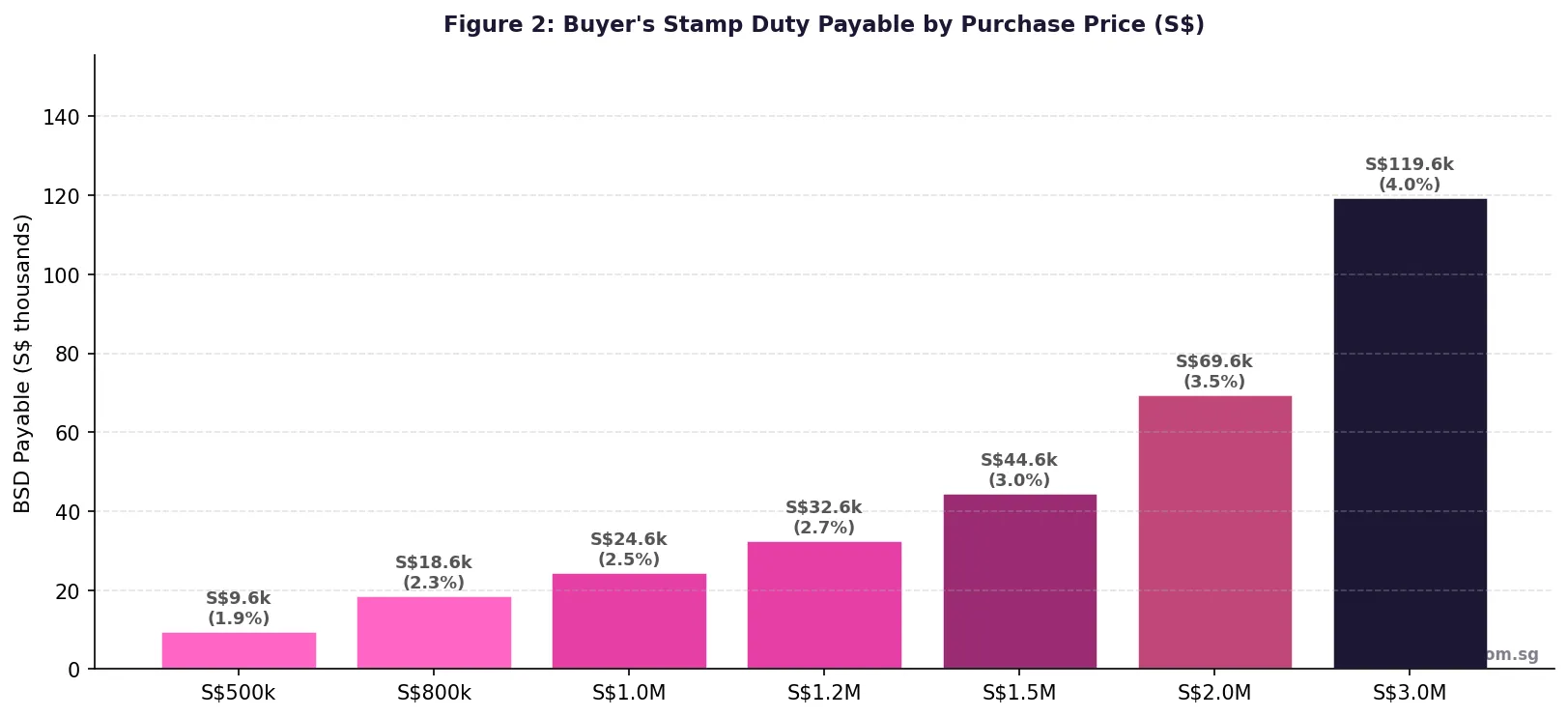
BSD (on S$1.5M) ~S$44,600 (both strategies) ~S$44,600
Min Cash Required 5% of purchase price 5% + 20% ABSD (cash or financing)
Max LTV 75% (no outstanding loan) 45% (outstanding HDB bank loan retained)
TDSR Limit 55% of gross income 55% of gross income
Typical Timeline 7–9 months (resale condo) 6 months from OTP exercise to sell HDB
CPF OA Accrued Interest 2.5% p.a., must refund to CPF upon HDB sale Same

Worked Example: The Tans Upgrade from Tampines to Condo

Mr and Mrs Tan are a Singapore Citizen couple in their late thirties. They purchased a Tampines HDB 5-room resale flat in 2019 for S$620,000, using S$180,000 from CPF OA and taking an HDB bank loan for S$440,000 at 2.6% per annum. As of April 2026 — seven years into the loan — their outstanding loan balance is approximately S$360,000, and their CPF refund obligation (principal S$180,000 + accrued interest ~S$33,000) totals S$213,000. The flat is valued at S$750,000 on the open market.

Proceeds calculation (sell-first):

  • Sale price: S$750,000
  • Less: outstanding HDB loan repayment: −S$360,000
  • Less: CPF refund obligation: −S$213,000
  • Net cash-in-hand: S$177,000
  • CPF OA balance after refund: S$213,000 (available for new purchase)

New condo purchase at S$1.5M (sell-first, no ABSD):

  • BSD payable to IRAS: ~S$44,600
  • ABSD: S$0 (HDB sold first)
  • 5% minimum cash: S$75,000
  • Loan quantum (75% LTV): S$1,125,000
  • CPF usable (OA): S$213,000 (can cover remaining 20% − 5% cash = S$225,000; short by ~S$12,000 in CPF — top up from cash or savings)
  • Total upfront cash outlay: ~S$132,000 (BSD S$44.6K + cash S$75K + CPF shortfall S$12K)
  • Usable HDB cash proceeds (S$177K) exceed cash outlay (S$132K): surplus ~S$45,000

Combined gross household income for TDSR: S$14,000/month. Monthly mortgage on S$1,125,000 at 3.5% stress rate over 25 years ≈ S$5,630. TDSR = 40.2% — within the 55% cap. The upgrade is financially feasible.

Additional cash needed when HDB upgrading to private condo Singapore citizen second property ABSD 2026
Figure 3: Additional cash or loan funding needed above HDB equity proceeds, by condo price point and usable equity level. All figures assume 20% ABSD (SC 2nd property) and 3% BSD; sell-first scenario removes the ABSD bar entirely.

Why the Upgrade Matters for Singapore Wealth Building

The HDB-to-private upgrade has historically been Singapore’s most reliable individual wealth-building step. URA transaction data consistently shows that private residential prices in the Rest of Central Region (RCR) and Core Central Region (CCR) have outpaced HDB resale price appreciation over 10-year rolling periods, particularly in proximity to MRT interchanges and integrated developments. The 2016–2026 decade saw HDB resale values rise approximately 40–55% in prime estates, while comparable private freehold or 99-year leasehold condos in the same districts appreciated 60–90%.

That said, the upgrade decision is not purely about capital appreciation. Private condo ownership typically involves higher monthly outgoings — management fees, sinking fund contributions, higher property tax under the non-owner-occupier progressive rate (administered by IRAS), and higher mortgage quantum — which compress monthly cash flow for the first 5–10 years. Households should model the cash-flow impact carefully using the actual mortgage rate (SORA + spread, typically 3.4–3.8% as of April 2026 for new floating-rate packages) rather than the stress-test rate.

What Might Come Next: Policy Watch for Upgraders

The current ABSD framework (20% for SC second property) has been in place since April 2023 and shows no sign of immediate revision. MAS and MND have both signalled that macroprudential tools will remain elevated as long as private property prices continue to rise. The URA reported a 0.9% quarter-on-quarter increase in private residential prices in Q1 2026 (full statistics released 25 April 2026), on top of a 0.6% gain in Q4 2025, suggesting sustained upward pressure that gives authorities little reason to ease ABSD. Upgraders planning their move in 2026–2027 should assume the 20% SC ABSD rate persists for the foreseeable future, and should build the sell-first timeline around that assumption.

One area to watch is the Lease Buyback Scheme and CPF use rules for older HDB upgraders (aged 55+), where CPF Retirement Account obligations create a different equity-release calculus. MND’s Committee of Supply 2026 speech hinted at ongoing reviews of CPF Retirement Sum drawdown rules for older owner-occupiers — any loosening could marginally improve equity available for the upgrade among this cohort.

Frequently Asked Questions

Can I buy a private condo before selling my HDB flat?

Yes, but as a Singapore Citizen you will be liable for 20% ABSD on the private condo purchase price, payable within 14 days of exercising the OTP. IRAS provides a Remission Scheme for married couples where at least one is a Singapore Citizen: if you sell your HDB within six months of the private condo’s key collection date (new launch) or OTP exercise date (resale), you may apply to IRAS for a refund of the ABSD paid. The refund is not automatic and requires a formal application within the stipulated window. Note that the 5% cash down payment for the private condo is still required upfront and is not refunded.

What happens to the CPF money I used for my HDB flat?

Upon selling your HDB flat, all CPF Ordinary Account monies used for the purchase — including the initial down payment, subsequent monthly instalments drawn from CPF, and any CPF Housing Grants received — must be refunded to your CPF OA with accrued interest at 2.5% per annum compounded annually. This refunded amount re-enters your CPF OA and can be used immediately for the down payment on your private condo purchase (subject to the CPF Withdrawal Limit and Valuation Limit rules). You do not lose this money — it simply remains within the CPF system rather than being paid out as cash. The CPF Board’s property portal at cpf.gov.sg provides a withdrawal calculator to estimate your exact refund obligation.

How much cash do I actually need to upgrade?

The minimum cash component for any private property purchase in Singapore is 5% of the purchase price. This must be paid in cash — CPF OA funds or bank loans cannot cover this component. For a S$1.5M condominium that is S$75,000. On top of this, you will need cash or CPF for the Buyer’s Stamp Duty (approximately S$44,600 on S$1.5M), legal fees (~S$3,000–$5,000), and a valuation fee (~S$300–$600). If you are using the sell-first strategy and have no ABSD to pay, total cash and CPF outlay to exercise the OTP is approximately S$120,000–$130,000 for a S$1.5M property, with the remainder funded by your mortgage and CPF OA balance.

Can I retain my HDB flat and buy a private condo?

Singapore Citizens and Permanent Residents are not prohibited from simultaneously owning an HDB flat and a private property, but the financial cost is high: as an SC you will pay 20% ABSD on the private property purchase, and as a PR you will pay 30% ABSD on your second property. Additionally, while you own both, the HDB flat remains subject to HDB rules including the restriction on fully subletting the flat until MOP is met (unless you are above 35, divorced, a single with the right to sublet under HDB’s rules, or have specific HDB approval). If you proceed with this dual-ownership approach, you must ensure your TDSR covers both your HDB loan instalments and the new private mortgage simultaneously.

What is the Temporary Housing Solution during the gap between HDB completion and condo collection?

Most sell-first upgraders experience a 1–6 month gap between HDB legal completion and moving into the new private property. The most common approach is a deferred completion arrangement negotiated with the HDB buyer at the point of signing the OTP — you agree to stay in the flat for a fixed rental period (typically 2–3 months at a market rate) after legal completion while your new home is prepared. Alternatively, families rent a unit in the open market at prevailing rates, or stay with extended family. Factoring rental costs of S$2,000–$4,500 per month (depending on unit size and district) into your upgrade budget is essential, particularly for the east and central regions where new launch condo waiting periods can extend to 3–5 years.

Are there specific private condos I cannot buy with my HDB equity?

There are no restrictions on which private condominium an HDB upgrader may purchase. However, two practical constraints often apply. First, Restricted Residential Properties under the Residential Property Act — Good Class Bungalows and most landed housing in Singapore — require Ministerial approval for Singapore Permanent Residents and are unavailable to foreigners entirely; Singapore Citizens may purchase without restriction. Second, if your usable CPF OA balance is below the Valuation Limit (the lower of purchase price and market value), your CPF usage will be capped; you must fund the shortfall from cash. Always check the CPF Board’s updated Valuation Limit rules at cpf.gov.sg before committing to a price point.

What happens if I cannot sell my HDB within the 6-month ABSD remission window?

If you purchased a private condo while retaining your HDB flat (buy-first strategy) and are unable to sell the HDB within six months of the private condo’s key collection date or OTP exercise date, the ABSD remission is forfeited — the 20% ABSD you paid upfront is not refunded. In practice, HDB resale transactions in Singapore typically complete within 8–16 weeks of listing, so the six-month window is generally achievable if you list the HDB promptly after exercising the condo OTP. The risk is greatest when buying a resale condo (shorter completion timeline) while your HDB is slow to sell. If you are uncertain, the sell-first strategy eliminates this risk entirely.

Related Articles

Disclaimer

This article is intended for general informational purposes only and does not constitute financial, legal, or property advice. Stamp duty rates, CPF rules, HDB regulations, and MAS lending guidelines are subject to change; always verify current figures directly with the Inland Revenue Authority of Singapore (IRAS), the CPF Board, the Housing Development Board, and the Monetary Authority of Singapore. Consult a licensed property agent, bank mortgage specialist, and solicitor before making any property transaction decision. Nothing in this article should be treated as a solicitation to buy or sell any property.


Translate »