Singapore Property Selling Guide 2026: How to Sell Your HDB, Condo or Landed Property — Step by Step
Singapore Property Selling Guide 2026: How to Sell Your HDB, Condo or Landed Property — Step by Step

Singapore property selling guide 2026 — complete step-by-step guide for HDB flat, condo and landed property sellers
Quick Answer — Key Takeaways

  • There is no capital gains tax in Singapore — profit from a property sale is not taxed unless IRAS deems you a property trader.
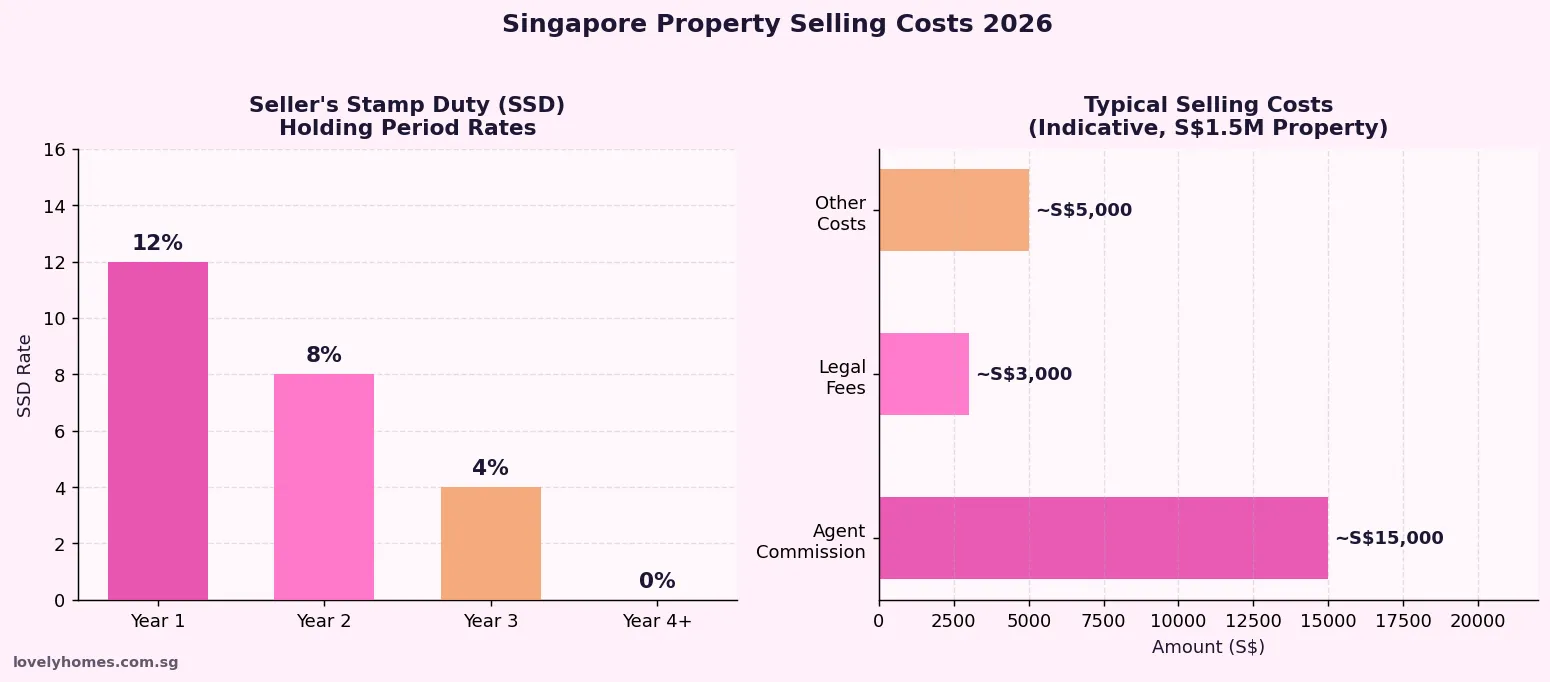
  • Seller’s Stamp Duty (SSD) applies if you sell within 3 years of purchase: 12% (under 1 year), 8% (1–2 years), 4% (2–3 years), 0% thereafter.
  • HDB flat sellers effectively never pay SSD because the 5-year Minimum Occupation Period (MOP) exceeds the 3-year SSD window.
  • All CPF Ordinary Account (OA) monies used for the property must be refunded upon sale — principal plus accrued interest at 2.5% per annum.
  • Agent commission is typically 2% for HDB resale and 1–2% for private property (negotiable; no government-mandated rate).
  • SC married couples who buy a new private property before selling their HDB flat pay ABSD 20% upfront but may claim a remission if the HDB is sold within 6 months.
  • The HDB resale process takes approximately 8–12 weeks; private property completion typically runs 10–16 weeks after OTP exercise.
  • Sellers must file the Resale Checklist (HDB) or grant an Option to Purchase (private) as the formal first step — verbal agreements are not binding.

What This Guide Covers

Selling a property in Singapore is a structured, multi-step process governed by the Housing and Development Board (HDB), the Urban Redevelopment Authority (URA), the Inland Revenue Authority of Singapore (IRAS), and the Singapore Land Authority (SLA). Whether you are selling an HDB flat, a private condominium or landed home, understanding your obligations — and your costs — before you sign anything will protect both your timeline and your net proceeds.

This guide walks through every stage of the selling process: from registering your intent to sell through to collecting your sale proceeds. We cover Seller’s Stamp Duty (SSD), CPF Ordinary Account refunds, agent commission, legal fees, the ABSD remission for upgraders, and what the numbers actually look like at three common price points.

Step 1: Confirm Your Eligibility to Sell

HDB Flat Sellers

Before listing your HDB flat, confirm that you have fulfilled the Minimum Occupation Period (MOP). Under HDB rules, the MOP is generally five years from the date of flat collection (key collection) for BTO and resale flats, and 10 years for Prime Location Public Housing (PLH) flats in areas such as Rochor, Central, and River Peaks. Flats under the Plus category (introduced from the October 2024 BTO exercise onwards) also carry a 10-year MOP.

Once your MOP is satisfied, register your Intent to Sell on the HDB Resale Portal at least seven days before granting any Option to Purchase (OTP). HDB uses this window to flag eligibility issues — for example, outstanding upgrading contributions or HDB loan arrears — before any buyer is committed.

Private Property Sellers

There is no waiting period for selling private residential property, but you must check whether SSD applies (see Section 3 below). If you purchased the property as an investment under a corporate entity, the Additional Conveyance Duties (ACD) regime administered by IRAS may also be relevant. Most owner-occupier sellers are unaffected by ACD, which primarily targets equity interest transfers.

Step 2: Appoint an Agent and Set a Price

In Singapore, sellers of private property engage their own agent and pay their own commission. For HDB resale transactions, the seller’s agent is also typically paid by the seller. The Council for Estate Agencies (CEA) licences all property agents in Singapore; you may verify any agent’s registration at the CEA Public Register.

Commission is negotiable — there is no statutory rate. Market practice is approximately 2% of the sale price for HDB flats and 1–2% for private property. For very high-value or difficult-to-move properties, the rate may be negotiated higher. Some sellers opt for a fixed fee arrangement. Always confirm the agreed commission in writing before signing any appointment letter.

Setting the right asking price requires reviewing recent comparable transactions (available free via URA’s REALIS portal and HDB’s public resale flat transaction data). Overpricing slows your sale; underpricing erodes your equity position.

Step 3: Seller’s Stamp Duty (SSD) — Know Your Exposure Before You List

SSD is administered by IRAS under the Stamp Duties Act (Cap 312). It was reimposed in January 2011 and refined in March 2017, when the current three-year, three-tier structure took effect. SSD applies to all residential properties — HDB flats, condominiums, and landed homes alike — sold within three years of purchase.
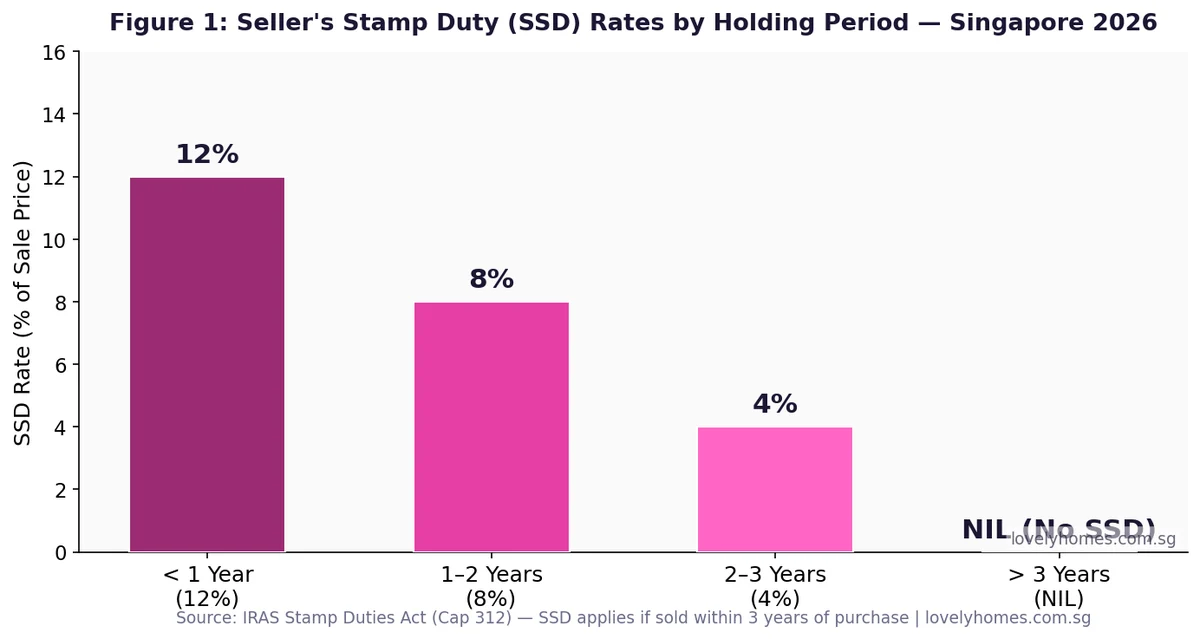
Seller's Stamp Duty SSD rates by holding period Singapore 2026 — bar chart showing 12% under 1 year, 8% 1 to 2 years, 4% 2 to 3 years, NIL after 3 years
Figure 1: SSD Rates by Holding Period — Singapore 2026. Holding period is measured from the date of purchase to the date of the sale contract (OTP date for private; HDB Resale Application date for HDB). Source: IRAS.
Holding Period SSD Rate Example: Property Sold at S$1,200,000 Who This Affects Most
Less than 1 year 12% S$144,000 Short-term flippers; forced sellers
1 year to 2 years 8% S$96,000 Sellers whose circumstances changed
2 years to 3 years 4% S$48,000 Early investors; job relocation sellers
3 years or more NIL S$0 Most owner-occupiers and long-term investors

SSD is calculated on the higher of the sale price or the market value assessed by IRAS at the time of sale. It is payable by the seller within 14 days of the sale contract date (OTP exercise date for private property, or HDB Resale Application date for HDB transactions). Late payment attracts a penalty of up to four times the unpaid duty.

Practical note for HDB sellers: Because the HDB MOP is five years and SSD applies only within three years, HDB flat sellers who complete their MOP will never be subject to SSD. The SSD window closes at the three-year mark; the MOP does not open until the five-year mark.

Hardship exemptions exist but are rarely granted. IRAS considers genuine financial distress, medical incapacity, or divorce — the applicant must demonstrate that the sale was necessitated by a circumstance beyond their control.

Step 4: CPF Ordinary Account Refund — How Accrued Interest Works

When you use CPF savings to purchase a property, you are borrowing from your own retirement account. To prevent erosion of retirement savings, the CPF Board requires that upon sale, all CPF monies withdrawn for the property are refunded to your CPF OA — including the interest those monies would have earned had they remained in the OA. This “accrued interest” accrues at the prevailing CPF OA interest rate, currently 2.5% per annum (guaranteed floor rate as of 2026).

The refund sequence is: (1) principal CPF withdrawn, (2) accrued interest. Only after this refund do you receive your net cash proceeds. For sellers who purchased many years ago with large CPF drawdowns, the accrued interest component can be substantial.

Illustration: If you drew S$200,000 from CPF OA to purchase a property in January 2019 and sell it in June 2026 (7.4 years), the accrued interest is approximately S$200,000 × 2.5% × 7.4 = S$37,000. Your CPF refund is therefore S$237,000, not S$200,000. This money goes back into your CPF OA and will be available for your next property purchase or for retirement withdrawal at age 55+.

The accrued interest is not a penalty; it is simply the return of the compounded interest your CPF savings would have earned in the OA. Sellers sometimes mistake this for a “profit tax” — it is not. It does, however, reduce your net cash-in-hand on sale, which matters if you need cash for your next purchase’s downpayment.

Summary of Key Seller Obligations

Obligation Administered by When Due Penalty for Default
Register Intent to Sell (HDB) HDB ≥ 7 days before OTP Cannot proceed with sale
Pay SSD (if applicable) IRAS Within 14 days of contract Up to 4× unpaid duty
Repay outstanding HDB loan HDB At legal completion Completion delayed
Refund CPF OA principal + accrued interest CPF Board At legal completion Sale proceeds withheld
Discharge caveat (if private property) SLA At legal completion Title cannot pass
Pay agent commission CEA-licenced agent At legal completion Civil action by agent
Pay conveyancing legal fees Seller’s solicitor At legal completion Files withheld

Step 5: Understanding Your Net Proceeds

Your net cash proceeds from a property sale are what remains after repaying all outstanding obligations. Most sellers are surprised to find that the headline sale price bears little resemblance to the cash they actually receive, particularly if the property was heavily financed and CPF funds were used extensively.
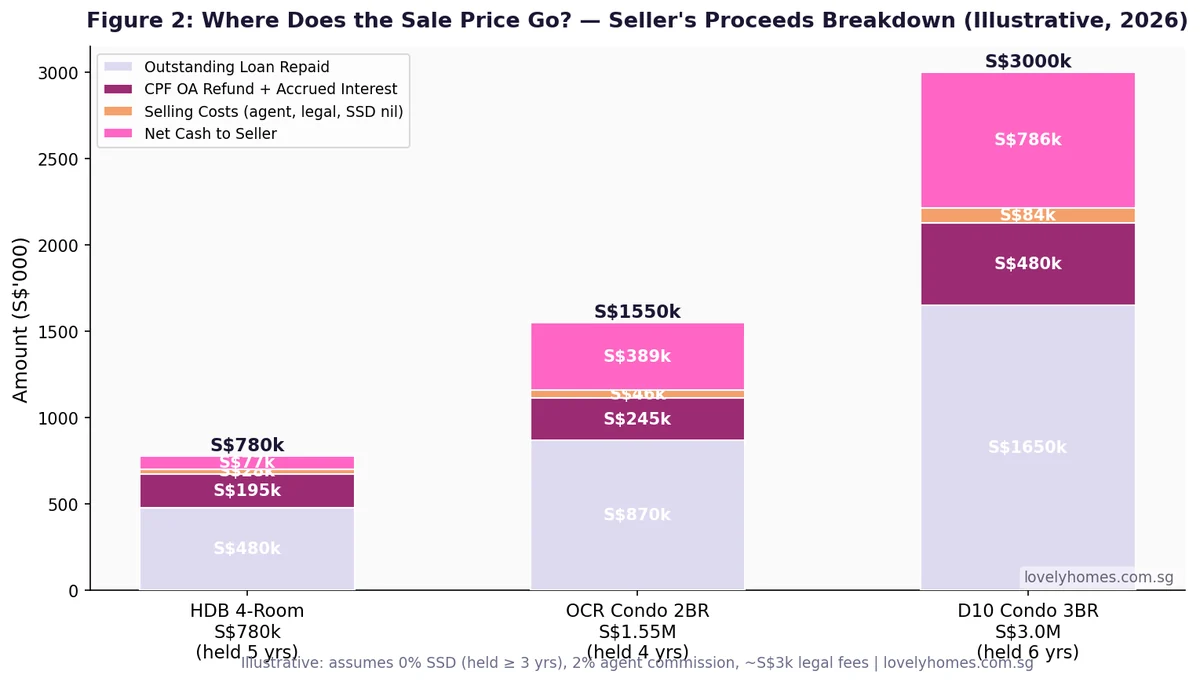
Seller net proceeds breakdown by property price point HDB 4-Room condo OCR D10 stacked bar chart Singapore 2026
Figure 2: Where Does the Sale Price Go? — Seller’s Proceeds Breakdown at Three Price Points (Illustrative, 2026). Assumes 0% SSD (held ≥ 3 years), 2% agent commission, and ~S$3k legal fees. Actual figures vary by loan balance, CPF drawdown history, and tenure.

The chart above shows three illustrative scenarios for a seller who has held the property for more than three years (SSD = nil). In every case, the outstanding loan repayment is the single largest deduction. The CPF refund (principal plus accrued interest) is the second largest. Net cash to the seller ranges from S$77,000 on an HDB flat to S$786,000 on a prime district condominium — which underscores why understanding your equity position before listing is critical.

Step 6: Selling Costs — Agent, Legal, and Sundry Fees
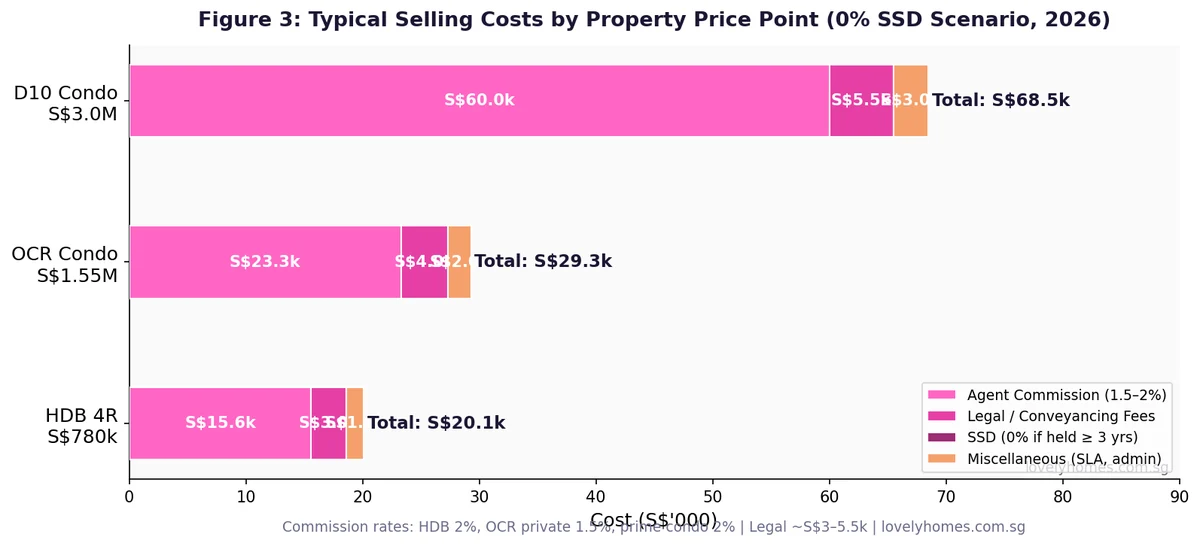
Selling costs breakdown agent commission legal SSD by property price point Singapore 2026 horizontal stacked bar chart
Figure 3: Typical Selling Costs by Property Price Point (0% SSD Scenario, 2026). The largest variable cost is agent commission, which is fully negotiable. SSD = nil for properties held ≥ 3 years.

Selling costs in Singapore are modest by regional standards, but they still add up:

  • Agent commission: The dominant selling cost. Typically 2% of the sale price for HDB (both seller and buyer each pay their own agent). For private property, 1–2% is standard. On a S$3 million condominium at 2%, commission is S$60,000.
  • Conveyancing legal fees: S$2,000–S$4,500 for most standard transactions. Solicitors in Singapore generally follow the Law Society scale but are free to quote fixed fees. Complex transactions (e.g., partial CPF pledging, foreign seller, multiple mortgagees) may cost more.
  • HDB administrative fees: For HDB resale, an administrative fee of S$80 is charged at the Resale Completion Appointment.
  • SLA caveat withdrawal: If you lodged a caveat as buyer (common for private property), the caveat must be withdrawn at sale. Fee: S$64.45 via the SLA e-filing portal.
  • SSD (if applicable): As described above — 0% if held ≥ 3 years, up to 12% for sub-one-year sales.

Worked Example: Mr & Mrs Goh — Selling HDB, Upgrading to Private

Mr and Mrs Goh are Singapore Citizens, married, with a combined monthly income of S$15,000. They purchased a 5-room Bishan HDB flat in January 2019 at S$600,000 via an HDB concessionary loan (80% LTV). They have fulfilled their MOP (January 2024) and wish to sell in June 2026 and purchase an Outside Central Region (OCR) condominium unit.

HDB Sale Proceeds Breakdown (Sale price S$920,000):

Item Amount Notes
Sale price S$920,000 Agreed transacted price
Less: Outstanding HDB loan (S$376,000) Approx balance after 7.5 years at 2.6% p.a.
Less: CPF OA principal refund (S$120,000) Total CPF drawn for downpayment + instalments
Less: CPF accrued interest (S$22,200) ~2.5% p.a. on S$120k × 7.4 years
Less: Agent commission (2%) (S$18,400) Seller pays own agent
Less: Legal / conveyancing fees (S$2,800) Seller’s solicitor
Less: SSD NIL Held > 3 years; MOP confirmed cleared
Net cash to Mr & Mrs Goh S$380,600 Available for next purchase + cash savings

Next Step — OCR Condo Purchase (S$1,350,000): After selling the HDB first, Mr and Mrs Goh own zero residential properties. As Singapore Citizens purchasing their first private property, ABSD is nil. BSD on S$1.35M is S$37,200 (progressive rates up to 4% above S$1M). Bank loan at 75% LTV = S$1,012,500 at 3.0% p.a. over 25 years = S$4,800/month. TDSR: S$4,800 ÷ S$15,000 = 32% — comfortably within the 55% threshold. Cash upfront: S$337,500 (downpayment) + S$37,200 (BSD) = S$374,700 — funded from the S$380,600 net HDB sale proceeds. The transaction is feasible without additional savings.

ABSD Remission for SC Married Couples — The “Buy First, Sell Later” Option

Some upgraders prefer to secure their new private property before selling the HDB to avoid a gap period where they are without a home. Under the current rules (effective April 2023), a Singapore Citizen married couple buying a second residential property must pay ABSD at 20%. However, they may apply to IRAS for an ABSD remission if the HDB flat is sold within six months of the purchase of the private property (for a completed unit) or within six months of the private property’s Temporary Occupation Permit (TOP) date (for an uncompleted unit).

This is a powerful option but carries risk: if the HDB sale falls through or is delayed beyond the six-month window, the ABSD is forfeited. On a S$1.35 million purchase, ABSD at 20% is S$270,000. Couples considering this route must maintain sufficient liquidity to fund the ABSD upfront while awaiting the refund.

What This Means for Property Sellers in 2026

Singapore’s property market in Q1 2026 recorded private residential price growth of 0.9% (URA), with the Outside Central Region leading at 2.2% gains. HDB resale prices remain elevated, with a five-room flat at Henderson Road transacting at S$1.728 million in April 2026 — the highest-ever HDB resale price. In this environment, sellers generally hold the advantage, but the SSD and ABSD frameworks mean that timing your sale matters enormously. Selling within the three-year SSD window destroys value fast; holding beyond three years and structuring your purchase correctly (sell first or use remission carefully) preserves it.

What Might Come Next

The MAS Financial Stability Review (November 2025) flagged property market resilience but noted that elevated interest rates and slowing transaction volumes in the CCR warranted monitoring. Industry analysts suggest that the government is unlikely to ease cooling measures in 2026 absent a material correction in prices — meaning the SSD and ABSD frameworks should be treated as fixed parameters for planning purposes at least through 2027. Any revision to the ABSD remission window (currently six months) would require a formal policy announcement from the Ministry of Finance and IRAS.

Frequently Asked Questions

Can I use CPF to pay agent commission or legal fees when selling?

No. CPF savings cannot be used directly to pay agent commission or legal fees for a property sale. These costs must be paid in cash. CPF can only be used for property-related purposes at the point of purchase — specifically downpayment, monthly instalments, and BSD/ABSD (subject to timing rules). Upon sale, your CPF OA receives the principal refund plus accrued interest, which then becomes available for future property purchases or CPF-approved uses.

Is there any tax on the profit I make from selling my property?

Singapore does not levy a capital gains tax. Profit from the sale of a private residential property or HDB flat is generally not taxable. However, IRAS retains the discretion to treat gains as income if you are deemed to be carrying on a business of property trading — characterised by a pattern of frequent, short-hold purchases and sales with profit intent. Owner-occupiers and genuine long-term investors are almost never subject to this treatment. SSD is the government’s primary disincentive against short-term speculation and is entirely separate from income tax.

What happens to my CPF accrued interest when I sell? Is it lost?

The accrued interest is not lost — it goes back into your CPF OA, where it continues to earn the 2.5% guaranteed rate (with the additional 1% on the first S$60,000 of combined CPF balances). If you are below 55, you can use the CPF OA funds for your next property purchase. If you are 55 or above, the refund first tops up your Retirement Account to the Full Retirement Sum (S$213,000 in 2026), and any excess in the OA can be used for property or withdrawn. The accrued interest does reduce your cash-in-hand at sale, which is why planning your equity position before listing is important.

If I sell my HDB flat, can I buy a private property immediately?

Yes. Once your HDB flat is sold and the legal completion has taken place, you no longer own an HDB flat and your residential property count drops accordingly. Singapore Citizens purchasing their first private property pay no ABSD. Singapore Permanent Residents purchasing their first private property pay 5% ABSD. However, note that CPF proceeds from the HDB sale are returned to your CPF OA and are not accessible as cash on the day of completion — they typically post to your OA within a few working days. Ensure your cash flow for the new property’s downpayment is sourced accordingly.

What is the difference between the Option to Purchase (OTP) and the Sale & Purchase Agreement (S&P)?

The OTP is a contractual right granted by the seller to the buyer, giving the buyer a period (typically 14 days for private property) to decide whether to exercise the option. The option fee (typically 1% of the purchase price) is paid when the OTP is granted. If the buyer exercises the OTP, they pay the exercise fee (typically 4%), bringing the total deposit to 5%. The Sale & Purchase Agreement (S&P) is the binding contract executed upon exercise of the OTP, setting out all terms of the transaction including the completion date (usually 8–12 weeks). For HDB resale, the equivalent process uses a standardised OTP issued by HDB and submitted through the HDB Resale Portal — there is no separate S&P document.

How does SSD apply if I inherited the property?

SSD is based on the original purchase date of the property, not the date of inheritance. If the deceased purchased the property in March 2024 and you inherited it and sell it in May 2026 (approximately 2 years), SSD at 8% would apply. This catches many beneficiaries off guard. The SSD holding period is not reset by the change in ownership via inheritance. Beneficiaries who inherit property that is within the SSD window should factor this into their estate planning and timing decisions. There is no automatic exemption for inherited properties.

Do I need to pay property tax up to the day of completion?

Yes. Property tax is levied on an annual basis by IRAS and is the seller’s liability up to the date of legal completion. Your solicitor will apportion the property tax between seller and buyer in the completion account — the buyer reimburses the seller for property tax from the completion date to the end of the calendar year (or whatever period the annual tax covers). This apportionment is standard practice and will appear in your completion account prepared by your conveyancing lawyer. Owner-occupier rates (0% on the first S$8,000 AV, 4% on the next S$47,000 AV) typically mean property tax is modest for residential sellers.

Related Articles


Disclaimer: This article is for general informational purposes only and does not constitute legal, financial, tax, or property advice. Property transactions in Singapore are governed by a complex and evolving framework of legislation and regulations administered by HDB, URA, IRAS, CPF, MAS, CEA, and SLA, among others. All figures, rates, and timelines cited are accurate as at 1 June 2026 based on publicly available sources, but may change. Always consult a licensed property agent, conveyancing solicitor, and financial adviser before proceeding with any property transaction. For official guidance, refer to: hdb.gov.sg, iras.gov.sg, cpf.gov.sg, ura.gov.sg.
Seller’s Stamp Duty (SSD) Singapore 2026: Complete Guide to Rates, Rules & Exemptions

Seller’s Stamp Duty (SSD) Singapore 2026: Complete Guide to Rates, Rules & Exemptions

Quick Answer — Seller’s Stamp Duty at a Glance

  • SSD applies when you sell a Singapore residential property within 3 years of purchase (for properties acquired on or after 11 March 2017).
  • Rates: Year 1 — 12%, Year 2 — 8%, Year 3 — 4%. No SSD after the 3-year holding period.
  • SSD is levied on the higher of the sale price or market value — IRAS may conduct an independent valuation.
  • SSD applies to both private residential properties and HDB resale flats — though HDB’s 5-year MOP means SSD is rarely triggered in practice for HDB owners.
  • SSD must be paid within 14 days of the date of the sale contract or transfer document.
  • There is no remission for SSD based on citizenship or residency status — it applies equally to Singapore Citizens, PRs and foreigners selling within the holding period.
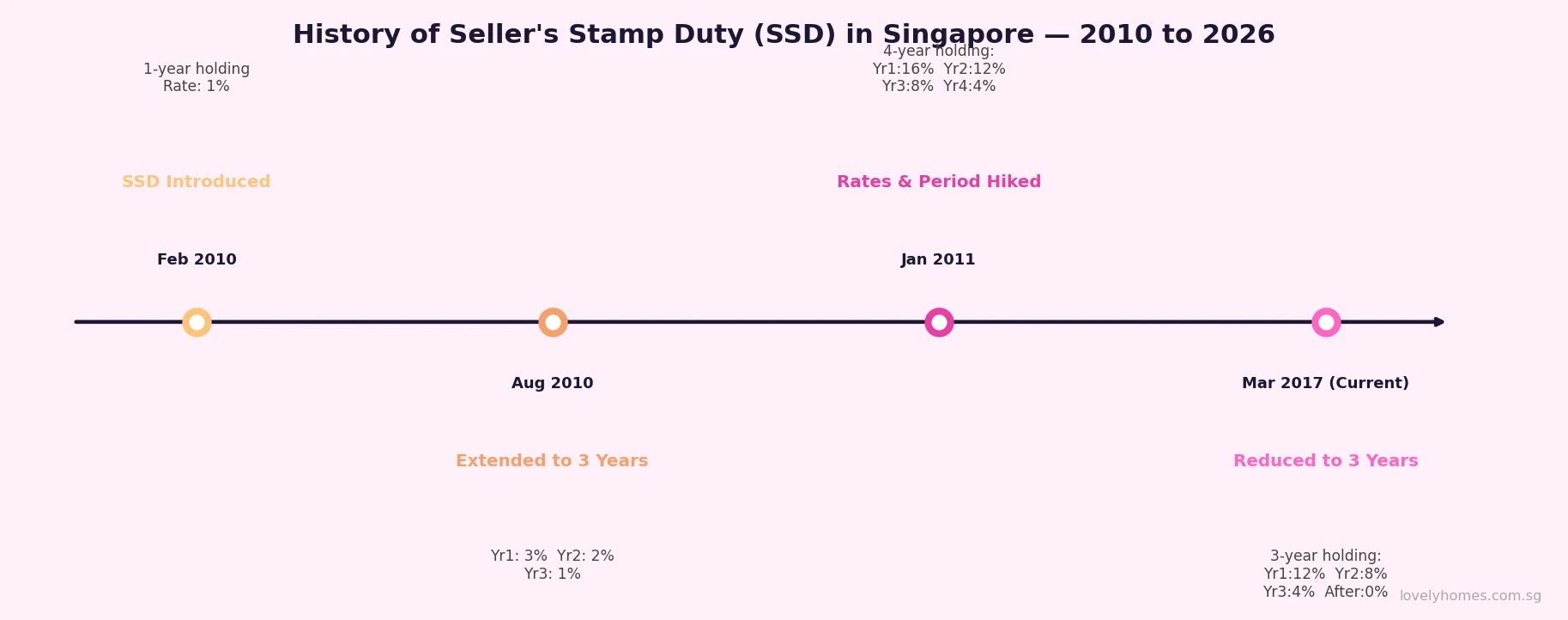
  • Prior regime (properties acquired 14 Jan 2011–10 Mar 2017): 4-year holding period, rates of 16% / 12% / 8% / 4%.

What Is Seller’s Stamp Duty (SSD) and Why Does It Exist?

Seller’s Stamp Duty is a tax levied by the Inland Revenue Authority of Singapore (IRAS) when a property owner sells a residential property within a specified holding period after purchase. Unlike the Additional Buyer’s Stamp Duty (ABSD) — which targets the buyer — SSD targets the seller, specifically those who sell quickly after buying. The rationale is straightforward: rapid reselling of residential property is a hallmark of speculative activity. By making short-term flipping expensive, SSD reduces the incentive to buy property purely for a quick profit rather than for genuine occupation or long-term investment.

SSD was first introduced in February 2010 as part of Singapore’s broader property market cooling framework — the same suite of tools that also includes ABSD, the Total Debt Servicing Ratio (TDSR), and Loan-to-Value (LTV) limits. For a full account of how Singapore has used these levers over the years, see our Property Cooling Measures Timeline.

SSD Rates in Singapore — Current and Historical

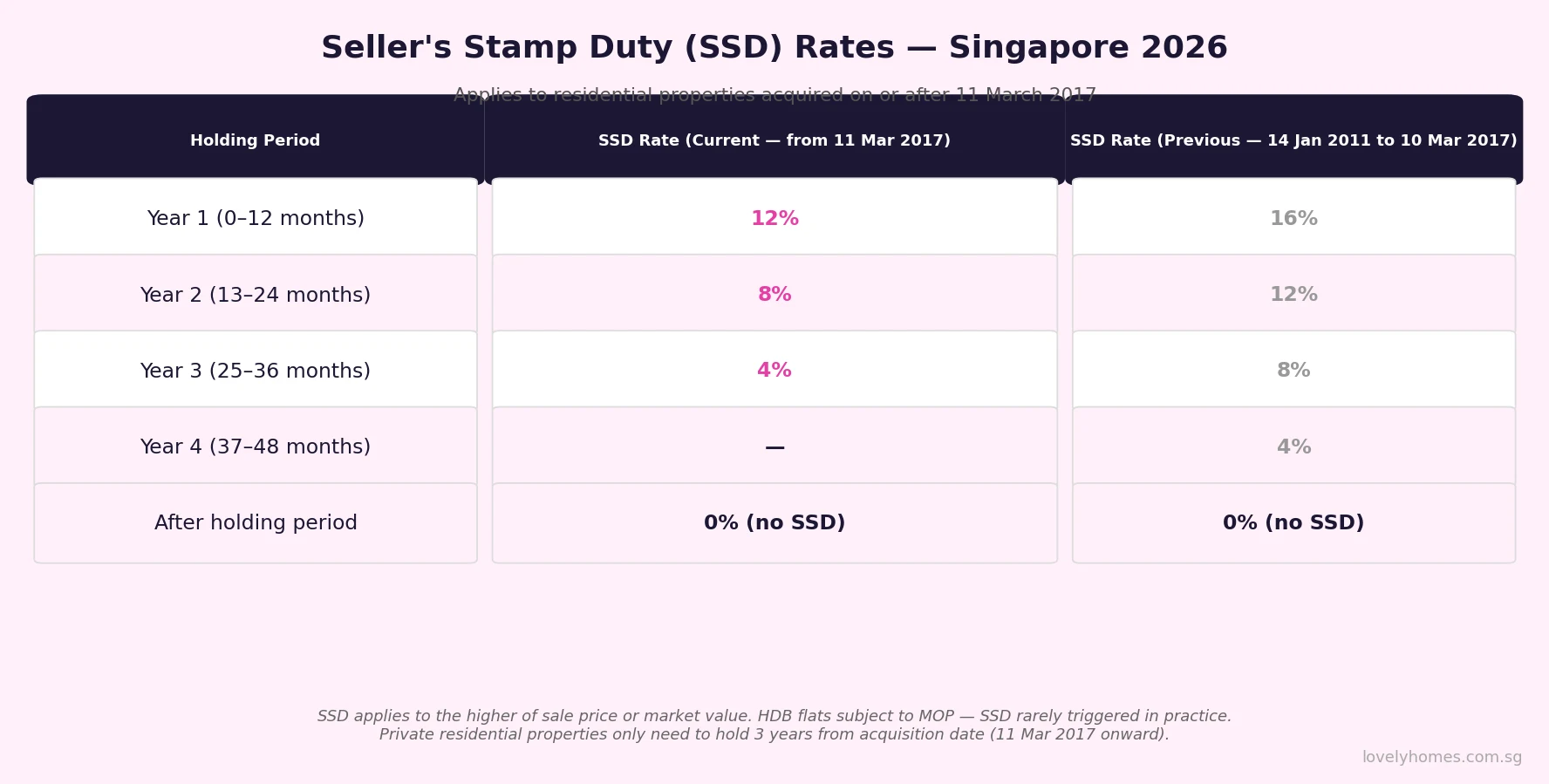
The rates below reflect the current SSD regime, which has applied to all residential properties acquired on or after 11 March 2017. Properties purchased before that date are subject to the rates in force at the time of acquisition.

Seller's Stamp Duty SSD rates Singapore 2026 by holding year — current and previous regime
Figure 1: SSD rates by holding year — current regime (from 11 March 2017) versus the previous 4-year regime (14 January 2011 to 10 March 2017). Source: IRAS.
Holding Period SSD Rate — Current (from 11 Mar 2017) SSD Rate — Previous (14 Jan 2011–10 Mar 2017)
Year 1 (0–12 months from purchase) 12% 16%
Year 2 (13–24 months) 8% 12%
Year 3 (25–36 months) 4% 8%
Year 4 (37–48 months) 4%
After holding period 0% (no SSD) 0% (no SSD)

The holding period is measured from the date of purchase — specifically, the date the Option to Purchase (OTP) was exercised, or the date of the Sale & Purchase Agreement if no OTP was used. For an uncompleted property (buying off-plan), IRAS calculates from the date of the S&P Agreement, not the TOP date.

How Much SSD Will You Pay? A Worked Example

SSD is a flat rate applied to the entire sale price or market value — whichever is higher. It is not a progressive or tiered tax.

Example: Mr and Mrs Chen (Singapore Citizens) purchased a S$1.8 million District 10 resale condominium in April 2025. In November 2026 — 19 months after purchase — they receive a job relocation offer and decide to sell. The property is now valued by IRAS at S$1.95 million.

  • Holding period: 19 months → Year 2 — SSD rate 8%
  • SSD base: higher of S$1.95M (IRAS valuation) or sale price S$1.9M → S$1,950,000
  • SSD payable: S$1,950,000 × 8% = S$156,000
  • Payment due within 14 days of the date of the sale contract.

That S$156,000 would eliminate most of the capital appreciation they had hoped to realise. This is precisely the deterrent effect SSD is designed to create.

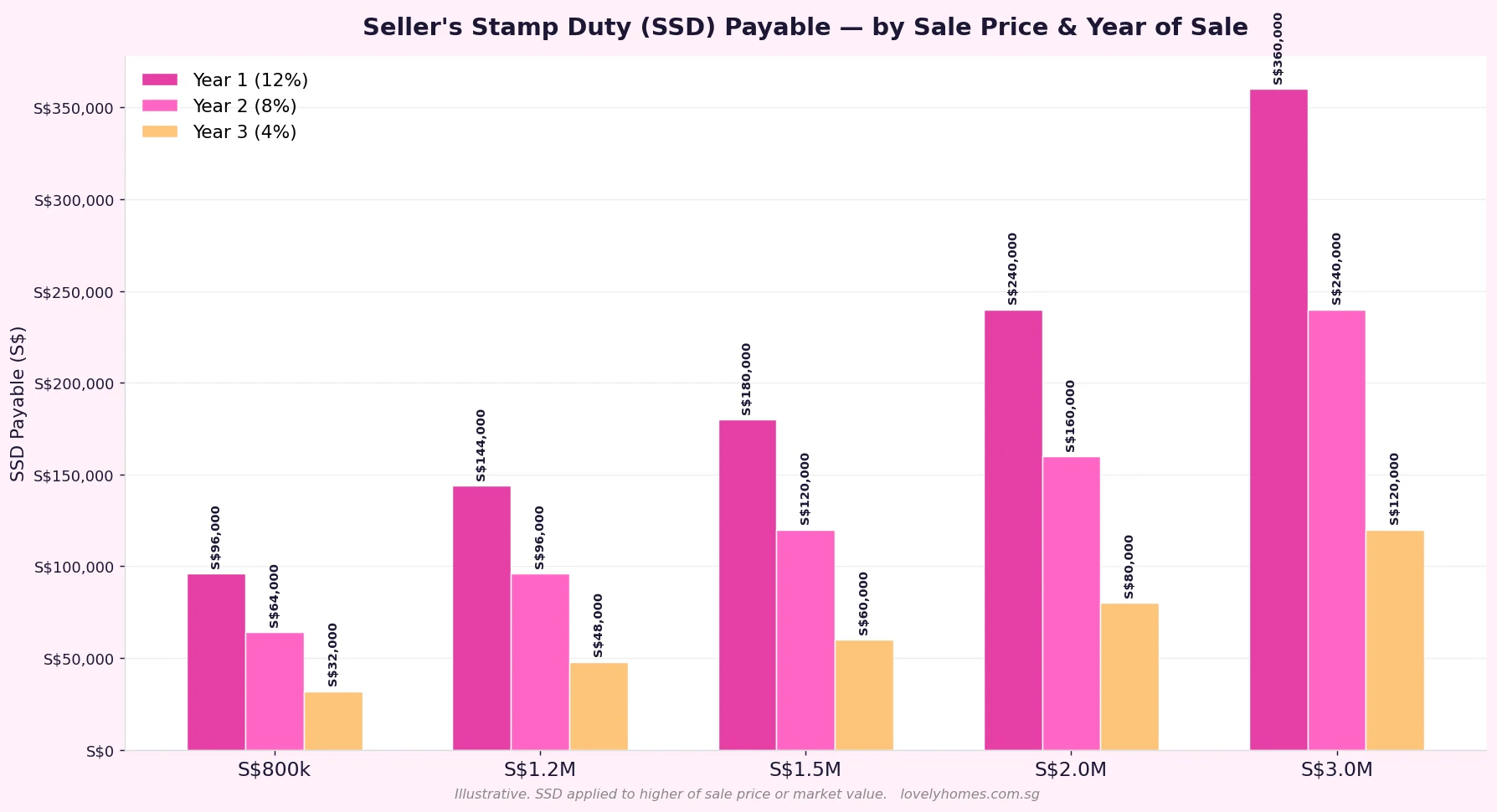
SSD payable by sale price and year of sale Singapore 2026 bar chart
Figure 2: Seller’s Stamp Duty payable by sale price and year of sale. All figures illustrative; SSD applied to the higher of sale price or market value.

Does SSD Apply to HDB Flats?

Yes — SSD applies to both private residential properties and HDB resale flats. There is no exemption for HDB sellers. However, in practice, SSD almost never applies to HDB flat sales because of the Minimum Occupation Period (MOP).

Most HDB flats — including BTO, resale, and EC purchases — require a 5-year MOP before the flat can be sold on the open market or rented out in full. Since the current SSD holding period is only 3 years, any HDB flat owner who has completed the MOP has also automatically cleared the SSD period. The SSD and MOP rules only interact in edge cases — for example, if an HDB owner obtains a special exemption to sell before MOP completion (which is rare and requires HDB approval), SSD may still apply to the transaction.

For private residential properties, there is no equivalent of the MOP, so SSD is the primary mechanism discouraging early resale.

SSD and the Different Holding Period Regimes

The holding period and rates under SSD have changed three times since its introduction. The applicable regime depends on when you purchased the property, not when you sell it:

  • Acquired on/after 11 March 2017: 3-year holding period; rates 12% / 8% / 4%.
  • Acquired 14 January 2011–10 March 2017: 4-year holding period; rates 16% / 12% / 8% / 4%.
  • Acquired 30 August 2010–13 January 2011: 3-year holding period; lower rates 3% / 2% / 1%.
  • Acquired 20 February–29 August 2010: 1-year holding period; rate 1%.
  • Acquired before 20 February 2010: SSD did not exist; no SSD payable.
History of Seller's Stamp Duty SSD Singapore timeline 2010 to 2026
Figure 3: Timeline of SSD regime changes in Singapore, February 2010 to present. Source: IRAS / Ministry of Finance.

What Transactions Attract SSD?

SSD is triggered on the disposal of a residential property within the applicable holding period. This includes:

  • Open-market resale of a private condo, landed house, or HDB resale flat.
  • Transfer of a property by way of sale (including between related parties at market value).
  • A gift of property — where IRAS deems a market value applies, SSD may be chargeable on the transferor.
  • Assignment of an OTP or S&P agreement where the sub-purchaser takes over before the property is transferred.

SSD is not triggered by:

  • Transfer of a residential property by way of inheritance or pursuant to a court order (e.g. in divorce proceedings) — though legal advice should be taken on the specifics.
  • Compulsory acquisition of land by the Government under the Land Acquisition Act.
  • Transfer between spouses pursuant to a divorce court order (subject to conditions).

Can SSD Be Avoided or Remitted?

Unlike ABSD — which has several remission schemes for qualifying buyers — there is no standard remission scheme for SSD. Once SSD is triggered, it is generally payable in full. The only legitimate ways to avoid SSD are:

  1. Hold for the full SSD period. The most reliable approach: simply do not sell within 3 years of purchase. Time your decision to sell around the anniversary of your OTP exercise date.
  2. Rely on a recognised exemption. Government compulsory acquisitions and specific court-ordered transfers may not attract SSD — take specialist legal advice.
  3. Negotiate for the buyer to absorb it. In strong markets, some sellers negotiate for the buyer to pay a higher price that effectively covers the SSD. This is a commercial negotiation rather than a legal remission.

Attempting to circumvent SSD through artificial schemes — such as inserting a related party as an intermediate buyer — is a criminal offence under the Stamp Duties Act. IRAS has the power to set aside transactions that it determines were structured to avoid stamp duty.

Selling Before the SSD Period: What to Consider

Occasionally, life events force a sale within the SSD window: a job relocation, financial hardship, divorce, or death. In such cases, SSD is generally unavoidable, but sellers should take steps to maximise their net proceeds:

  • Engage a conveyancing lawyer to confirm which SSD regime applies and calculate the exact sum due.
  • Factor SSD into your reserve price — selling for anything less than the minimum price required to cover SSD, mortgage redemption, and CPF refund (with accrued interest) will result in a cash shortfall.
  • Check whether any CPF accrued interest obligations further eat into proceeds.
  • If you are also buying a replacement property, account for the full chain of stamp duty costs: you may owe SSD on the sale and ABSD on the purchase.

SSD vs ABSD — What Is the Difference?

Feature SSD (Seller’s Stamp Duty) ABSD (Additional Buyer’s Stamp Duty)
Who pays? The seller The buyer
When triggered? Selling within the SSD holding period Buying a 2nd+ residential property (or any property as foreigner/entity)
Applies equally regardless of citizenship? Yes No — rates vary by citizenship & property count
Current rates 12% / 8% / 4% (years 1–3) 0%–65% depending on buyer profile
Remission available? Very limited Yes — married couple, developer, FTA nationals
Primary purpose Deter short-term speculation / flipping Moderate demand from investors and foreigners

What Might Come Next for SSD?

SSD was last adjusted in March 2017, when the Government reduced the holding period from 4 years to 3 years and lowered rates, signalling greater confidence in market stability. As of May 2026, there has been no indication from the Ministry of Finance or MAS of any imminent change to the SSD framework. That said, Singapore’s cooling-measures framework has historically been responsive to price pressures — if private residential prices were to accelerate meaningfully, a tightening of SSD (or other measures) cannot be ruled out. For up-to-date guidance, monitor IRAS and the Ministry of Finance.

Frequently Asked Questions

Is SSD payable on the sale price or the market value?

SSD is calculated on the higher of the actual sale price or the market value of the property at the time of sale, as determined by IRAS. If you sell a property at a price below its market value — for example, in a family transfer — IRAS will use the market value for the SSD calculation. This prevents sellers from artificially suppressing prices to reduce their SSD bill.

Does SSD apply to commercial or industrial property?

No. SSD applies only to residential properties — private condominiums, landed houses, HDB resale flats, and executive condominiums. Commercial shophouses, office units, industrial buildings, and pure-land plots are not subject to SSD. This is one reason some investors prefer commercial or industrial assets for shorter-term investment horizons.

When must SSD be paid after signing the sale contract?

SSD must be paid within 14 days of the date of the document that triggers the duty — typically the sale contract or the transfer document. Your conveyancing lawyer will stamp the document and collect the SSD as part of the closing process. Late payment attracts penalties and interest under the Stamp Duties Act.

I inherited a property less than 3 years ago. Do I pay SSD if I sell it?

A property acquired by way of inheritance is not a purchase — it is a transmission on death. IRAS’ position is that where a property is acquired through inheritance, the SSD holding period does not apply in the same way as a purchase. However, if the estate purchased the property (rather than having long held it), the executor’s position can be complex. You should seek specific advice from a conveyancing solicitor familiar with stamp-duty rules before proceeding with any sale of an inherited property.

Can I use CPF to pay SSD?

No. Stamp duties — including SSD and ABSD — cannot be paid directly from your CPF Ordinary Account. They must be settled in cash. Before committing to a sale within the SSD window, ensure you have sufficient liquid funds to cover the SSD liability on top of all other closing costs (agent commission, legal fees, mortgage redemption penalty if any).

My property was purchased jointly with my spouse. How does SSD apply?

For jointly owned property, SSD is assessed on the entire transaction — not split between owners. Both joint tenants or tenants-in-common are jointly and severally liable for the SSD. The holding period is measured from when the property was originally acquired. If you are selling a jointly owned property and the holding period has not expired, both parties must factor in the full SSD liability when planning the sale.

Does SSD apply to the sale of a new launch (uncompleted) condo?

Yes, but the holding period starts from the date of the Sale & Purchase Agreement (the date you signed the S&P with the developer), not the TOP date. This means that if you bought an uncompleted project in 2024 and it TOPs in 2027, you may already be past the SSD window by the time you are able to sell. However, some buyers who assigned or sub-sold their S&P agreements before completion have historically triggered SSD on the assignment — IRAS treats such assignments as a disposal.

Related Articles

Disclaimer

This article is for general informational purposes only and does not constitute legal, tax, or financial advice. SSD rates and rules are set by the Inland Revenue Authority of Singapore (IRAS) and are subject to change. The worked examples and figures in this article are illustrative only and do not constitute a valuation or legal opinion. Before entering into any property transaction — particularly one that may attract SSD — you should consult a licensed conveyancing solicitor, a certified financial planner, and verify the current position directly with IRAS.

×

Click anywhere or press Esc to close

En-Bloc Sale Process Singapore 2026: A Homeowner’s Step-by-Step Guide

En-Bloc Sale Process Singapore 2026: A Homeowner’s Step-by-Step Guide

En-bloc sale process Singapore 2026 hero
En-Bloc Sale Process Singapore 2026 — what every owner should know before voting yes or no.

Quick Answer

  • An en-bloc (collective) sale is when the majority of owners in a strata development sell the entire site to a single buyer, normally a developer planning redevelopment.
  • The legal framework is the Land Titles (Strata) Act 1967 (Cap. 158) and the regulator is the Strata Titles Board (STB).
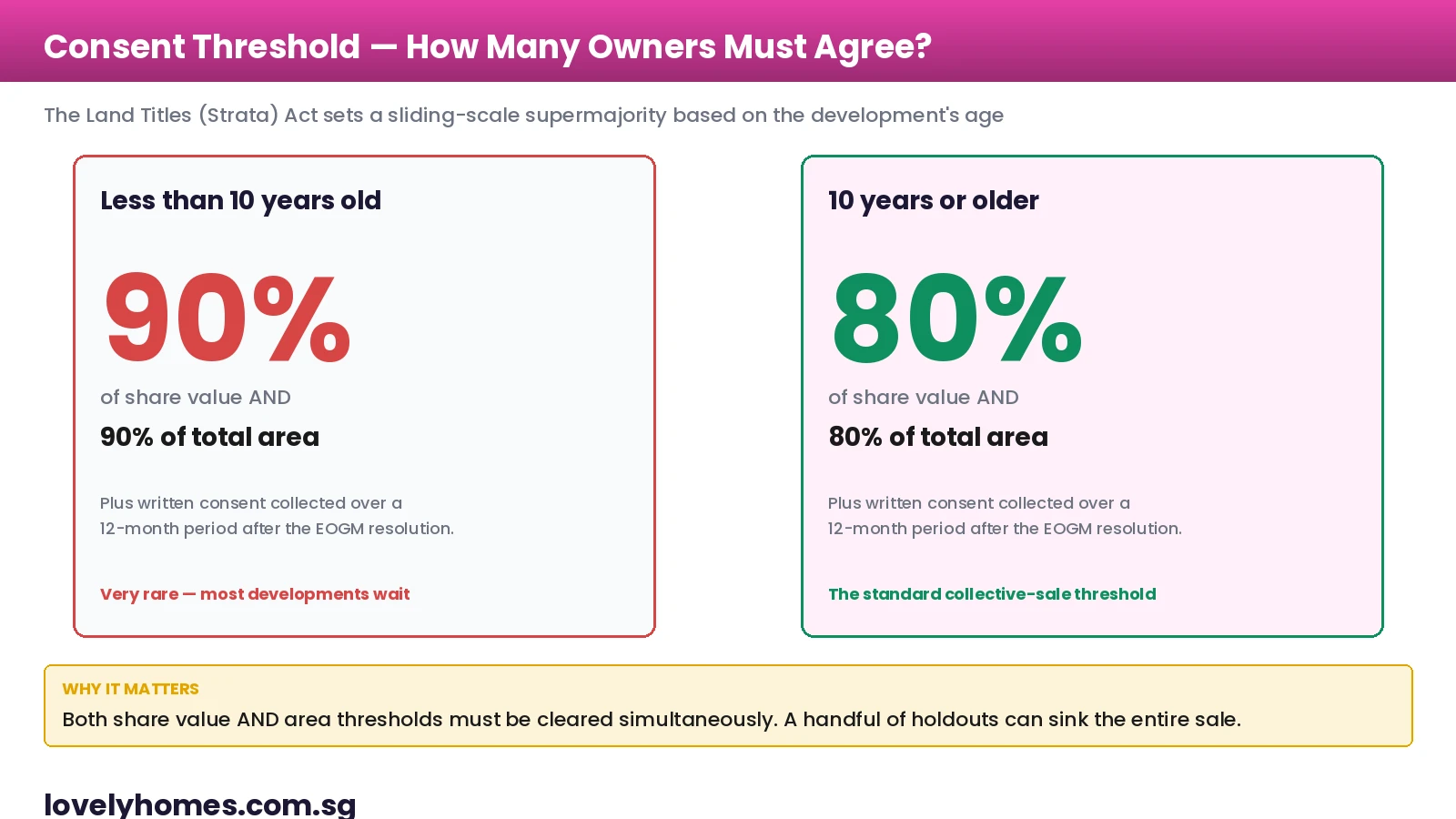
  • The consent threshold is 80% of share value AND 80% of total area for developments at least 10 years old; 90%/90% for younger developments.
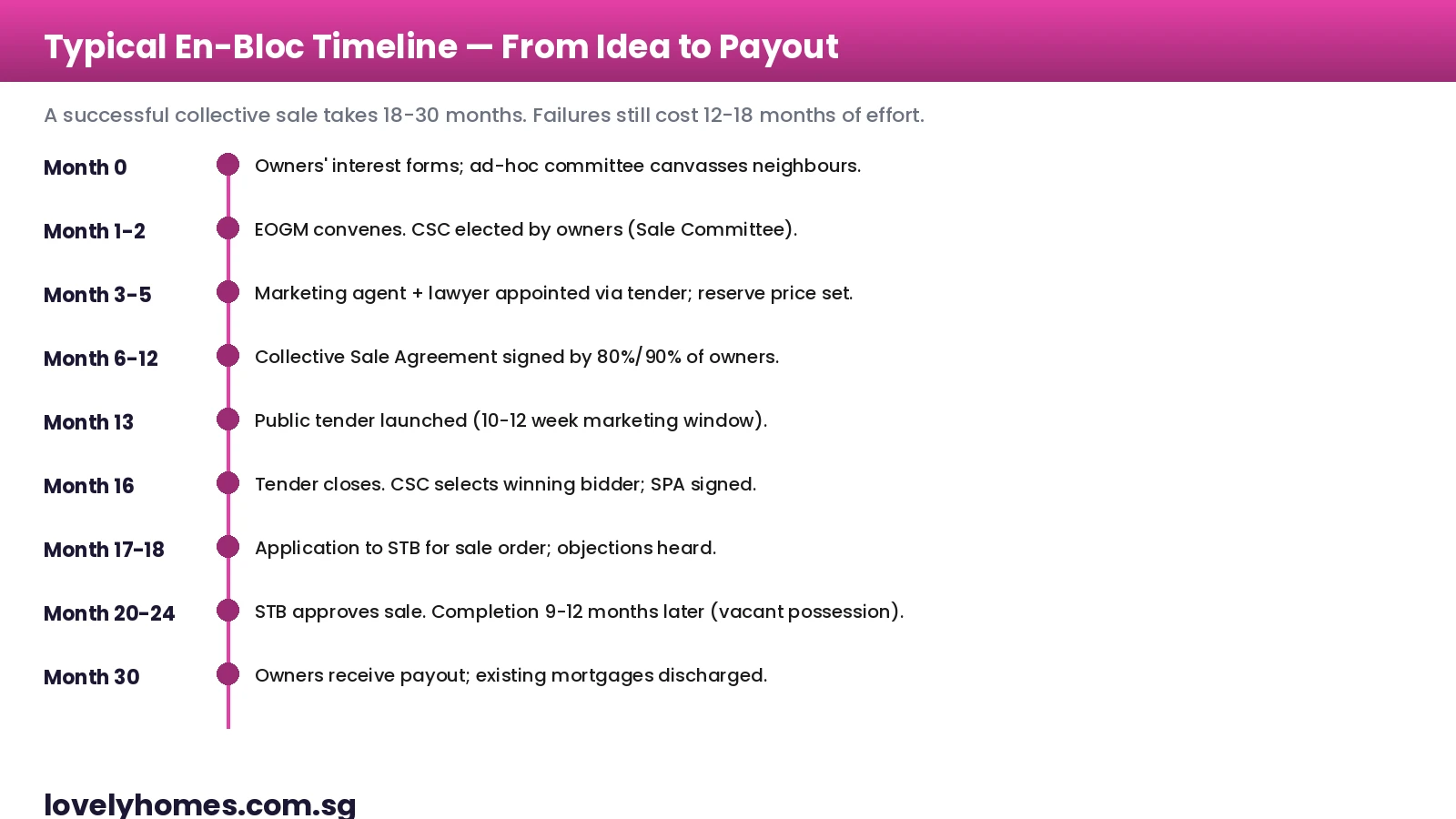
  • The full process from idea to payout takes 18 to 30 months if everything goes well; failed attempts still consume 12-18 months of effort.
  • Owners must elect a Sale Committee (CSC) at an EOGM. The CSC appoints a tender consultant and a lawyer through a competitive tender.
  • Loyang Valley sold for S$880m in March 2026 — the largest residential en bloc since Thomson View. Activity is otherwise subdued; only two residential collective sales completed in 2025.
  • Owners pay no stamp duty on the sale itself but ABSD applies on any replacement property; consider lease decay, tax leakage and the ABSD trap before voting yes.

What an En-Bloc Sale Actually Is

An en-bloc — short for “en bloc” — sale is a collective sale of every unit in a strata-titled development to a single buyer. Once the supermajority of owners agree and the Strata Titles Board approves the sale, the ownership of the entire estate transfers and the development is typically demolished and rebuilt at a higher density. The Singapore framework sits between two competing public-policy goals: protecting individual owners’ property rights, and freeing up well-located but ageing land for renewal so the city can densify.

The mechanism was created by the Land Titles (Strata) Act 1967 and significantly tightened in 1999 and again in 2007 after a wave of acrimonious sales. The current law gives owners robust procedural rights — STB scrutiny, mediation, the right to be heard — but the underlying economic deal is binary: 80% (or 90%) of share value and area must agree, and the remaining minority is then bound by the supermajority’s decision.

En-bloc consent threshold 80 percent 90 percent Land Titles Strata Act
Figure 1: The two consent thresholds set by the Land Titles (Strata) Act.

Who Initiates an En-Bloc Attempt?

Almost every successful collective sale begins with a small group of owners — usually two to five — who privately agree the development is undervalued, ageing, and primed for redevelopment. They circulate a paper at the next AGM, gauge interest informally, then call for an Extraordinary General Meeting (EOGM) to authorise the formation of a Collective Sale Committee.

The CSC is elected by simple majority and is bound by strict statutory duties of good faith. It must consist of at least three owners, ideally with a mix of demographics — younger families, retirees, investor-owners — so the committee credibly represents the development. The CSC is not paid; members serve voluntarily, although the tender consultant’s fee (between 0.5% and 1.0% of the sale price) is a substantial professional cost that comes out of the proceeds.

The Numbers That Decide Everything

An en-bloc sale lives or dies on two consent percentages and two financial numbers.

The consent percentages. These come from the Sixth Schedule of the Land Titles (Strata) Act. Below 10 years old, you need 90% of share value and 90% of total area. From the 10th anniversary onwards, the threshold drops to 80%/80%. Both numbers must clear simultaneously, calculated against the date the last owner signs the Collective Sale Agreement (CSA). The CSC has up to 12 months from launch to collect the signatures.

The reserve price. This is the lowest price the CSC is authorised to accept on the public tender. Set it too high and the tender fails outright; set it too low and minority owners can credibly argue at STB that the CSC did not act in good faith. The reserve price is supported by an independent valuation report from a SISV-accredited valuer and is normally pegged to a “redevelopment land value” benchmarked off recent comparable GLS bids.

The breakeven psf. This is the developer’s target — purchase price plus 35% land ABSD plus construction plus financing plus a target margin, divided by the gross floor area allowed by URA. If the breakeven psf comes out higher than what new launches in the same micromarket are achieving, no developer will bid.

The payout per unit. This is what each owner receives, calculated by a formula in the CSA — usually a hybrid of strata-area weighting, share-value weighting, and a uniform per-unit premium. The CSA must specify the formula on day one; you cannot change it after signing.

En-bloc collective sale timeline Singapore 18 to 30 months
Figure 2: A typical 30-month timeline from EOGM to payout.

The Process Step by Step

Step 1 — Preliminary canvassing (Months 0-2). Informal interest forms; CSC elected at EOGM by simple majority; statutory affidavits filed.

Step 2 — Professional appointments (Months 3-5). CSC tenders the tender consultant appointment and the lawyer appointment. Both run on a no-deal-no-fee or lightly weighted fixed-fee basis. Parallel valuation engagement; reserve price drafted and agreed.

Step 3 — Collective Sale Agreement (Months 6-12). The CSA is the master contract that all consenting owners sign. It contains: the reserve price, the apportionment formula, the tender-consultant fees, the legal fees, the powers granted to the CSC, the cooling-off period (5 days), and the time-bar for revocation. STB will scrutinise this document closely.

Step 4 — Public tender (Months 13-16). The tender consultant runs a 10-12 week tender. Developers submit sealed bids. The CSC selects the highest acceptable bid above the reserve price; a Sale & Purchase Agreement (SPA) is then signed with the winning bidder, normally subject to STB approval.

Step 5 — STB application and hearing (Months 17-24). The CSC files Form 1 with the Strata Titles Board within four weeks of the SPA. STB serves notice on every owner; objecting minority owners may file written objections. Mediation typically follows; if no settlement, a contested hearing.

Step 6 — Completion and payout (Months 25-30). Once STB issues a sale order, vacant possession is delivered (typically 9-12 months later). Each owner’s outstanding mortgage and CPF Accrued Interest are repaid first; the net proceeds are then released to the owner.

Worked Example — Distributing a S$880m Sale

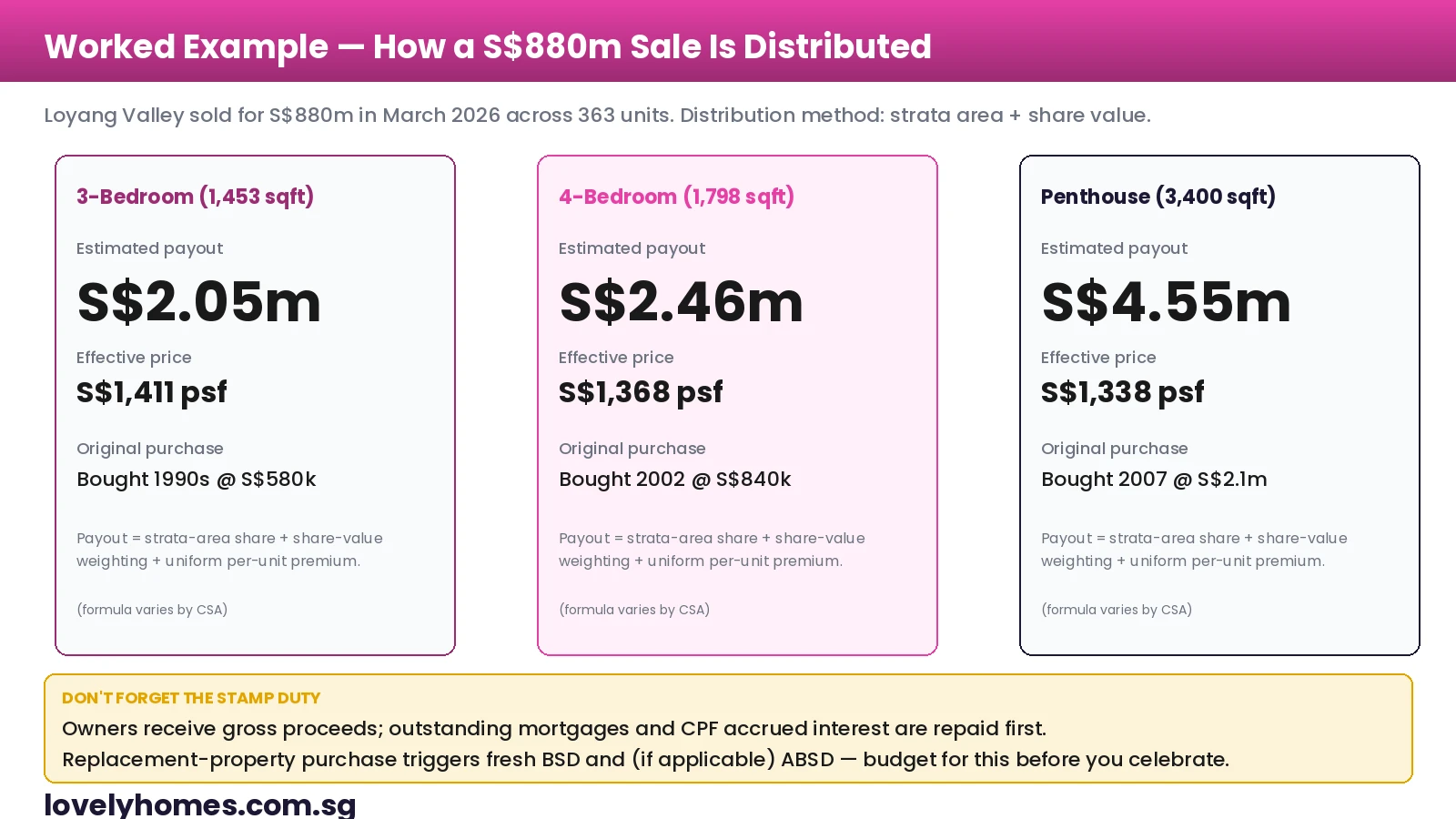
Loyang Valley, the 363-unit Yio Chu Kang Road development that sold to SingHaiyi for S$880m in March 2026, illustrates the payout mechanics. The CSA used the standard hybrid formula: roughly 50% weighting on strata floor area and 50% on share value, with a small uniform per-unit premium. A 1,453 sqft three-bedder bought in the early 1990s at around S$580,000 walked away with approximately S$2.05m gross — a 3.5x return on the original purchase before adjusting for inflation. A 3,400 sqft penthouse received roughly S$4.55m.

The gross numbers are the headline, but the math owners actually care about runs net. Outstanding mortgage and CPF Accrued Interest are repaid before any cash leaves the lawyer’s escrow account. CPF Accrued Interest in particular has been compounding at 2.5% for decades, so an owner who used S$200,000 of CPF in 1995 is now seeing roughly S$590,000 deducted at completion.

En-bloc payout distribution worked example Loyang Valley S$880m
Figure 3: Three sample units inside Loyang Valley and what each owner received.

The ABSD Trap That Catches Replacement Buyers

The single most common surprise for en-bloc sellers is the Additional Buyer’s Stamp Duty bill on their replacement property. Owners assume the en-bloc sale and the replacement purchase are the “same transaction”; the law says they are not. Once the en-bloc completes and the proceeds land, you are a Singapore citizen buying your second property — which currently attracts 20% ABSD on the new purchase price.

The remission you may be thinking of is for married couples buying a single matrimonial home: provided you sell your first property within six months of the new purchase, the ABSD on the second property is refunded. But the en-bloc payout schedule (typically 9-12 months for vacant possession) means the existing flat is sometimes not fully extinguished by the time you have committed to the new home. Sequence the purchase carefully and consult a conveyancing lawyer before signing the Option to Purchase on a replacement.

Why En-Bloc Activity Is Subdued in 2026

The market in 2025-2026 has been notably quiet, with only two successful residential collective sales completing in 2025 and Loyang Valley headlining the early-2026 cycle. Three structural forces are at work.

Land ABSD at 35%. Developers buying en-bloc sites pay 35% ABSD on the land cost (with a 5-year remission if all units in the new development are sold within five years of the date of contract). On a S$700m site that is S$245m of upfront cash. Combined with construction inflation, the breakeven psf for redeveloped units is S$2,800-3,200 — uncomfortable in many OCR submarkets.

Abundant GLS supply. The 1H 2026 Government Land Sales programme is large. Developers prefer GLS sites because they are pre-zoned, free of strata-title messiness, and avoid the ABSD payable on en-bloc land. Anecdotally, the same developer often will not bid for both a collective sale and a parallel GLS tender; they pick one.

Owner expectations. Owners have watched their estates rise at 5-7% per annum on the URA Property Price Index and now expect en-bloc premiums of 20-30% over individual market value. Developers can rarely price that.

Pros and Cons for the Individual Owner

Pros Cons
Premium of 20-40% over individual market value (when conditions are right) Time and emotional cost — 18-30 months of meetings and uncertainty
Liquidity event for older owners with most of their wealth tied up in the home Forced relocation; very few replacement options at the same psf in mature estates
Resets the lease clock — buyer normally redevelops on a fresh 99-year tenure ABSD bill on replacement property if not sequenced carefully
Releases capital that may be redeployed into smaller, newer or yield-bearing assets CPF Accrued Interest has compounded for decades; net cash often less than expected
Avoids ageing-estate maintenance levies and lift/cladding upgrades For minority objectors, the supermajority decision is binding once STB approves

What Minority Objectors Can Actually Do

If you are in the 20% who voted no, your statutory protections are real but narrow. You may file a written objection at the STB hearing on grounds set out in section 84A(7) of the Land Titles (Strata) Act: that the transaction is not in good faith having regard to the sale price, the method of distribution of the proceeds, or the relationships between the parties. You may also object on the grounds that the proceeds will be insufficient to redeem your outstanding mortgage and CPF — STB has historically given weight to genuine financial hardship in this scenario.

What you cannot do is force a higher sale price or insist on staying. If STB rules the sale was made in good faith, you must convey within the SPA’s completion period. Costs of objection are usually modest because STB is meant to be accessible to lay parties, but engaging a property lawyer is strongly recommended.

What Might Come Next

The en-bloc cycle in Singapore tends to swing on five-year horizons. The 2017-2018 cycle saw 38 successful sales in 18 months before cooling-measure tightening squeezed it. The 2021-2022 cycle saw a smaller wave. The current 2025-2026 cycle is so far measured in single-digit completions per year. The next significant catalyst would be either a meaningful cut in land ABSD for collective-sale sites, or a cut in the 80%/80% threshold to 75%/75% — both have been floated by industry but neither is on the legislative pipeline as of April 2026.

For owners in eligible developments, the practical advice is to sequence the conversation rather than wait for a perfect cycle. The base rate of CSCs that achieve a successful sale on the first attempt is below 30%, so plan for the long arc. For developers, sites with low plot ratios that can be uplifted under the latest URA Master Plan remain the only consistently viable plays.

Frequently Asked Questions

What is the difference between an en-bloc sale and a collective sale?

The two terms are used interchangeably in Singapore. “En bloc” is the historic French legal term that appears in older case law; “collective sale” is the term used in the Land Titles (Strata) Act and STB’s published forms. The mechanism is identical: the supermajority of owners selling the whole development as one parcel.

Can I refuse to sign the Collective Sale Agreement?

Yes. Signing the CSA is voluntary. If you do not sign, you are simply not part of the consent percentage. However, if the supermajority is achieved without you and STB approves the sale, you are still bound by the order to convey your unit at the apportioned price — refusal to sign the CSA only removes your voice from the proceeds-distribution negotiations, not your obligation to convey.

How is the share value of my unit calculated?

Share value is fixed at the time the development is granted strata title and is recorded in the strata roll held by the MCST. It is broadly proportional to floor area but with adjustments for unit type (penthouses and shop units typically get a slightly higher share value per sqft). You can check your share value on your management corporation’s records or on a recent maintenance-fee invoice.

What if my outstanding mortgage exceeds my en-bloc payout?

This is a “negative equity” scenario and is rare in Singapore but possible at older luxury sites where buyers paid peak prices. The mortgagee bank’s redemption is paid first; if the proceeds are insufficient, you owe the bank the shortfall. STB has historically given some weight to genuine financial hardship objections under section 84A(7) but cannot order a higher price.

Do I have to pay stamp duty on the en-bloc sale?

No. The en-bloc seller pays no stamp duty on the sale itself — stamp duty (BSD and, where applicable, ABSD) is payable by the buying developer on the purchase price. However, you do pay BSD and possibly ABSD on any replacement property you purchase. Plan the timing so that the matrimonial-home ABSD remission applies to the new purchase if you qualify.

Can the tender consultant guarantee a successful sale?

No, and any agent who promises one should be avoided. The tender consultant’s role is to run a competitive tender, advise on the reserve price, and prepare the marketing pack. Whether developers actually bid above the reserve depends on market conditions, the development’s location and density potential, and prevailing land ABSD rates. Fees are typically structured as no-deal-no-fee precisely because of this uncertainty.

What happens to my tenants if my unit is going through an en-bloc sale?

Existing tenancies survive the change of ownership but the new buyer (the developer) is unlikely to renew them. Most tenancies have a “redevelopment” or “early termination” clause anyway. If yours does not, the tenant is entitled to remain until the lease expiry; the developer will typically negotiate an early-termination payment to deliver vacant possession.

Disclaimer. This article is general information about en-bloc and collective-sale procedure in Singapore as at 29 April 2026. It is not legal, tax, valuation or financial advice. Always verify the current statutory thresholds, fees and procedures with the Strata Titles Board, the Land Titles (Strata) Act, and your own licensed property lawyer or tender consultant before voting on a Collective Sale Agreement.

Inheriting Property in Singapore 2026: Probate, Stamp Duty & Estate Planning Essentials

Inheriting Property in Singapore 2026: Probate, Stamp Duty & Estate Planning Essentials

Inheriting property in Singapore is one of those events most families confront only once or twice in a lifetime. The legal mechanics are forgiving compared with the United Kingdom or the United States — Singapore has no estate duty, no inheritance tax, and no capital-gains tax on residential property — but the process is still demanding. The deceased’s estate must clear probate, the heir must understand how the property fits into their existing ABSD count, and several stamp-duty deadlines run from the date of death rather than the date of transfer. Get any of these wrong and you can either lose months of clear title or unwittingly trigger ABSD on a future purchase.

This 2026 guide walks the entire journey end to end — what happens whether or not the deceased left a Will, the statutory shares set by the Intestate Succession Act, the typical costs of probate, the stamp-duty position on transfer to the heir, and the all-important interaction with ABSD on the heir’s next property purchase. All figures and rules below reflect Singapore’s position as of 29 April 2026. For the live position, always check Family Justice Courts, the Intestate Succession Act, and IRAS Stamp Duty.

Quick Answer — inheriting property in Singapore

  • Singapore abolished estate duty for deaths from 15 February 2008. There is no longer an inheritance tax.
  • The deceased’s estate goes through probate (with a Will) or Letters of Administration (without one).
  • Without a Will, the Intestate Succession Act (ISA) sets statutory shares between spouse, children and parents.
  • Transfer of property to the heir is a transmission, not a sale — no BSD or ABSD on that transfer.
  • BUT — the inherited property counts toward the heir’s property tally for ABSD on their next purchase.
  • Joint-tenancy property passes automatically by survivorship — outside the Will or ISA.
  • HDB flats follow extra rules — only Singapore Citizen/PR family members who meet eligibility can inherit and remain in occupation.

The Two Pathways: With a Will and Without

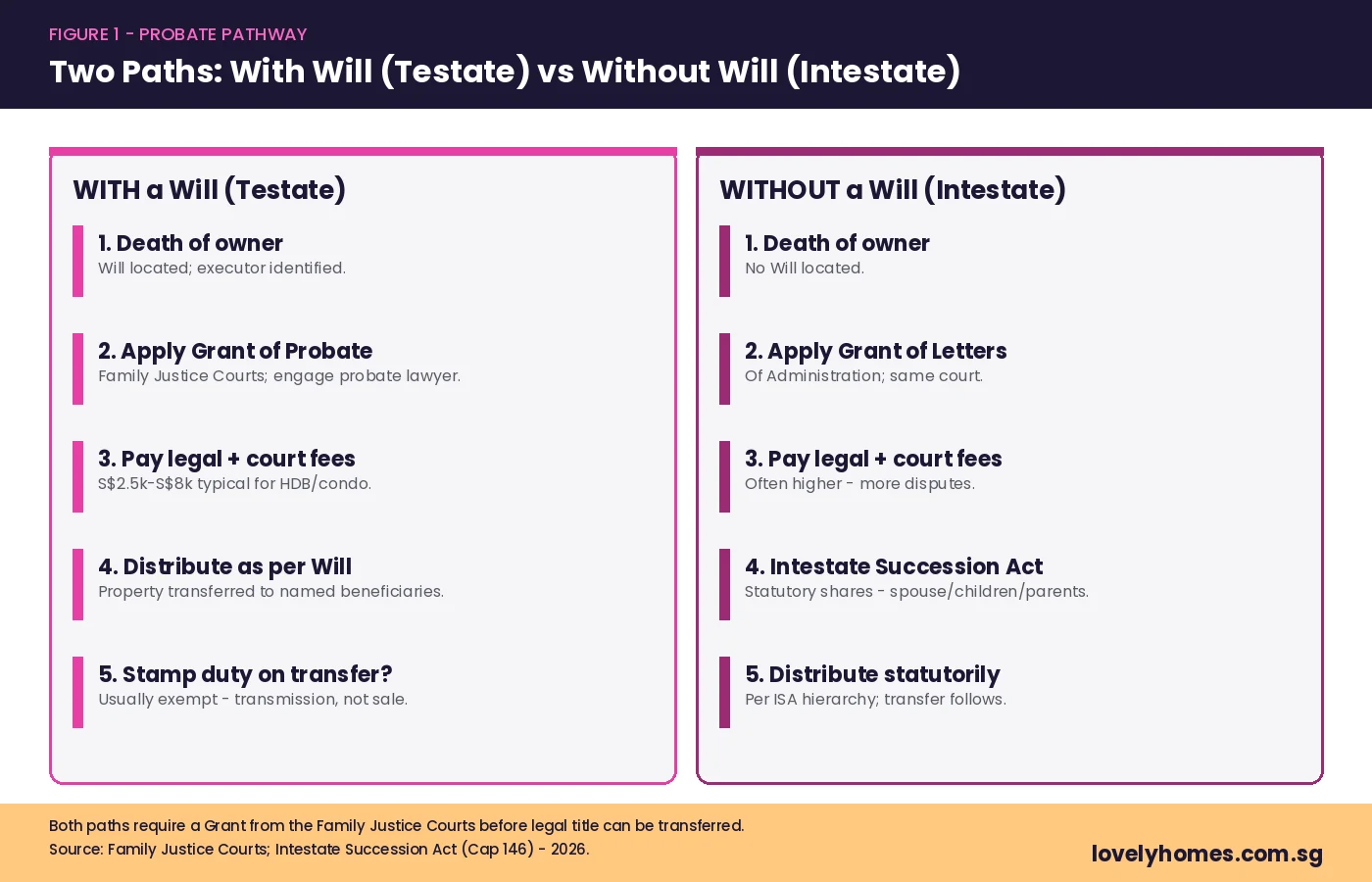
The first question after a death is the same one solicitors ask: was there a Will? The answer determines which application the executors or family must make to the Family Justice Courts, who has standing to administer the estate, and how the property is ultimately divided.

Probate pathway diagram - testate vs intestate inheritance Singapore 2026
Figure 1: The two pathways for inheriting property in Singapore. Both end with the property being transmitted into the heir’s name once the Court issues the Grant.

With a Will (Testate Succession)

If the deceased left a valid Will, the named executor applies to the Family Justice Courts for a Grant of Probate. The Will dictates who inherits the property — the executor’s job is to carry out those instructions after settling the estate’s debts. For a clean estate (no caveats, no contests, full documentation), a Grant of Probate is typically issued within 4–8 weeks. Probate fees range roughly S$3,000 to S$8,000 in legal costs for a single residential property, plus court filing fees of a few hundred dollars.

Without a Will (Intestate Succession)

Where there is no Will, the next-of-kin applies for a Grant of Letters of Administration. The applicant administers the estate and distributes it according to the statutory shares set out in the Intestate Succession Act (ISA). Letters of Administration take longer than probate — typically 8–16 weeks — because the Court must satisfy itself who is entitled to apply, what the estate consists of, and that no contest exists. Where the estate is over S$5 million or contains foreign assets, the timeline extends materially.

Joint-Tenancy — The Quiet Third Path

For property held by spouses as joint tenants, the surviving spouse takes the deceased’s share automatically by survivorship — outside the Will, outside the ISA, and outside probate altogether. The surviving spouse simply lodges a Notice of Death with the Singapore Land Authority (SLA) along with the death certificate, and the title is updated. This is the cleanest of the three pathways. By contrast, tenancy-in-common property passes through the Will or the ISA like any other estate asset. For the difference, see our Joint Tenancy vs Tenancy in Common Singapore 2026 guide.

The Intestate Succession Act — How an Estate Without a Will Is Split

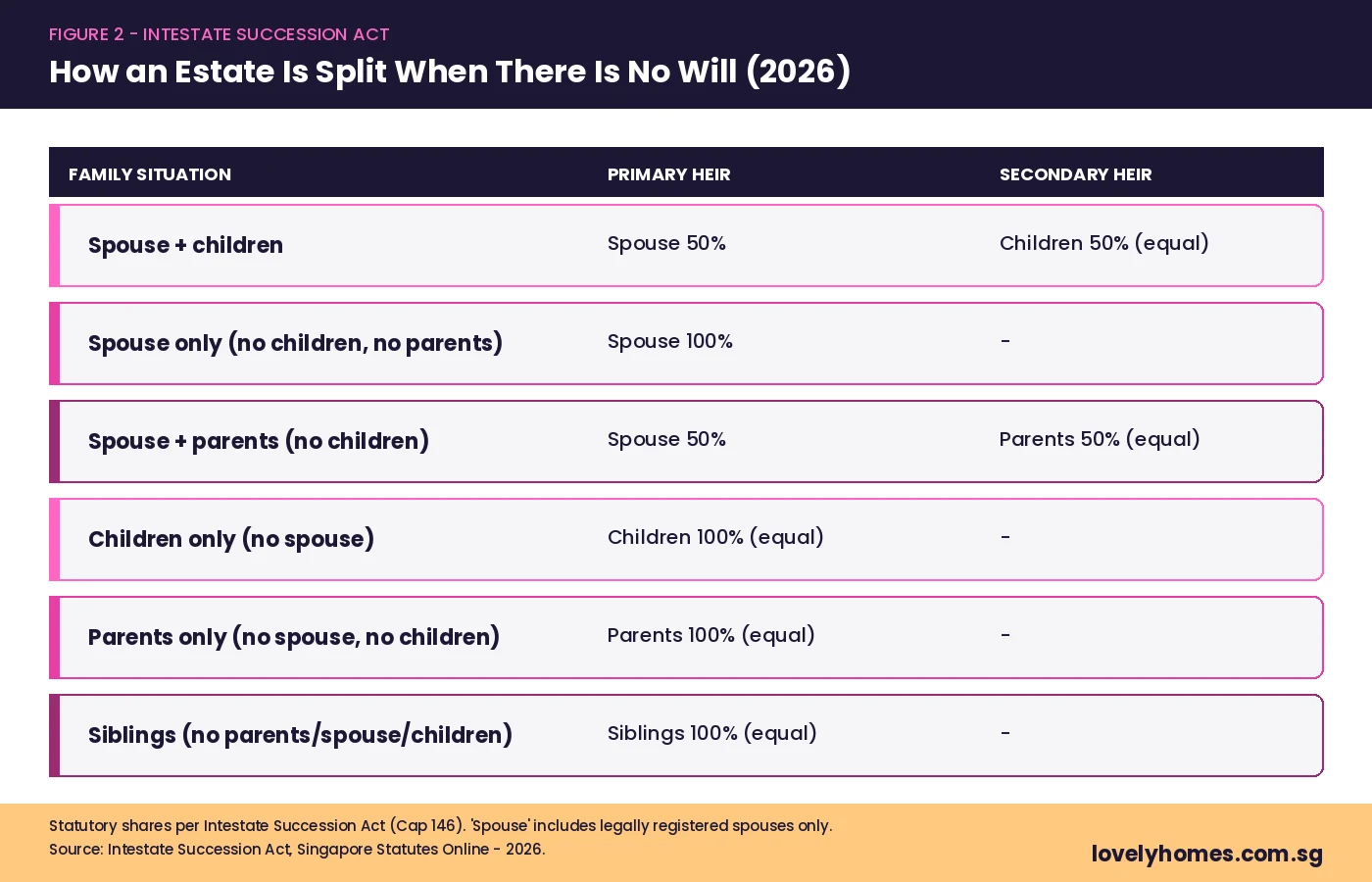
If you die intestate (without a Will) and you are domiciled in Singapore, the Intestate Succession Act (Cap 146) determines exactly who gets what. The Act is gender-neutral but assumes a fairly traditional family structure — spouse, children, parents, siblings — in that order of priority.

Intestate Succession Act statutory shares chart for 2026
Figure 2: Intestate Succession Act statutory shares, 2026. Where there is no Will, distribution follows the Act’s strict order.
Family Situation Statutory Distribution
Spouse + children Spouse 50%; children 50% (split equally between children)
Spouse only (no children, no parents) Spouse takes 100%
Spouse + parents (no children) Spouse 50%; parents 50% (equally)
Children only (no spouse) Children 100% (equal shares per stirpes)
Parents only (no spouse, no children) Parents 100% (equally)
Siblings (no parents, no spouse, no children) Siblings 100% (equally)
No surviving immediate or extended family Estate goes to the Singapore Government (bona vacantia)

Two practical points worth highlighting. First, “spouse” in the Act means a legally registered spouse only — long-term partners, fiancés, and ex-spouses are excluded, no matter how long the relationship. Second, step-children are not statutory heirs unless legally adopted. If you have a blended family, you almost certainly need a Will — the ISA will not deliver the outcome most blended families assume.

HDB Inheritance — Special Rules That Override the General Position

HDB flats are not just real estate — they are part of Singapore’s public housing system, with eligibility rules that override the general law of succession. When a HDB owner dies, the flat does not simply transfer to the heir named in the Will or the ISA share — HDB still has to approve who can inherit and remain in the flat. The rules are roughly:

  • The heir must be Singapore Citizen or PR. Foreigner heirs cannot inherit and remain on title for an HDB flat.
  • The heir must satisfy HDB’s family-nucleus or single-buyer eligibility. A 28-year-old single child cannot inherit the flat outright until age 35 under the Single Singapore Citizen Scheme — the flat is held in trust until then or sold on the open market.
  • Existing property by the heir matters. If the heir already owns a private residential property, HDB’s ownership rules require the heir to dispose of the private property within 6 months of the inheritance to retain the HDB flat, or vice versa.
  • The flat’s remaining MOP and SC quota apply. Inheritance does not reset the Minimum Occupation Period or trigger any quota issues, but the heir must continue to comply with rental, sublet, and EIP/SPR quota rules.

For a HDB-specific deep-dive, our How to Sell an HDB Flat 2026 guide covers the complications when an inherited HDB flat must be sold to fund the estate or to free the heir to remain on private property. The HDB section of the official HDB site sets out the live position.

Stamp Duty on the Inheritance — What You Actually Pay

Singapore’s tax position on inheritance is unusually generous compared with major Western jurisdictions:

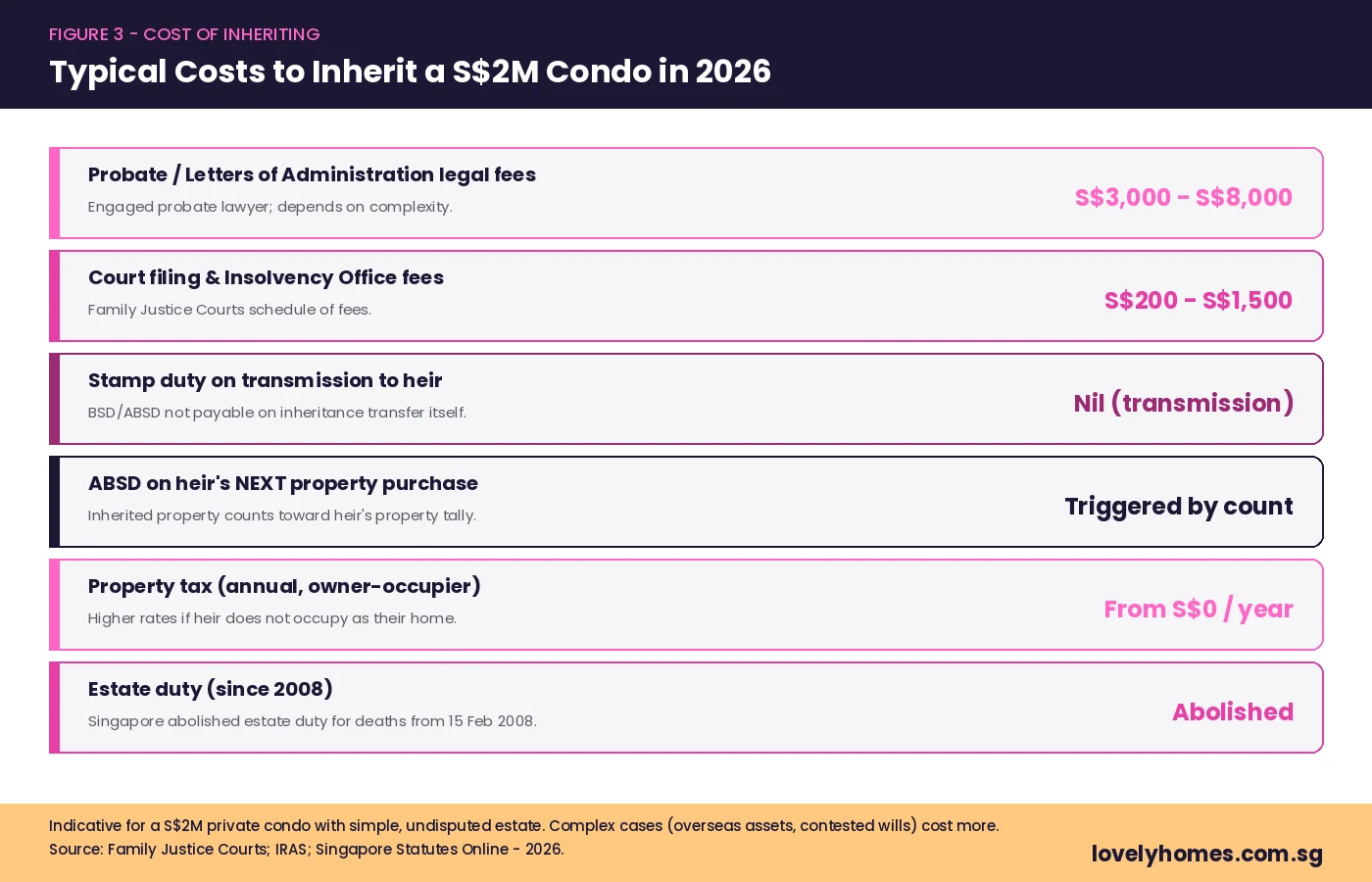
Cost breakdown of inheriting a S$2 million property in Singapore 2026
Figure 3: Indicative cost of inheriting a S$2M private condo in 2026. Singapore charges no estate duty and no BSD/ABSD on the transmission itself.

1. No estate duty since 15 February 2008

Singapore abolished estate duty for deaths occurring on or after 15 February 2008. There is no “death tax”, no “inheritance tax”, and no “estate tax” on the value of the property at the date of death. This is a major reason why Singapore is favoured by family-office structures over the UK (40% inheritance tax) or the US federal estate tax.

2. No BSD or ABSD on transmission

The transfer of the property from the deceased’s estate to the heir is a transmission — not a sale — and therefore not subject to Buyer’s Stamp Duty (BSD) or Additional Buyer’s Stamp Duty (ABSD). This is consistent with IRAS’s position that ABSD only applies on a purchase. Inheriting your parent’s flat does not, in itself, trigger any stamp-duty bill.

3. BUT — ABSD count is affected for the heir’s next purchase

Here is the trap. While the inheritance itself attracts no ABSD, the inherited property counts toward the heir’s property tally for any future purchase. A Singapore Citizen who inherits their parent’s HDB flat now owns one residential property — their next purchase will be an SC-2nd at 20% ABSD, not the SC-1st at 0%.

Heirs who are mid-purchase when the inheritance arrives need to plan carefully. A common workaround is to renounce the inherited interest in favour of another beneficiary — legally permissible under the Probate & Administration Act, provided the renunciation is done before the heir takes any benefit from the property. We strongly recommend speaking to a probate lawyer before renouncing because the implications are irreversible. For broader context on ABSD, see our ABSD Singapore Complete Guide 2026.

4. Property tax continues, billed to the new owner

The annual property tax obligation passes to the heir on transmission. If the heir occupies the property as their home, owner-occupier rates (lowest band) apply. If the heir already has another home and rents the inherited property out, IRAS will apply the higher non-owner-occupier rates. See our Singapore Property Tax 2026 guide for current rates and bands.

CPF Refund — The Easily-Missed Step

If the deceased used CPF to fund the property, the principal sum used plus accrued interest must be refunded to their CPF account on transfer. The CPF refund is paid to the deceased’s estate (effectively to the named CPF nominees, if any, or otherwise distributed by the executor). This is not a tax — it is the final clearing of the deceased’s CPF position. The figure can be substantial: a 4-room HDB flat that was funded with S$200,000 of CPF in 2000 might owe over S$400,000 of principal-plus-accrued-interest in 2026.

Heirs sometimes mistake this CPF refund for a charge that they have to pay personally. They do not — the refund comes out of the estate’s share of any sale proceeds, or, if the property is being retained, the estate must arrange for the refund from cash assets. The refund is a precondition for clear title and cannot be deferred.

How Long Does the Whole Process Take?

For a simple estate — one residential property, undisputed Will or clean intestacy, one or two heirs, no overseas assets — the typical journey looks like this:

Stage Typical Timeline Who Drives It
Locate Will & gather documents 1–2 weeks Family
Engage probate lawyer 1 week Family
File Grant application (probate or LA) 2–4 weeks Lawyer
Court issues Grant 2–6 weeks for probate; 8–16 for LA Court
Lodge Grant + Notice of Death with SLA 1–2 weeks Lawyer
CPF refund & outstanding loan settlement 2–4 weeks Lawyer / family
Title transmitted to heir 2–3 weeks after CPF/loan clearance SLA
Total simple estate ~3–4 months testate; ~5–7 months intestate

Contested estates, estates over S$5 million, estates with overseas immovable property, or estates where the deceased’s domicile is uncertain all add months to the timeline. Engaging an experienced probate solicitor early is the single most important action a family can take to keep the timeline on track.

A Worked Example — What Mr Tan’s Family Actually Pays

Mr Tan, a Singapore Citizen aged 78, dies in March 2026. He leaves behind:

  • A 4-room HDB flat in Bedok (held in his sole name), valued at S$650,000.
  • A S$2 million private condominium in District 15 (held jointly with his wife as joint tenants).
  • A simple Will leaving the HDB flat equally to his two adult children, both Singapore Citizens.

The flow:

  1. Condo — immediate transfer. The District 15 condominium passes automatically to Mrs Tan by survivorship. No probate, no Will, no ISA. Mrs Tan lodges the death certificate with SLA. Cost: roughly S$300 in lodgement fees.
  2. HDB flat — through probate. The executor (eldest son) applies for a Grant of Probate. Court issues the Grant in five weeks. Probate legal fees: ~S$4,500. The HDB flat is then transmitted equally to the two children. Both children are Singapore Citizens, but each already owns a private condo — under HDB rules, they cannot retain the inherited HDB flat and must dispose of either the HDB or the private property within six months. Family decides to sell the flat on the open market.
  3. CPF refund. Mr Tan had used S$280,000 of CPF (principal + accrued interest) on the HDB flat. The refund flows from sale proceeds to his CPF account, then to nominees.
  4. Sale proceeds distributed. Net of the CPF refund and S$8,000 selling costs, the remaining S$362,000 is divided equally between the two children (S$181,000 each).
  5. ABSD impact for the children. Because each child took beneficial ownership of the HDB flat before selling it, each had two residential properties on title for that brief window. Their next condo purchase will be an SC-3rd-property at 30% ABSD — not 0%. The family should have spoken to a probate lawyer about renouncing in favour of the surviving spouse, or selling the flat directly out of the estate without taking transmission.

This is the textbook example of why estate planning matters. With one Will revision — leaving the HDB flat to Mrs Tan instead — the entire ABSD complication for the children would have been avoided.

How Estate Planning Works in Singapore (Briefly)

Three estate-planning instruments do most of the heavy lifting:

  1. A valid Will. Drafted, signed, and witnessed per the Wills Act. Costs from S$300 (simple Will at a high-street firm) up to several thousand for a complex estate. The single highest-leverage action any property-owning Singaporean can take.
  2. CPF nominations. CPF moneys do not pass through the Will or the ISA — they go to nominees. Without a CPF nomination, balances go to the Public Trustee for distribution per ISA. Update CPF nominations whenever there is a major life event.
  3. Manner of co-ownership. Married couples buying property together should consciously choose between joint tenancy (survivorship transfers automatically) and tenancy in common (each owner’s share passes through their estate). The choice has profound implications for inheritance, divorce, and ABSD planning.

For an even more direct approach, large families with significant property holdings sometimes use private trusts — though Singapore’s ABSD-on-trustees position (65% on the trustee’s entity rate) means trust structures need careful structuring to avoid triggering punitive ABSD. This is well outside the scope of a general guide and demands specialist trust counsel.

What Might Come Next

Two areas to watch. First, Singapore’s policy stance on intergenerational transfer is generally favourable, but the ABSD position on inherited property has been quietly tightening since 2018. Expect IRAS to continue scrutinising arrangements where inheritance is structured to avoid ABSD — in particular “in-life gifts” and trust structures that benefit a Singapore property owner’s children. Second, the Family Justice Courts have signalled that they may digitise more of the probate process by 2027, which should compress the testate timeline below 4 weeks for simple estates. None of this is policy yet, and these paragraphs are editorial speculation only.

Frequently Asked Questions

Do I have to pay any tax when I inherit property in Singapore?

No tax is payable on the transmission itself — Singapore abolished estate duty for deaths from 15 February 2008, and no BSD or ABSD applies on a transfer that is not a sale. You will, however, pick up the annual property-tax obligation from the date of transmission, and any future purchase you make will count the inherited property toward your ABSD tally.

My parent died without a Will. Can I just sign over my share to my sibling?

Yes — this is called a Deed of Family Arrangement, signed after the Grant of Letters of Administration is issued. All ISA-statutory heirs must agree, and the deed is filed with the Court. It allows the family to redirect the estate without having to go to a full reapplication. Engage a probate solicitor to draft the deed and ensure stamp duty implications are covered.

Can I refuse the inheritance?

Yes. A beneficiary can renounce their interest under the Probate & Administration Act before taking any benefit from the property. The renunciation must be in writing and is irrevocable. Heirs sometimes do this to avoid the ABSD-count consequence of inheriting, channelling the property to a sibling who would not be affected.

What happens to the deceased’s outstanding mortgage on the property?

Most Singaporean homeowners carry Mortgage Reducing Term Assurance (MRTA) or the Home Protection Scheme (HPS) for HDB. Either policy pays off the outstanding loan on death — the heir takes the property unencumbered. If no MRTA/HPS exists, the mortgage continues and the heir must either continue servicing it (if eligible to take over the loan) or sell the property to discharge it.

If I am a Singapore Citizen and inherit a Malaysian property, do I need to declare it in Singapore?

Yes. Even though no Singapore tax is due on the inheritance itself, you must declare any overseas residential property you own when applying for ABSD remission, HDB schemes, or LBS — the Singapore Government counts overseas residential property toward eligibility tests. You will also have Malaysian filing obligations, including the Real Property Gains Tax position on any future disposal.

Can a foreigner inherit a Singapore property?

Yes for private property — foreigners can inherit and own non-restricted private residential property in Singapore, subject to the Residential Property Act for landed homes. For HDB flats, foreigners cannot inherit the flat directly — the HDB flat must be sold and the proceeds distributed instead. Engage a Singapore lawyer who deals with cross-border probate.

How much do probate lawyers cost in 2026?

For a simple estate with one residential property and no contests, expect around S$3,000–S$8,000 in legal fees (with a Will) or S$4,000–S$10,000 (without a Will, since Letters of Administration take longer and require a personal-representative bond). Court filing fees are typically a few hundred dollars more.

Related Articles

Disclaimer: This guide is for general information only and does not constitute legal, tax, or financial advice. Probate, succession, stamp duty, and HDB inheritance rules change over time and depend on individual circumstances. Always verify the live position with the Family Justice Courts, the Intestate Succession Act, the HDB website, and IRAS, and consult a Singapore-qualified probate solicitor before acting on any estate matter.

HDB Resale Levy Singapore 2026: Who Pays It, How Much, and How to Avoid It

HDB Resale Levy Singapore 2026: Who Pays It, How Much, and How to Avoid It

HDB resale levy Singapore 2026 — full guide hero image
HDB Resale Levy Singapore 2026 — who pays, when, and how to plan around it.

Quick answer — the resale levy in 30 seconds

  • The HDB resale levy is a one-off charge on second-timer households who take a second housing subsidy from HDB (BTO, Sale of Balance Flats, or a new Executive Condominium).
  • It does not apply if you sell your subsidised flat and buy on the open resale market without claiming any fresh HDB grant.
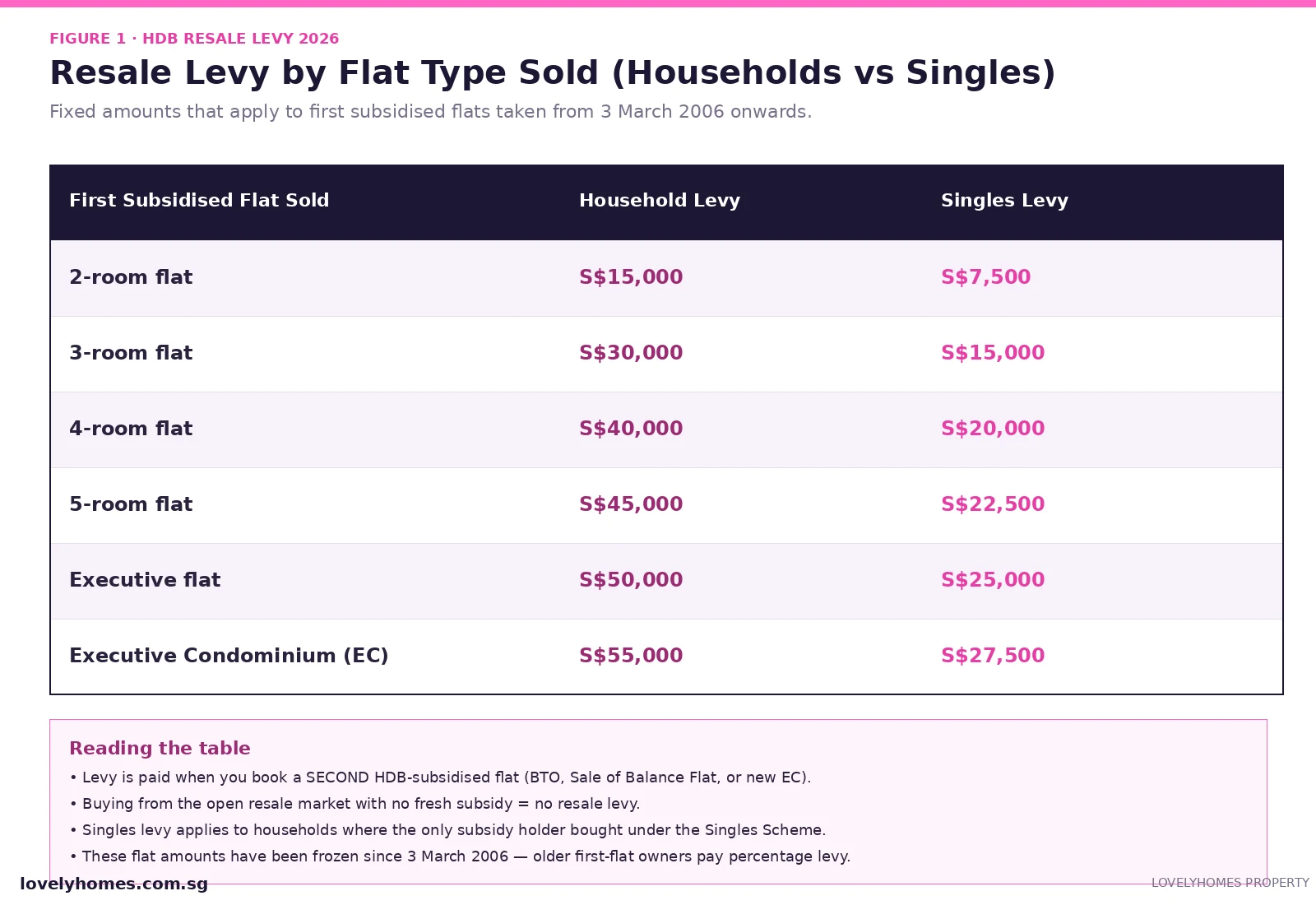
  • For first subsidised flats taken from 3 March 2006, the levy is a fixed amount — S$15,000 for a 2-room sold up to S$55,000 for an EC.
  • Households who got their first subsidy before 3 March 2006 pay a percentage levy of 10–25% of the resale price instead.
  • Singles Scheme buyers pay half the household amount.
  • The levy is paid in cash (or net cash proceeds from selling the first flat) — CPF cannot be used.
  • Payment is collected at the point of booking the second subsidised flat, before key collection.
  • Buying on the open market means no levy, but you still face BSD, ABSD (where applicable) and SSD if you sell within three years.

What is the HDB resale levy?

The resale levy is a charge that the Housing & Development Board (HDB) imposes on a household which has already enjoyed a housing subsidy and now wants a second bite at one. The Government’s logic is straightforward: public housing subsidies are taxpayer-funded, and a household should not collect them twice without contributing back. Selling the first subsidised flat is fine; what triggers the levy is the act of booking another subsidised flat — a fresh BTO, a Sale of Balance Flat, an open booking unit, or a brand-new Executive Condominium directly from the developer.

Crucially, the levy is administered by HDB, not IRAS. It is separate from Buyer’s Stamp Duty, ABSD, and Seller’s Stamp Duty. You can owe stamp duties and a resale levy in different scenarios, and they are calculated, paid, and tracked independently.

HDB resale levy Singapore 2026 — fixed levy amounts by flat type for households and singles
Figure 1 · Fixed-dollar resale levy amounts in force since 3 March 2006. Source: HDB.

Who actually pays the levy?

The resale levy travels with the household, not the property. If at any point in your housing history you (or your spouse, or your essential occupier) have already enjoyed an HDB subsidy, you are a second-timer in HDB’s eyes the next time you approach them for a fresh subsidy. The subsidies that count include:

  • A new flat purchased directly from HDB (BTO, Sale of Balance Flats, Re-Offer of Balance Flats, open-booking flats).
  • A Design, Build and Sell Scheme (DBSS) flat bought from a private developer.
  • An Executive Condominium bought directly from the developer (first hand).
  • A resale flat bought with one of the older Resale Application Grants — CPF Housing Grant for Family, Singles Grant, or Half-Housing Grant — taken before changes to the levy rules.
  • HUDC flats and SERS replacement flats taken under HDB schemes count similarly.

If your only subsidy was the Enhanced CPF Housing Grant (EHG) or the Family Grant on a resale flat purchased after 3 March 2006, you are not automatically deemed a levy-paying second-timer for the purpose of a future resale flat purchase — but you do pay the levy if you next buy a new flat or new EC.

How the levy is calculated

Two regimes apply, and the dividing line is the date of your first subsidised flat’s key collection (or in the case of an EC, the date you signed the Sale & Purchase Agreement).

Fixed-dollar levy (first flat from 3 March 2006)

This is the regime almost every modern buyer falls under. The amount is locked to the type of flat you sold:

First subsidised flat sold Household levy Singles Scheme levy
2-room flat S$15,000 S$7,500
3-room flat S$30,000 S$15,000
4-room flat S$40,000 S$20,000
5-room flat S$45,000 S$22,500
Executive flat / HUDC S$50,000 S$25,000
Executive Condominium S$55,000 S$27,500

The fixed amount does not move with property prices, which is good news for households whose first flat appreciated heavily in resale. A 4-room sold today for S$700,000 still owes only S$40,000 in levy — about 5.7% of the resale price.

Percentage levy (first flat before 3 March 2006)

Older second-timers face the legacy regime. Levy is set as a percentage of the higher of the resale price or 90% of the market valuation:

First subsidised flat sold Household levy % Singles Scheme levy %
2-room flat 10% 5%
3-room flat 20% 10%
4-room flat 22.5% 11.25%
5-room flat 25% 12.5%
Executive flat / HUDC 25% 12.5%

For a household that sold a 4-room legacy flat for S$650,000, the percentage levy lands at S$146,250 — markedly higher than the modern fixed levy. This is one reason long-time HDB owners often choose to remain in the resale market rather than ballot for a fresh BTO.

When and how the levy is paid

HDB collects the resale levy at the point of booking the second subsidised flat. In practice this means:

  1. You sell your first subsidised flat. CPF is refunded with accrued interest; the cash balance is yours.
  2. You ballot for, queue, and book a second BTO/SBF/SBF or sign for an EC.
  3. HDB issues a payment notice for the levy, payable in cash only. CPF cannot be used.
  4. Levy is paid before signing the lease agreement / S&P. Failure to pay forfeits the booking.

If the second flat is booked before the first has been sold, HDB defers the levy to the resale completion date and may require an undertaking. Some buyers structure it this way to avoid being homeless between sale and BTO completion, especially in long-build projects.

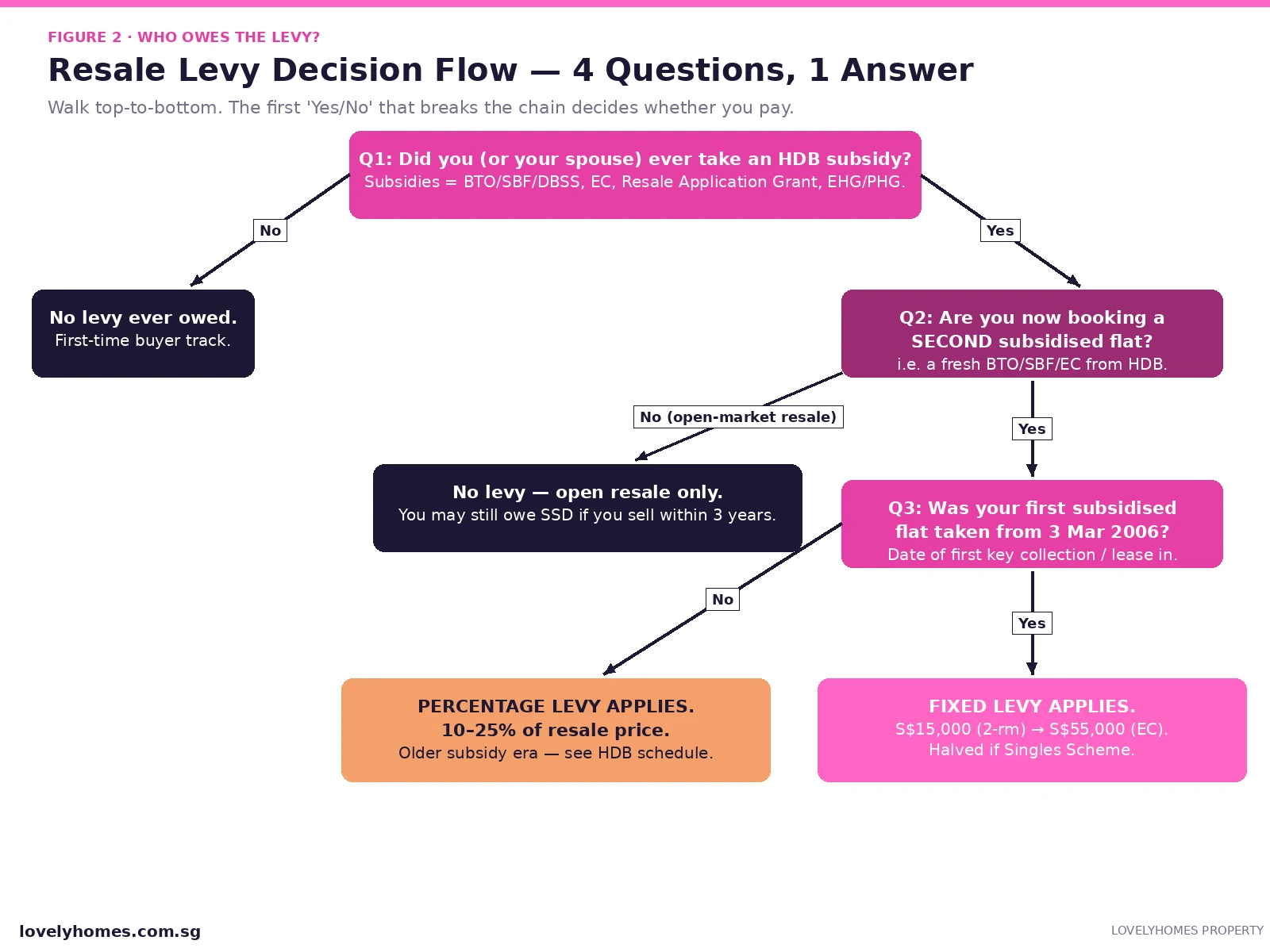
HDB resale levy 2026 decision flow — who owes the levy
Figure 2 · Walk the four questions in order — the first answer that breaks the chain decides your outcome.

Who is exempt or partially relieved?

HDB allows a small set of waivers and concessions, and these matter most for older households and downgraders:

  • Buying a 2-room Flexi flat on a short lease (45 years or less) at age 55 and above. The resale levy is waived in full to encourage right-sizing.
  • Buying a Studio Apartment / Community Care Apartment. No resale levy applies (these are senior-targeted typologies).
  • Divorce settlements where one party retains the existing flat. No levy event; only one of the parties may face a levy if they later buy a fresh subsidised flat.
  • Sub-letting income or rental of bedrooms does not trigger the levy. The levy only fires when the subsidised flat is sold and a new subsidised flat is booked.
  • Open-market resale purchases without grants are not levy events. You can move from a 4-room HDB to another resale 5-room without grant, and no levy is triggered.

Resale levy vs CPF refund vs stamp duty — separating the bills

It is easy to confuse three different cash flows that all hit a second-timer household at roughly the same time. They are independent and add up:

What you pay Who collects Triggers Source of funds
Resale levy HDB Booking second subsidised flat Cash only
CPF accrued interest CPF Board (refund into your OA) Sale of any flat Auto-deducted from sale proceeds
Buyer’s Stamp Duty IRAS Any property purchase Cash + CPF allowed
Additional Buyer’s Stamp Duty IRAS Second / third / foreign buyer purchase Cash + CPF allowed
Seller’s Stamp Duty IRAS Sale within 3-year holding period From sale proceeds

The CPF accrued interest is not a fee — it is your own money being returned to your OA — but it shrinks the cash you can deploy on the next purchase. Plan around it the same way you plan around the resale levy.

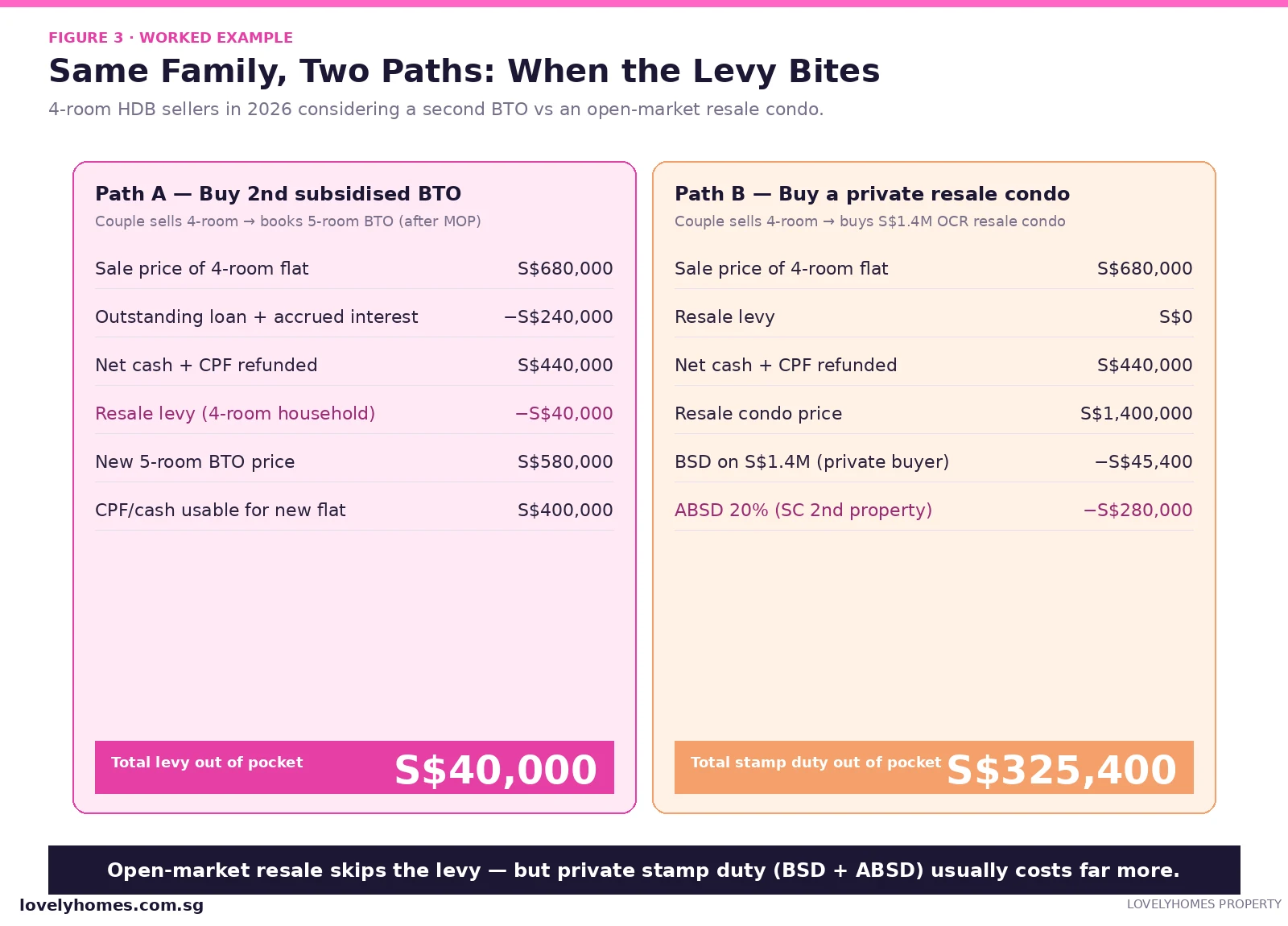
Worked example — same family, two paths

Take a Singapore Citizen couple, married 12 years, who bought a 4-room BTO in Punggol for S$320,000 in 2014 with a Family Grant. In 2026 they have hit the 5-year MOP, the flat is valued at S$680,000, and they are deciding whether to upgrade through a fresh BTO or to buy a private resale condo.

HDB resale levy worked example 2026 — second BTO vs private resale condo cost stack
Figure 3 · Whichever way they go, the resale levy is small relative to private stamp duty.

Path A — buying a 5-room BTO — costs S$40,000 in levy plus the new flat price of S$580,000. Path B — buying an S$1.4M open-market resale condo — skips the levy entirely but adds S$45,400 in BSD and S$280,000 in ABSD at the 20% citizen-second-property rate, totalling S$325,400 in stamp duty. The headline conclusion: the resale levy is real money, but it is dwarfed by ABSD whenever the alternative is a private-market upgrade. Couples often see this comparison only after they put pen to paper, which is why it pays to model both routes early.

Why the levy exists at all

Singapore’s housing model rests on two policy pillars: keeping public housing affordable to first-timers, and rationing taxpayer subsidies. Without a levy, a household could ride the BTO market repeatedly — cashing in on resale price growth at each cycle and stepping up to bigger flats with full subsidies each time. The levy is the friction that makes a second BTO a deliberate choice rather than a default. It also keeps queues for new BTOs balanced — first-timers always get priority, but second-timers compete for the remaining quota and pay the levy if they win one.

Compared with peer markets, the Singapore approach is unusual. Hong Kong’s Home Ownership Scheme uses a price clawback rather than a flat levy. Australia’s First Home Owner Grant has no second-time levy because grants there are smaller and time-limited. The Singaporean fixed-dollar approach is a useful piece of housing-policy plumbing that most buyers only encounter once.

What this means for you

If you are a current HDB owner thinking about your next move, the levy reshapes the decision in three concrete ways. First, it makes the open resale route surprisingly competitive — for many flat types the levy is comparable to the lawyer-and-valuer fees on a private resale and is comfortably under the BSD on a S$1.5M condo. Second, because the levy is fixed, smaller flat owners (2-room, 3-room) face a friendlier upgrade path than larger flat owners; the household that sold a 5-room or EC pays the most. Third, the levy is cash-only — that imposes a real liquidity hit at exactly the moment you are also funding the down-payment, legal fees, and renovation on the next home.

A common mistake is to treat the levy as one of many transaction costs and bake it into the budget late. Run the numbers up front, ideally on the same spreadsheet you use for down payment and LTV planning. If you are upgrading to a private property, the right comparison is the levy versus the ABSD and BSD on the alternative — almost always a smaller bill, in absolute terms, than the stamp duties on a S$1.5M+ condo.

What might come next

The fixed-dollar regime has been frozen since March 2006. Construction costs and median flat prices have roughly tripled since then, which has progressively eroded the real value of the levy. There has been periodic public commentary that the Government may reconsider the schedule — either by indexing it to a property price benchmark or by raising the EC and 5-room amounts. In the same vein, the percentage-based legacy regime continues to age out as pre-2006 first-flat owners exit the market.

Two policy directions are plausible from here. One is a recalibration that pushes the larger-flat levies upward to keep relative ratios stable as flat prices move. The other is a structural rethink that ties the levy to the resale price like the legacy regime, but capped to avoid punishing strong resale gains. Either direction would arrive with notice and a generous grace period for booked transactions; speculation is not a reason to rush a BTO ballot. The forward-looking view here is that some upward adjustment is likely over the next several years, but transparency and lead time are part of HDB’s playbook.

Frequently asked questions

Does the resale levy apply if I sell my HDB and buy a private condo?

No. The levy only triggers when you book another subsidised flat from HDB (BTO, SBF, fresh EC). Buying a private resale condo or a new condo from a developer does not engage the levy at all — although you will face full BSD plus ABSD where applicable.

Does the resale levy apply when I buy a resale flat with a CPF grant?

For first subsidised flats taken from 3 March 2006 onwards, second-timer households who buy a resale flat with grants are subject to a smaller adjustment rather than a full resale levy. Historically (pre-March 2006) a percentage levy did apply. Always check HDB’s resale flat eligibility letter for your specific case before you make an offer.

Can I pay the resale levy from my CPF Ordinary Account?

No. The levy is payable in cash. The cash you have on hand from the sale of your first flat — after CPF is refunded with accrued interest — is the typical source of funds. Some households top up with a small bridging loan to cover the gap between flat sale completion and second-flat booking.

What if my spouse and I both owned subsidised flats before marriage?

HDB looks at the household, not the individual. If either of you previously took an HDB subsidy, the next subsidised flat the new household books is treated as a second purchase. Only one resale levy is owed per household per flat sold.

Will the levy be waived if I am buying a smaller flat to right-size?

Only in tightly defined cases — chiefly the 2-room Flexi short-lease flat at 55+, and Studio Apartment / Community Care Apartment purchases. Right-sizing into a longer-lease 2-room or 3-room generally still triggers the levy if it is a fresh subsidised flat.

Does the resale levy apply to Executive Condominium buyers?

Yes — and it is the largest category, S$55,000 for households who previously sold an EC. Crucially, the levy fires on the first hand EC purchase only. After the EC’s 5-year MOP and 10-year privatisation, subsequent buyers are private-market buyers and never face the levy.

If I divorce and one of us keeps the flat, does the other party still owe the levy?

The party who retains the flat keeps the subsidy attribution; if they later remarry and book another subsidised flat, the levy applies. The other party’s eligibility is reviewed against their new household status — the levy is only assessed at the point of booking a fresh subsidised purchase.

Disclaimer: This article summarises the resale levy regime as administered by the Housing & Development Board (HDB) of Singapore. Levy amounts, eligibility rules and waivers may be updated by HDB from time to time. Always verify the current schedule against the HDB resale levy page on hdb.gov.sg, your eligibility letter, and where relevant the Inland Revenue Authority of Singapore (IRAS), the Central Provident Fund (CPF) Board, the Monetary Authority of Singapore (MAS), and SingStat for housing market data. This article does not constitute legal, financial or tax advice — speak to a licensed conveyancing lawyer, a HDB-listed mortgage advisor, or a registered financial adviser before transacting.

How to Sell Your Property in Singapore 2026: Costs, SSD, CPF Refund & Step-by-Step Process

How to Sell Your Property in Singapore 2026: Costs, SSD, CPF Refund & Step-by-Step Process

How to Sell Your Property in Singapore 2026 Complete Guide

Quick Answer — Key Takeaways

  • Seller’s Stamp Duty (SSD) of 12%, 8%, or 4% applies if you sell within 3 years of purchase (private residential properties)
  • Agent commission is typically 1–2% of sale price — negotiable; CEA-registered agents only
  • CPF funds used must be refunded to CPF OA with Accrued Interest (compounded at 2.5% p.a.) upon sale
  • The sale process from OTP to legal completion typically takes 10–12 weeks for private property; 8–12 weeks for HDB
  • Outstanding mortgage must be discharged from sale proceeds; early repayment penalty may apply (lock-in period)
  • No Capital Gains Tax in Singapore — profits from property sales are generally not taxed unless you are classified as a property trader by IRAS
  • Decoupling a property before sale may reduce ABSD on a subsequent purchase but requires careful legal structuring to avoid Section 33A anti-avoidance provisions

Selling Property in Singapore — Overview

Singapore’s property market has no Capital Gains Tax — meaning that profits from the sale of residential property are generally not subject to income tax, provided IRAS does not classify you as conducting a property trading business. However, selling a property in Singapore does involve a web of stamp duties, CPF refund obligations, agent fees, legal costs, and outstanding loan discharges. Understanding these costs upfront prevents unpleasant surprises at the point of sale.

The Seller’s Stamp Duty (SSD) — introduced in January 2011 and most recently recalibrated in April 2023 — is the most significant policy lever for sellers. At 12% for properties sold within the first year of purchase, SSD is designed to deter speculative flipping. This guide covers every major cost and step for selling a private residential property (condo, landed, or HDB) in Singapore in 2026.

Singapore property selling costs SSD rates 2026 data infographic
Figure 1: Seller’s Stamp Duty (SSD) rates and indicative selling cost components for a S$1.5M property, Singapore 2026.

Seller’s Stamp Duty (SSD) — Rates and Rules

Seller’s Stamp Duty is payable by the seller if a residential property is sold within 3 years of its purchase date (for private properties). The rates are based on the higher of the sale price or market value:

Holding Period SSD Rate (Current, from Apr 2023) SSD on S$1.5M Sale
Up to 1 year 12% S$180,000
More than 1, up to 2 years 8% S$120,000
More than 2, up to 3 years 4% S$60,000
More than 3 years 0% Nil

HDB flats are not subject to SSD, but have their own MOP (Minimum Occupation Period) of 5 years — during which the flat cannot be sold on the resale market at all.

All Costs When Selling Your Property

Cost Typical Amount Paid by / When
Agent Commission 1–2% of sale price Seller; at completion
Legal Fees (conveyancing) ~S$2,500–S$4,000 Seller; at completion
Seller’s Stamp Duty (SSD) 0–12% of sale price (if <3 years) Seller; within 14 days of OTP exercise
Mortgage Early Repayment Penalty 0.75–1.5% of outstanding loan (if in lock-in) Seller; upon full redemption at completion
CPF Refund (OA + Accrued Interest) All CPF used + 2.5% p.a. compound interest Mandatory; deducted from proceeds at completion
Property Tax (prorated to sale date) Varies by AV; prorated to completion date Seller; adjusted at completion
HDB Admin Fee (HDB resale only) S$40–S$80 Seller; to HDB

Worked Example: Selling a S$1.5M Condo Purchased 2 Years Ago

Scenario: SC seller, selling a condo purchased in April 2024 for S$1.4M, now selling in April 2026 at S$1.5M. Outstanding bank loan: S$900,000. CPF used: S$200,000 OA + S$10,000 accrued interest.

  • Gross Sale Price: S$1,500,000
  • Less SSD (8% × S$1.5M, sold in year 2): −S$120,000
  • Less Agent Commission (1.5%): −S$22,500
  • Less Legal Fees: −S$3,000
  • Less Outstanding Loan Redemption: −S$900,000
  • Less CPF Refund (S$200K + S$10K interest): −S$210,000
  • Net Cash Proceeds to Seller: S$1,500,000 − S$120,000 − S$22,500 − S$3,000 − S$900,000 − S$210,000 = S$244,500
  • Of which cash in hand (after CPF returned to CPF, not to pocket): ~S$244,500 (cash) + S$210,000 returned to CPF OA

Note: This example excludes any early repayment penalty on the bank loan. Verify with your bank and a property consultant. IRAS may treat profits as income if you are assessed as a property trader — consult a tax professional if you have sold multiple properties in recent years.

The Private Property Sale Process — Step by Step

For a private residential property (condominium or landed), the sale process broadly follows these stages over 10–12 weeks:

  1. Appoint a CEA-licensed agent (or sell directly). Agent markets the property, manages viewings, and facilitates negotiations.
  2. Accept an offer and grant an OTP. The buyer pays an Option Fee (typically 1% of agreed price). The OTP is valid for 14 days (standard) — extendable to 21 days by agreement.
  3. Buyer exercises OTP — pays the balance 4–9% deposit within the OTP period. Both buyer and seller appoint conveyancing solicitors.
  4. Solicitors conduct due diligence — title search, CPF charge check, Inland Revenue caveats, mortgagee consent if applicable.
  5. Completion — typically 8–10 weeks after OTP exercise. Sale proceeds are disbursed, mortgage is redeemed, CPF is refunded, and keys are handed over.

Frequently Asked Questions

Is there Capital Gains Tax on property sales in Singapore?

No. Singapore does not impose a Capital Gains Tax on property sales by individuals. Profits from property sales are not taxable — provided IRAS does not classify you as a property trader (i.e. someone who buys and sells properties as a business, subject to income tax on profits). If you have sold multiple properties in a short period, consult a tax professional to confirm your IRAS classification. The Inland Revenue Authority of Singapore (IRAS) administers all property tax matters.

How is the CPF refund calculated when I sell my property?

Upon selling your property, you must refund to your CPF OA: (1) all CPF funds withdrawn for the property (down payment, monthly instalments, BSD, legal fees funded by CPF), plus (2) accrued interest at 2.5% per annum, compounded annually, on those withdrawn amounts. This refund goes back into your CPF OA — it is not a tax, but it reduces the cash proceeds you receive. The CPF Board calculates the exact refund amount at completion. For long-held properties with large CPF withdrawals, accrued interest can be significant.

What if the sale price is less than the outstanding loan and CPF refund?

If the sale proceeds are insufficient to fully redeem the outstanding mortgage and refund all CPF funds with accrued interest, you would face a shortfall. In this scenario, you would need to top up the difference in cash. This is sometimes called a “negative sale.” To avoid this situation, sellers should always compute their minimum viable sale price before listing — accounting for loan balance, CPF refund, SSD, agent fees, and legal costs.

Can I avoid SSD by transferring the property to a family member?

No. SSD applies to all legal transfers of residential property within the holding period — including transfers to family members, whether by sale, gift, or trust arrangement. IRAS treats these as disposals subject to SSD. Section 33A of the Stamp Duties Act also provides anti-avoidance powers allowing IRAS to look through artificial arrangements designed to circumvent stamp duty obligations. Seek advice from a qualified stamp duty lawyer before attempting any form of property restructuring.

What happens if I have an HDB bank loan and sell before 3 years?

Unlike private property, HDB flats carry no SSD on their own — however, HDB resale flats cannot be sold during the 5-year MOP. If you have a bank loan (not an HDB concessionary loan) on a private property, an early redemption penalty (clawback) of 0.75%–1.5% of the outstanding loan may apply if you sell during the loan’s lock-in period (typically 1–3 years). Check your bank’s loan terms carefully before committing to sell. HDB concessionary loans do not carry lock-in penalties.

Related Articles

Disclaimer: Information on this page is for general reference only and does not constitute professional property, legal, financial, or tax advice. Stamp duty rules, CPF policies, and property regulations may change — verify all details with IRAS (iras.gov.sg), CPF Board (cpf.gov.sg), and HDB (hdb.gov.sg) before transacting. Consult a CEA-licensed property agent and a qualified solicitor for transaction-specific advice. LovelyHomes.com.sg does not hold a real estate agency licence.


Translate »