June 2026 BTO Results: Berlayar Rise and Lakeview Cascadia Dominate With 4.5-4.7 Times Oversubscription

June 2026 BTO Results: Berlayar Rise and Lakeview Cascadia Dominate With 4.5-4.7 Times Oversubscription

The June 2026 Build-To-Order (BTO) sales exercise closed on 24 June 2026 after five days of applications, confirming a pattern that has defined Singapore’s public housing market all year: Prime-classified projects in central and mature estates are dramatically oversubscribed, while Standard projects in the north and north-east attract softer demand — in some cases failing to reach full first-timer subscription. Here is the complete picture.

Quick Answer — June 2026 BTO Results at a Glance

  • 6,952 flats launched across 7 projects in Ang Mo Kio, Bishan, Bukit Merah, Sembawang, and Woodlands.
  • Total applications: 22,634 — overall subscription rate of 3.3 times (as at 5pm, 24 June 2026).
  • Star project: Berlayar Rise (Bukit Merah, Prime) — 8,824 applications, 4.5× oversubscribed. Nearly 40% of all applications in the exercise.
  • Runner-up: Lakeview Cascadia (Bishan, Prime) — 5,799 applications, 4.7× for certain flat types.
  • Weakest demand: Sembawang Portico and Sembawang Brook — first-timer family rates fell below 1× for all 3-room and larger flat types.
  • Singles demand surge: Woodgrove Acres (Woodlands) 2-bedroom flexi units hit 17.8× for first-timer singles.
  • More than 2,500 flats offered have wait times of three years or less under HDB’s expedited build programme.

The Full Project-by-Project Breakdown
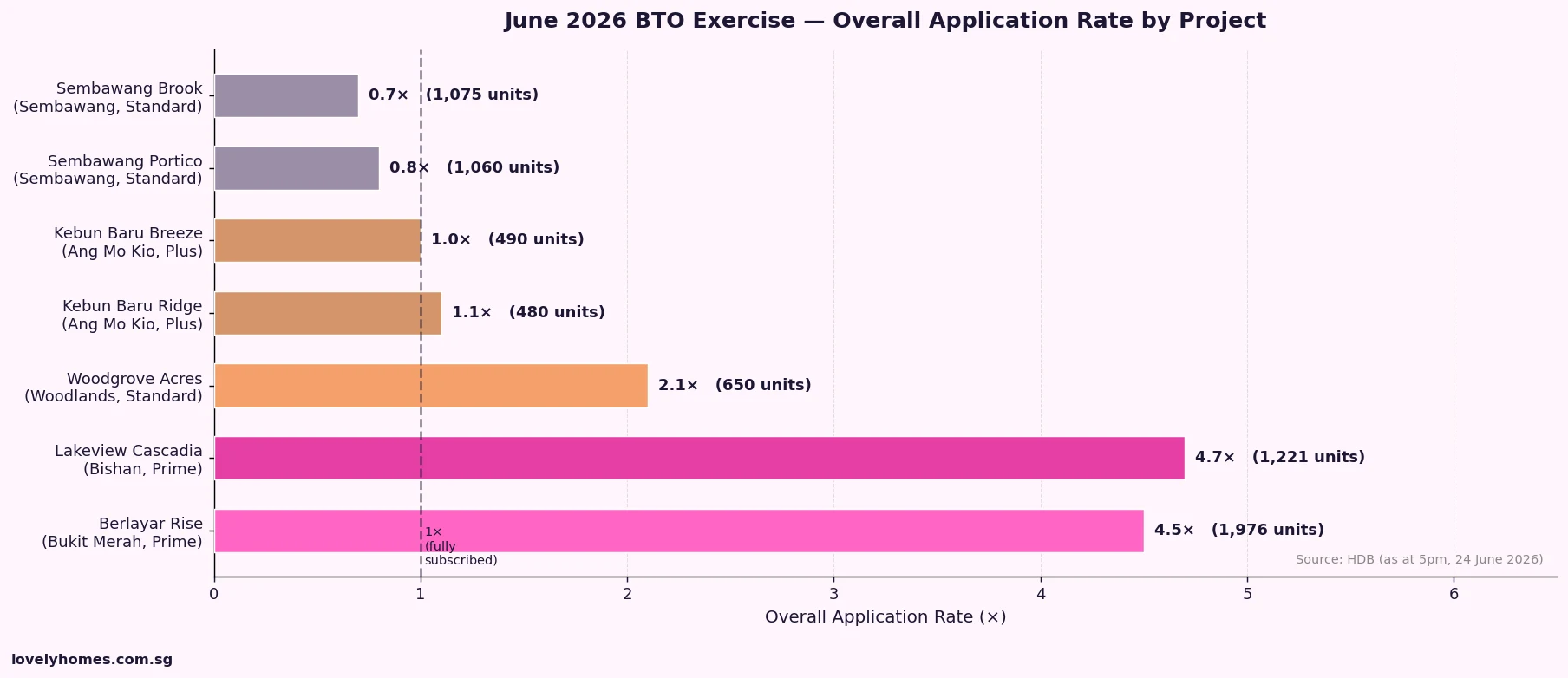
June 2026 BTO exercise application rate by project bar chart — Berlayar Rise, Lakeview Cascadia, Woodgrove Acres, Kebun Baru, Sembawang
Figure 1: Overall application rate by project, June 2026 BTO exercise (as at 5pm, 24 June 2026). Source: HDB Singapore.
Project Town Classification Units Applications Overall Rate
Berlayar Rise Bukit Merah Prime 1,976 8,824 4.5×
Lakeview Cascadia Bishan Prime 1,221 5,799 4.7×
Woodgrove Acres Woodlands Standard ~650 ~2× (singles 17.8×)
Kebun Baru Ridge Ang Mo Kio Plus ~480 ~1.1× (3-room 2T: 22.9×)
Kebun Baru Breeze Ang Mo Kio Plus ~490 ~1.0×
Sembawang Portico Sembawang Standard ~1,060 <1× (families)
Sembawang Brook Sembawang Standard ~1,075 <1× (families)

Source: HDB. Application rates as at 5pm, 24 June 2026. Woodgrove Acres, Kebun Baru, and Sembawang project unit counts are approximate; official HDB breakdown shows total 6,952 units across all 7 projects.

Berlayar Rise: The Greater Southern Waterfront Magnet

Berlayar Rise in Bukit Merah accounted for nearly 40% of all applications in the June exercise — a remarkable concentration of demand in a single project. The draw is straightforward: this is a Prime-classified development integrated with Telok Blangah MRT station on the Circle Line, positioned squarely within the Greater Southern Waterfront (GSW) transformation precinct. Prices for 4-room flats are estimated to start from around S$580,000 — a figure that, while elevated for public housing, represents a meaningful discount to what an equivalent private resale unit in the Telok Blangah/Bukit Merah corridor would cost (typically S$1.2–1.6 million for a comparable size).

The Prime designation means buyers are subject to the standard Prime location conditions: a 10-year Minimum Occupation Period (MOP), an income ceiling of S$14,000 for families, and subsidy clawback on resale (estimated at approximately 14%, based on the precedent set by the nearby Berlayar Residences project). For buyers who can meet those conditions and want a foothold in the GSW story, Berlayar Rise offers compelling long-term value. The development sits near the future Telok Blangah market and hawker centre, and the broader GSW transformation — connecting Keppel, Harbourfront, and Pasir Panjang — is a generational urban-planning project that will unfold over the next 15–20 years.

Prime vs Plus vs Standard: A Market Verdict
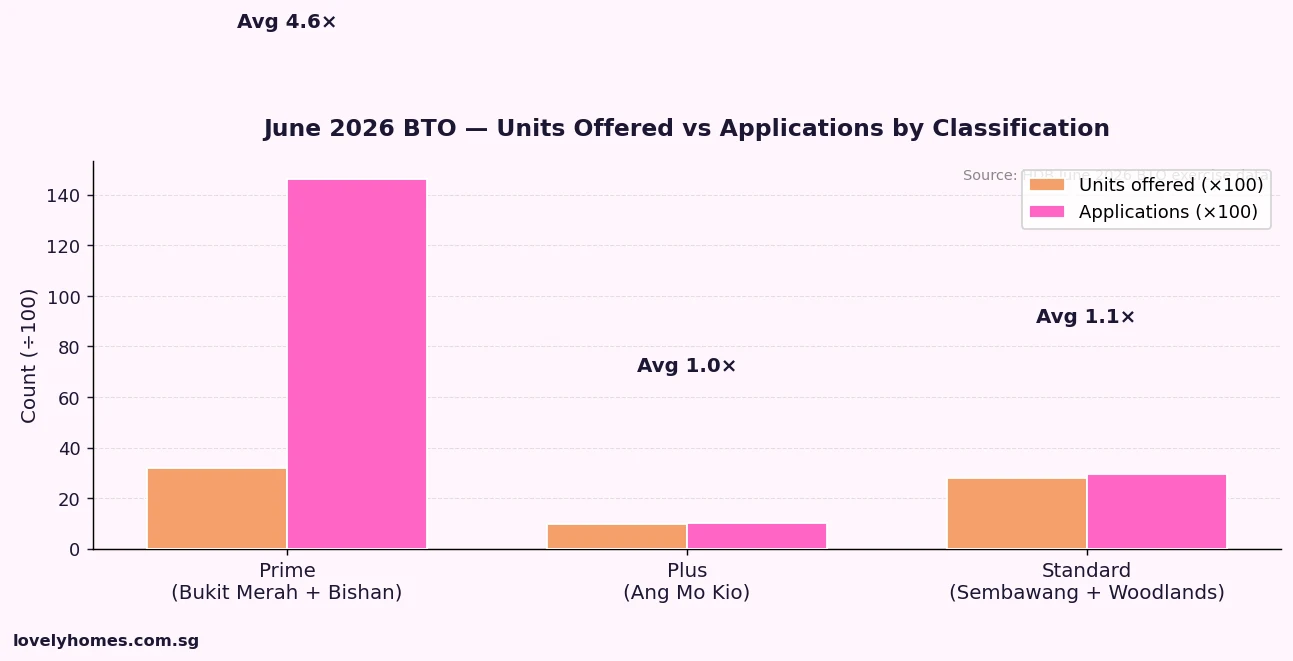
June 2026 BTO units offered versus applications by Prime Plus Standard classification chart
Figure 2: Units offered vs applications by BTO classification — June 2026 exercise. Prime projects (Bukit Merah + Bishan) absorbed the majority of demand despite representing fewer units. Source: HDB.

The June 2026 results are the clearest data point yet that Singapore’s three-tier BTO classification system (Prime, Plus, Standard) is functioning broadly as intended — but with some unintended consequences at the Standard end.

Prime projects (Berlayar Rise and Lakeview Cascadia) together offered 3,197 units but attracted approximately 14,623 applications — an average rate of 4.6 times. This is precisely the outcome the Government anticipated when it introduced the classification: demand for centrally located, well-connected projects is intense, and the subsidy recovery and MOP conditions are not deterring buyers who value location above all else.

Plus projects (Kebun Baru Breeze and Ridge in Ang Mo Kio) sat at approximately 1× overall subscription for first-timer families — marginally fully subscribed, which means successful ballots are likely but not certain for this cohort. The Plus designation was designed to sit between Prime and Standard in both location quality and subsidy level, and the Ang Mo Kio projects are genuinely well-located (D20, established mature estate, near Yio Chu Kang and Ang Mo Kio MRT). The lukewarm response may reflect the Plus conditions — 6-year MOP and clawback provisions — deterring the upgrader segment that has traditionally been the main buyer of Ang Mo Kio BTO flats.

Standard projects in Sembawang fell below full subscription for families. This is consistent with the market’s verdict on northern Singapore’s accessibility: despite the upcoming Cross Island Line (CRL) timeline, Sembawang remains a long commute for most CBD workers. The two projects together offered over 2,100 units — the largest supply block in the exercise — but attracted insufficient family demand to be oversubscribed. Unsuccessful ballot applicants from more competitive projects will likely be allocated here under HDB’s concession scheme.

The Singles Story: Woodlands Breaks Records

The most striking single data point in the June exercise was Woodgrove Acres in Woodlands: 2-bedroom flexi flats — the designated flat type for first-timer singles — were 17.8 times oversubscribed. This is an extraordinary figure that reflects both the shortage of BTO supply for singles (who are restricted to 2-bedroom flexi flats) and the growing demographic weight of single-person households in Singapore. The government has been incrementally expanding singles’ eligibility for BTO housing, but the 17.8× rate suggests the supply pipeline for singles remains severely constrained relative to demand.

What This Means for BTO Applicants

For applicants who were unsuccessful in the Berlayar Rise and Lakeview Cascadia ballots, the practical options are to re-apply in the October 2026 BTO exercise (details not yet announced), consider the concession flat allocation scheme which may direct them to Sembawang, or explore the HDB resale market where wait times are zero. Resale prices in mature estates have risen, but the Enhanced CPF Housing Grant (EHG) is available for resale purchases and can offset up to S$120,000 of the purchase price for eligible first-timers.

For families considering Sembawang, the below-1× first-timer rate means that applicants in this tranche are virtually guaranteed a flat if they apply — a rare situation in the BTO context. The trade-off is location and commute time, but Sembawang does offer genuine value: 4-room BTO flats in Standard Sembawang projects are typically priced in the S$330,000–S$430,000 range, representing the lowest entry point into new public housing available anywhere in the exercise.

What Might Come Next

The October 2026 BTO exercise is expected to launch in mid-October. HDB has indicated it will continue offering at least one Prime project per exercise to maintain supply at the most competitive tier. Industry observers expect the next Prime project to be in the Queenstown or Geylang/Kallang corridor, given the land parcels currently under preparation. For the Sembawang and Woodlands Standard supply overhang, HDB may consider adjusting pricing or flat-type mix in future launches to better match demand.

Frequently Asked Questions

What happens if a BTO project is undersubscribed?

If a BTO project does not receive sufficient applications to fill all available units within a flat type during the initial application period, HDB opens unsold flats for Sale of Balance Flats (SBF) exercises or re-offers them in subsequent BTO exercises. For the Sembawang Standard projects in June 2026, HDB’s concession flat scheme may direct unsuccessful applicants from oversubscribed projects to take up these units, often with a priority queue position. Buyers who accept concession flats in less popular projects lose the right to re-ballot in the same exercise but gain a guaranteed flat allocation.

What is the subsidy clawback for Berlayar Rise (Prime)?

The exact clawback percentage for Berlayar Rise has not yet been officially confirmed by HDB, but based on the precedent of the nearby Berlayar Residences (a Prime project from the October 2025 exercise), the clawback is estimated at approximately 14% of the resale price on first resale after the 10-year MOP. This means that if you sell a Berlayar Rise flat in 2036+ at, say, S$900,000, approximately S$126,000 would be clawed back by HDB before you receive your net sale proceeds. The clawback is intended to recover some of the Prime location subsidy from sellers who benefit from the price appreciation in the GSW area. Always check the specific clawback terms in your sales agreement.

Can first-timer singles apply for Berlayar Rise or Lakeview Cascadia?

First-timer singles (aged 35 and above) may apply for 2-bedroom flexi flats in Prime and Plus projects, subject to the same income ceiling (S$7,000 per month for singles) and the additional MOP/clawback conditions. However, the quota for singles in Prime projects is limited, and competition for 2-bedroom flexi units in Prime projects is historically intense. The June 2026 exercise did not publicly disclose the singles-specific application rate for Berlayar Rise or Lakeview Cascadia, but based on past exercises, 2-bedroom flexi units in Prime projects typically see subscription rates well above 5×.

What is the Minimum Occupation Period for these projects?

The MOP varies by classification: Prime projects (Berlayar Rise, Lakeview Cascadia) have a 10-year MOP. Plus projects (Kebun Baru Breeze and Ridge in Ang Mo Kio) have a 6-year MOP. Standard projects (Woodgrove Acres, Sembawang Portico, Sembawang Brook) have the standard 5-year MOP. During the MOP, owners cannot sell the flat on the open market or rent out the entire flat. Partial renting of individual rooms is permitted after an owner has fulfilled occupation requirements. The longer MOP for Prime and Plus projects is part of the policy design to moderate speculative demand and ensure these subsidised flats serve genuine owner-occupiers over the medium term.

When will the October 2026 BTO exercise launch?

HDB typically announces each BTO exercise approximately one month before applications open. Based on the 2025–2026 schedule, the October 2026 exercise is likely to open for applications in mid-to-late October 2026, with flat details announced in mid-September 2026. LovelyHomes will cover the October 2026 BTO launch as soon as HDB releases official details. You can subscribe to HDB’s e-alerts at homes.hdb.gov.sg to be notified when new launches are announced.

Related Articles

Disclaimer: Application rates and project details are sourced from HDB Singapore (as at 5pm, 24 June 2026) and industry reporting. Figures are subject to change as HDB publishes final ballot results. Subsidy clawback estimates are indicative based on comparable projects and are not official HDB figures for Berlayar Rise. Always refer to HDB’s official flat listings and consult a licensed property agent or HDB directly before making any application or purchase decision. LovelyHomes is not affiliated with HDB or any property agency.
HDB CPF Housing Grant Guide 2026: EHG, Family Grant, Step-Up, PHG and Singles Grant Explained

HDB CPF Housing Grant Guide 2026: EHG, Family Grant, Step-Up, PHG and Singles Grant Explained

×

Click outside or press Esc to close

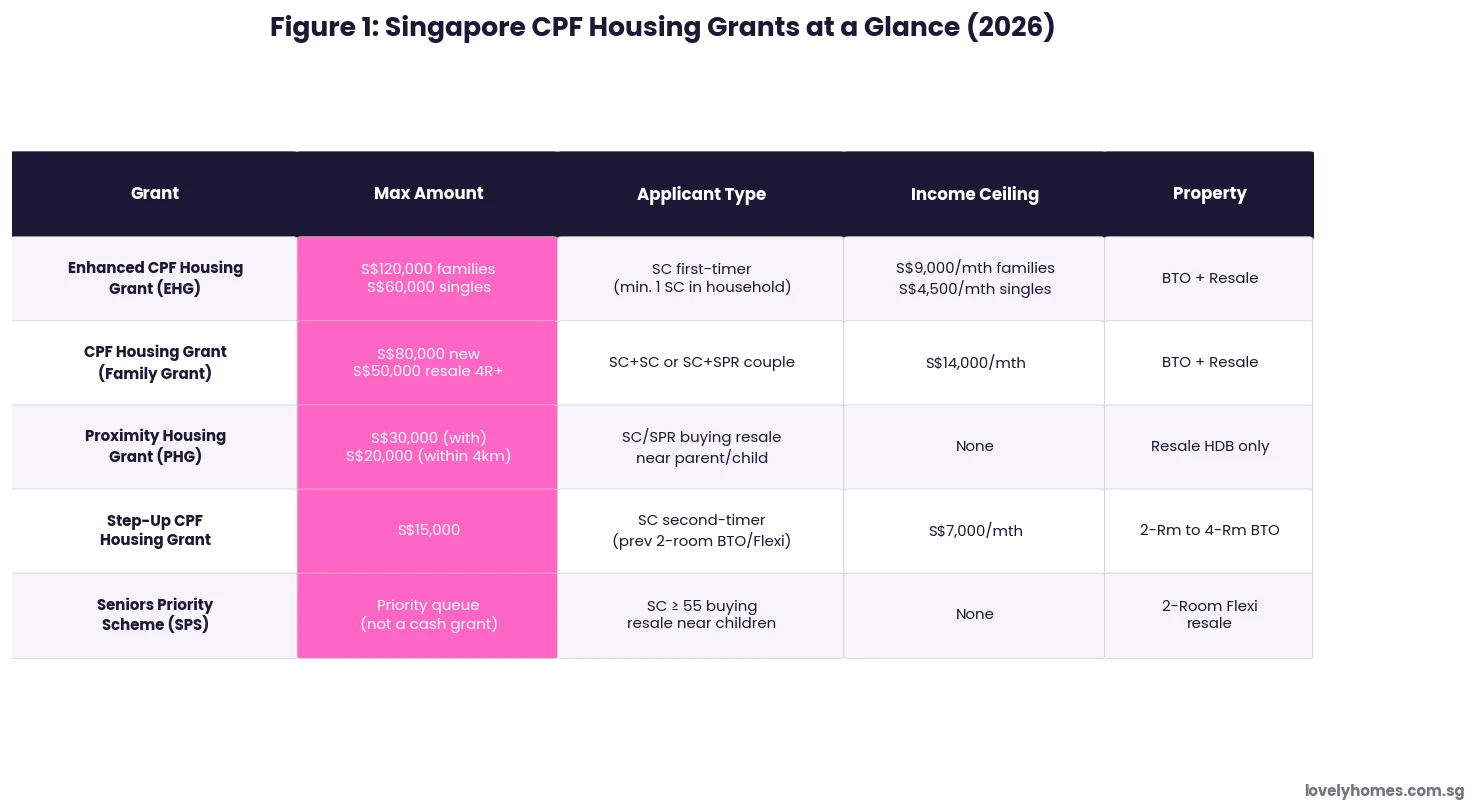
For most Singaporeans, the CPF Housing Grant system is the single most valuable financial lever available when buying an HDB flat. The right grant — or combination of grants — can reduce the purchase price by S$30,000 to S$160,000 and cut the cash outlay needed at the point of sale dramatically. Yet many buyers remain unclear about which grants they qualify for, how the grants interact, and what happens when eligibility conditions change before completion. This guide covers every HDB CPF Housing Grant available in 2026: the Enhanced CPF Housing Grant (EHG), Family Grant, Step-Up CPF Housing Grant, Proximity Housing Grant (PHG), and the Singles Grant — with full eligibility tables, income ceiling rules, and a worked example.

Quick Answer — HDB Grants at a Glance (2026)

  • The Enhanced CPF Housing Grant (EHG) provides up to S$80,000 for first-timer SC couples buying BTO or resale flats (income ceiling S$9,000/mth).
  • The Family Grant provides S$80,000 (SC couple, BTO) to S$50,000 (resale), on top of EHG — making combined grants up to S$160,000 for qualifying couples.
  • The Step-Up CPF Housing Grant gives second-timer SC families S$15,000 towards a 4-room or smaller BTO flat.
  • The Proximity Housing Grant (PHG) provides S$30,000 (living with) or S$20,000 (living near) parents or child — for resale buyers.
  • The Singles Grant gives eligible single SC applicants aged ≥35 up to S$25,000 towards a resale flat or S$25,000 for a 2-room BTO.
  • All grants are administered by HDB and applied via the HDB Flat Portal (homes.hdb.gov.sg) — not through the CPF Board directly.
  • Grants offset the purchase price and reduce the HDB loan quantum required; they are not paid in cash to the buyer.

What Are HDB CPF Housing Grants and Who Administers Them?

HDB CPF Housing Grants are subsidies provided by the Housing and Development Board (HDB) under Singapore’s public housing policy. Despite the “CPF” label, the grants are designed and administered entirely by HDB; the Central Provident Fund (CPF) Board plays a secondary role in that CPF Ordinary Account (OA) savings may be used to fund the portion of the flat price not covered by grants. The grants exist because HDB’s policy mandate — set by the Ministry of National Development (MND) — is to ensure that public housing remains affordable across a wide income range. Grants are structured to taper off as household income rises, so they provide the greatest assistance to lower-income first-time buyers.

Importantly, grants are credited directly to reduce the flat’s purchase price or loan quantum — they are never paid to buyers in cash. This means they reduce the amount you borrow (and therefore the interest you pay over the loan tenure) rather than arriving as a lump sum in your bank account. Understanding this distinction is critical when doing upfront cost planning.

Grant Amounts by Household Income — EHG and Family Grant

HDB CPF Housing Grant EHG and Family Grant amounts by household income 2026
Figure 1: Enhanced CPF Housing Grant (EHG) and Family Grant amounts by average household income — HDB BTO, SC couple first-timer, 2026. Source: HDB.

The EHG is the largest single grant available and applies across a wide income spectrum. Its key feature is that the grant amount decreases as income rises, in S$5,000–S$10,000 steps, from a maximum of S$80,000 for couples earning S$1,500 per month or less, stepping down to S$5,000 for couples earning between S$8,500 and S$9,000 per month. Couples with a gross monthly income above S$9,000 do not qualify for the EHG. Importantly, “household income” for grant purposes is the average gross monthly income of all working persons listed on the flat application, typically the two applicants and any occupants who are working.

Grant Eligibility Matrix — Who Qualifies for What

HDB CPF Housing Grant eligibility matrix 2026 — EHG Family Grant Step-Up PHG Singles
Figure 2: HDB CPF Housing Grant eligibility matrix — key buyer profiles versus grant type (2026). Source: HDB Grant Guide.

The matrix above illustrates how grants are layered across buyer profiles. An SC couple buying a BTO as first-timers can potentially stack the EHG (up to S$80,000) and the Family Grant (S$80,000), for a combined S$160,000 grant — the maximum available under any HDB grant combination. SC/SPR mixed-citizenship couples receive the Family Grant at a lower quantum (S$60,000 for BTO; S$50,000 for resale) and are eligible for the EHG, but at the EHG rate applicable to the SPR-tier income rules. Singles aged 35 and above receive a dedicated Singles Grant and are eligible for a scaled-down EHG.

Deep Dive: The Five Main HDB Grants in 2026

1. Enhanced CPF Housing Grant (EHG)

The EHG replaced the Additional CPF Housing Grant (AHG) and Special CPF Housing Grant (SHG) in September 2019. It is the most broadly applicable grant and covers both BTO and resale applications. Key conditions include: both applicants must have worked continuously for at least 12 months before the application date; the flat must not exceed a purchase price ceiling (for resale, the flat must be valued within the HDB resale price cap for the flat type and town); and applicants must not currently own or have disposed of private residential property within 30 months of application. The EHG applies regardless of flat type or location — a unique feature distinguishing it from the old SHG, which was restricted to non-mature estates.

2. Family Grant (BTO and Resale)

The Family Grant is citizenship-tiered and applies on top of the EHG. For SC-SC couples purchasing a new BTO flat, the Family Grant is S$80,000 regardless of income (subject to the S$14,000/mth income ceiling). For SC-SPR couples, the BTO Family Grant is S$60,000. For resale purchases, the quantum is S$50,000 (SC-SC) or S$40,000 (SC-SPR). The Family Grant can also be claimed by first-timer applicants who are singles applying under the Joint Singles Scheme, though the quantum is halved. There is no separate income ceiling for the Family Grant beyond the general resale/BTO eligibility income ceiling of S$14,000 per month gross household income.

3. Step-Up CPF Housing Grant

The Step-Up Grant is specifically for second-timer SC families — meaning applicants who previously owned or occupied an HDB flat, received a housing subsidy (including previous BTO application grant), or are currently living in a subsidised rental flat. The grant amount is S$15,000 and applies only to the purchase of a 4-room or smaller BTO flat. It is HDB’s way of facilitating the upgrading or right-sizing journey for mature families, while channelling the most significant grants to genuine first-timers. The income ceiling is S$7,000 per month.

4. Proximity Housing Grant (PHG)

The PHG is unique in that it is available for resale flat purchases only — it does not apply to BTO. It rewards buyers who choose to live near their parents or adult children. The quantum is S$30,000 if you buy a resale flat to live with parents or an unmarried child, and S$20,000 if you buy within 4 km of parents or a married child’s home. PHG can be combined with the EHG and Family Grant for resale purchases, making it a powerful stacking grant for families with a proximity reason to choose resale over BTO. There is no income ceiling for the PHG — it is available across all income levels subject to basic HDB eligibility.

5. Singles Grant

The Singles Grant is available to SC singles aged 35 and above applying for a 2-Room Flexi BTO flat or a resale flat. The quantum is S$25,000 for resale (4-room or smaller) and a scaled-down EHG for 2-Room Flexi BTO applications. Since January 2024, singles have been able to apply for 4-room resale flats (previously restricted to 5-room or smaller), broadening the effective pool. Singles who subsequently marry and upgrade to a larger flat may be treated as first-timers for the purposes of the EHG and Family Grant, subject to HDB’s conditions at the time of the subsequent purchase.

Summary Table — 2026 HDB Grant Quantum at a Glance

Grant Max Quantum Income Ceiling BTO / Resale
Enhanced CPF Housing Grant (EHG) S$80,000 S$9,000/mth Both
Family Grant (SC couple, BTO) S$80,000 S$14,000/mth BTO
Family Grant (SC couple, Resale) S$50,000 S$14,000/mth Resale
Family Grant (SC+SPR, BTO) S$60,000 S$14,000/mth BTO
Step-Up CPF Housing Grant S$15,000 S$7,000/mth BTO (4-room or smaller)
Proximity Housing Grant — With S$30,000 No ceiling Resale only
Proximity Housing Grant — Near S$20,000 No ceiling Resale only
Singles Grant (Resale) S$25,000 S$7,000/mth Resale (4-room or smaller)

Grant Impact on Upfront Cost — Three Worked Scenarios

HDB grant impact on upfront cost before and after grants BTO resale 2026
Figure 3: Illustrative upfront cost (downpayment + BSD) before and after applying maximum available grants — three buyer scenarios (2026). Source: LovelyHomes estimates based on HDB data.

Scenario A — BTO 4-Room, SC Couple, S$9,000/mth household income: A 4-room BTO flat in a non-mature estate at S$420,000. Gross monthly income is S$9,000 — at the EHG ceiling, so EHG is S$5,000. Family Grant (BTO, SC couple) is S$80,000. Total grants: S$85,000. Adjusted purchase price for grant purposes: S$335,000. 10% downpayment (HDB loan): S$33,500 cash/CPF. BSD on S$335,000: S$5,350. Estimated upfront: ~S$38,850. Without grants: 10% of S$420,000 = S$42,000 + BSD S$6,900 = ~S$48,900. Grant saving: ~S$10,050 in upfront costs, plus S$85,000 reduction in loan principal.

Scenario B — Resale 4-Room, SC+SPR Couple, S$6,000/mth income: Resale flat at S$560,000. EHG at S$6,000 income = S$35,000; Family Grant (resale, SC+SPR) = S$40,000; PHG (living near parents) = S$20,000. Total grants: S$95,000. Adjusted price: S$465,000. 25% downpayment (bank loan): S$116,250. BSD on S$560,000: S$12,200. Upfront: ~S$128,450. Without grants: 25% of S$560,000 = S$140,000 + BSD S$12,200 = ~S$152,200. Grant saving upfront: ~S$23,750 — largely via reduced loan principal.

Scenario C — Single SC, Aged 38, Resale 4-Room, S$5,000/mth income: Resale flat at S$380,000. Singles Grant: S$25,000. EHG (single, S$5,000 income) = S$40,000. Total: S$65,000. Adjusted price: S$315,000. HDB loan 90% LTV: S$283,500; 10% downpayment cash/CPF: S$31,500. BSD on S$380,000: S$6,300. Upfront: ~S$37,800. Without grants: S$38,000 + S$6,300 = ~S$44,300.

Common Pitfalls and Misconceptions

The most common misconception is that HDB grants are paid out as cash. They are not — they reduce the assessed purchase price or outstanding loan, so the benefit is realised over the loan tenure (less interest) rather than immediately. A second common error is failing to check whether either applicant has previously received a housing subsidy. Any prior CPF Housing Grant, AHG, SHG, or EHG will classify you as a “second-timer” for certain grants, which can significantly reduce your eligible quantum. Third, buyers sometimes conflate the EHG income ceiling (S$9,000/mth) with the general HDB eligibility income ceiling (S$14,000/mth for families; S$7,000/mth for singles buying new 2-room BTO). These are separate thresholds — you can be eligible to buy an HDB flat but not eligible for the EHG if your income exceeds S$9,000/mth.

What Might Change — HDB Grant Policy Outlook (2026–2028)

Editorial analysis — not financial advice or a government forecast. Grant amounts have been periodically revised upward since the EHG’s introduction in 2019 to keep pace with rising HDB resale prices. Given that median resale prices have risen materially since 2021, there is broad industry expectation that the income ceilings and/or grant quanta will be reviewed again in either the FY2026 or FY2027 Budget. The Singles Grant was enhanced in January 2024 to allow 4-room resale access; further extension to cover 5-room flats remains a periodic policy discussion. The PHG’s absence from BTO purchases is another area where advocacy groups have sought extension, particularly for couples who choose resale specifically for proximity to elderly parents.

Frequently Asked Questions

Can I get both the EHG and the Family Grant at the same time?
Yes — the EHG and Family Grant are designed to be stacked. A first-timer SC couple buying a BTO flat can receive both grants simultaneously, for a combined maximum of S$160,000 (S$80,000 EHG + S$80,000 Family Grant) if their household income is S$1,500 per month or below. For most couples in the S$6,000–S$9,000 income range, the combined grant will be in the S$95,000–S$130,000 range. For resale purchases, the EHG (up to S$80,000) and Family Grant (up to S$50,000 for SC-SC couples) can similarly be stacked, and the Proximity Housing Grant can be added on top if proximity conditions are met.
What counts as “household income” for grant eligibility?
HDB uses the “average gross monthly household income” over the 12 months before your HDB application as the reference figure. This includes the gross income of all applicants and any listed occupants who are working. Income from employment (salary, allowances, commissions) and self-employment is included. CPF contributions, rental income from existing property, and investment returns are generally excluded. If one applicant is unemployed, their income is counted as S$0 for averaging purposes — which can actually raise grant eligibility for some couples where only one partner works.
Can permanent residents (SPRs) receive HDB grants?
SPRs cannot receive HDB grants in their own right — grants are tied to Singapore Citizenship status. However, in a SC-SPR couple, the SC spouse’s citizenship status makes the household eligible for the Family Grant (at the SC+SPR quantum: S$60,000 for BTO, S$40,000 for resale) and the EHG. The PHG and Step-Up Grant are also available to SC-SPR couples. Couples where both applicants are SPR receive no CPF Housing Grants and must pay full market price for their HDB flat.
What happens to the grant if I sell the flat within the Minimum Occupation Period (MOP)?
Selling an HDB flat before meeting the Minimum Occupation Period (MOP — typically 5 years for standard BTO/resale, 10 years for Prime/Plus location BTO flats purchased on or after the new classification framework) is not permitted. If you are forced to sell due to approved exceptional circumstances before MOP, HDB may claw back the grant amount. After the MOP, you retain the benefit of the grant — but you will not be eligible for further CPF Housing Grants on your next HDB purchase if you have already been classified as a second-timer.
Does the Proximity Housing Grant apply if I buy near a sibling rather than a parent?
No — the Proximity Housing Grant (PHG) applies only to proximity with parents or an unmarried child living with you, or proximity to a married child’s home. Siblings, grandparents, aunts, uncles, or other relatives are not eligible as the proximity anchor. The “living with” condition means the parents are registered as occupants of the flat you purchase. The “living near” condition means your new resale flat must be within 4 km of the parents’ or child’s current home. HDB verifies proximity using registered addresses.
If I previously took a CPF Housing Grant, can I get another one for my next flat?
Generally, no — once you have received a CPF Housing Grant (including the old AHG, SHG, or the current EHG or Family Grant), you are classified as a “second-timer” for subsequent flat purchases. Second-timers can apply for the Step-Up CPF Housing Grant (S$15,000 for 4-room or smaller BTO), but are not eligible for the EHG or Family Grant again. The Singles Grant and PHG may still be available in specific circumstances. This is why it is important to use your first-timer grant status strategically — ideally for the property where you will stay for the long term.
How do I apply for HDB grants and how long does approval take?
Grant applications are integrated into the HDB Flat Portal (homes.hdb.gov.sg) — you apply for grants as part of the flat application process, not as a separate standalone application. For BTO applications, grant eligibility is assessed after the HDB Letter of Offer (LOO) is issued, typically within 3–5 months of the ballot outcome. For resale transactions, grant eligibility is confirmed at the HDB appointment stage, after the Option to Purchase (OTP) has been granted and exercised. HDB typically completes the eligibility assessment within 2–4 weeks of receiving the required income documents. The grant credit appears on your HDB Resale Completion Appointment confirmation or your BTO Signing of Agreement for Lease document.

Related Articles


Disclaimer: This article is produced by the LovelyHomes Editorial Team for informational purposes only and does not constitute financial, legal, or housing advice. Grant amounts, income ceilings, and eligibility conditions are set by HDB and are subject to change without prior notice. All figures cited are based on publicly available HDB data as at June 2026. Readers should verify current grant eligibility and quantum directly with HDB via the HDB Flat Portal (homes.hdb.gov.sg), the HDB InfoWEB, or by calling the HDB Sales/Resale Enquiry hotline. Consult a licensed financial adviser before making any housing or financial decisions.

Singapore First-Time Buyer Complete Guide 2026: HDB BTO, Resale or New Launch

Singapore First-Time Buyer Complete Guide 2026: HDB BTO, Resale or New Launch

Buying your first home in Singapore is one of the most important financial decisions you will make. Whether you are eyeing a HDB BTO flat, a resale flat, or a new launch private condo, this Singapore first-time buyer guide 2026 walks you through eligibility rules, CPF housing grants, stamp duty, financing limits, and how to choose the right option for your income and life stage.

Quick Answer: 10 Things Every Singapore First-Time Buyer Must Know

  • No ABSD — Singapore Citizens (SC) buying their first residential property pay 0% Additional Buyer’s Stamp Duty.
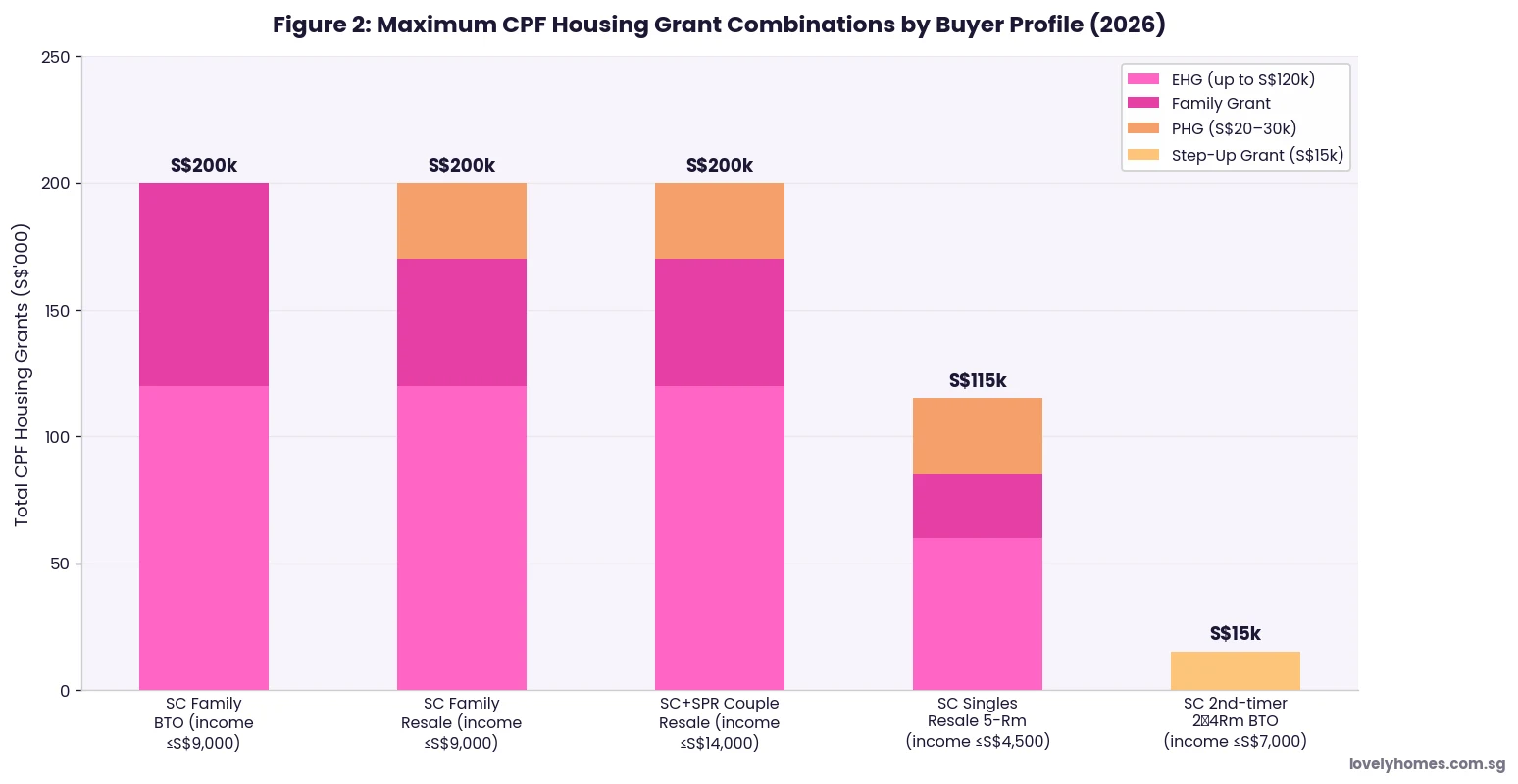
  • HDB BTO is the cheapest entry — subsidised prices plus up to S$200,000 in CPF grants for eligible families.
  • MSR 30% — for HDB loans, your monthly mortgage cannot exceed 30% of gross income.
  • TDSR 55% — for any property loan, total debt obligations (including car, personal loans) cannot exceed 55% of gross income, administered by MAS.
  • HDB downpayment — 10% if using HDB concessionary loan; 25% (5% cash mandatory) if using a bank loan.
  • Private property downpayment — 25% total (5% cash OTP, 20% CPF/cash); maximum loan-to-value (LTV) is 75%.
  • Buyer’s Stamp Duty (BSD) is payable by all buyers — from 1% on the first S$180,000 to 6% on amounts above S$3M.
  • BTO wait time — typically 3 to 5 years; Shorter Waiting Time (SWT) flats offer ~3 years.
  • Resale HDB — ready immediately but no CPF housing grants via HDB loan if income exceeds ceiling; also subject to Cash-over-Valuation (COV).
  • New launch private — no HDB eligibility restrictions, but no CPF grants, higher prices, and progress payments apply.

Who Qualifies as a First-Time Buyer in Singapore?

The Singapore government defines a first-time residential property buyer as a person who has not previously owned or held any residential property (HDB flat, private condo, landed property) in Singapore. First-timers benefit from zero ABSD on their purchase, as well as priority balloting for HDB BTO flats.

For HDB flats specifically, citizenship and household composition also matter. Singapore Citizens (SC) can purchase both HDB flats and private property. Singapore Permanent Residents (SPR) may buy HDB resale flats (subject to Ethnic Integration Policy and Non-Citizen Quota) but cannot purchase new HDB BTO flats directly. Foreigners cannot purchase HDB flats at all and face a 60% ABSD on private property purchases since April 2023.

Income ceilings apply for HDB BTO and some grant schemes. For most BTO exercises in 2026, the gross monthly household income ceiling is S$14,000 (or S$21,000 for multi-generation families).

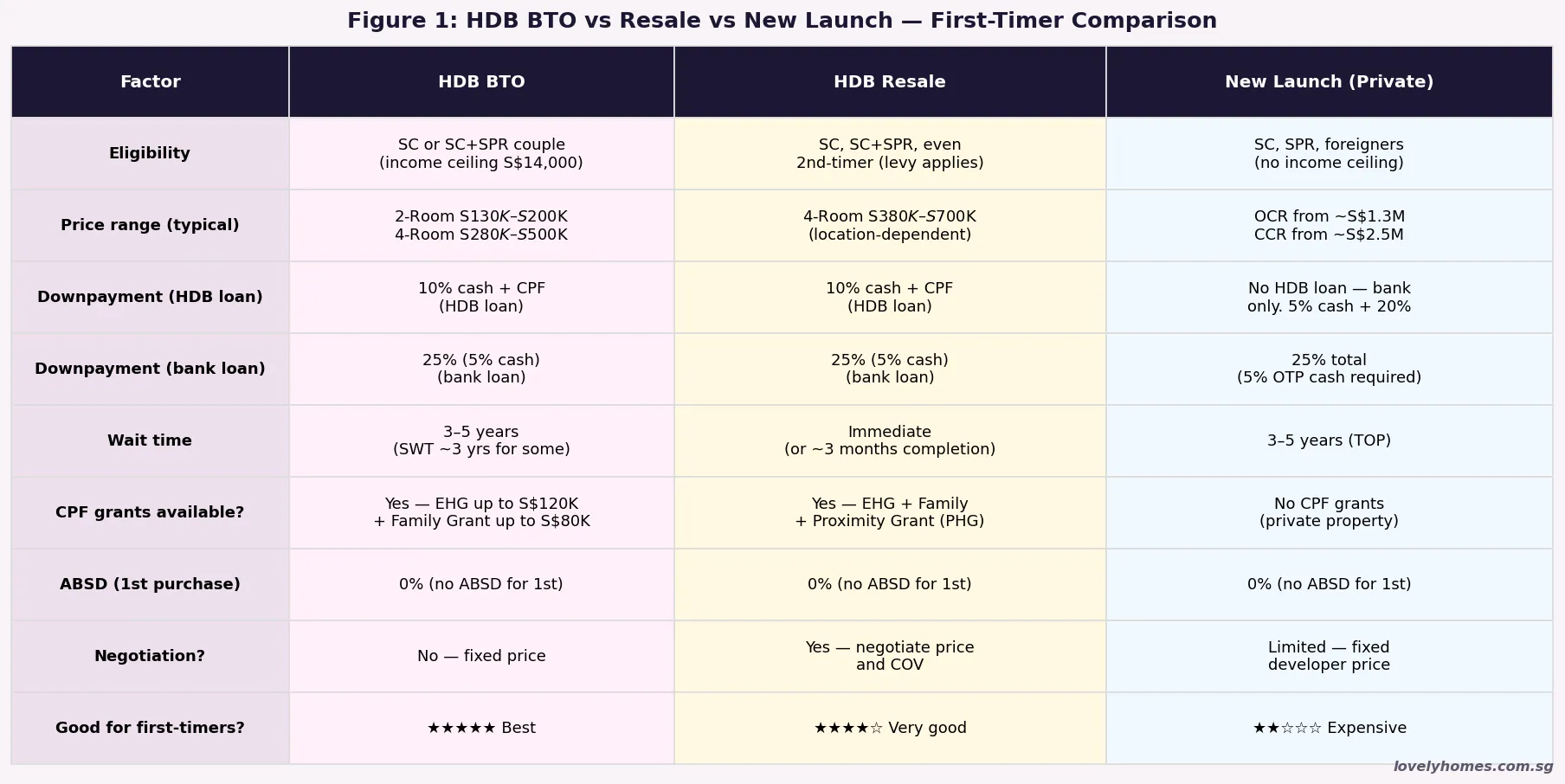
HDB BTO vs resale vs new launch comparison Singapore 2026 first-time buyer guide
Figure 1: HDB BTO vs HDB Resale vs New Launch Private — First-Timer Comparison (2026). Click to enlarge.

Understanding Your Budget: TDSR, MSR, LTV and Downpayment

Before choosing between HDB and private property, you must understand what you can actually borrow. Two MAS-administered rules govern this:

Rule Applies To Limit Administered By
MSR (Mortgage Servicing Ratio) HDB loans and bank loans for HDB/EC 30% of gross monthly income MAS / HDB
TDSR (Total Debt Servicing Ratio) All property loans 55% of gross monthly income MAS
LTV — HDB concessionary loan HDB flats, HDB loan 80% of flat value HDB
LTV — Bank loan (1st property) Any property, bank loan 75% of property value MAS
Minimum cash downpayment (HDB loan) HDB flat 0% cash; 10% from CPF/cash HDB
Minimum cash downpayment (bank loan) Any property 5% cash; remaining 20% CPF/cash MAS

Your TDSR calculation includes all monthly obligations — mortgage, car loan, student loan, credit card minimum payments. If you carry a car loan of S$900/mth, that reduces your maximum mortgage by the same amount.

For HDB buyers using an HDB loan, the HDB concessionary rate in 2026 is 2.60% per annum — 0.10% above the CPF Ordinary Account interest rate of 2.50%. Bank loan rates in Q2 2026 range from approximately 1.55% (1-year fixed) to 1.80% (SORA-linked floating), making banks cheaper in the short term but subject to rate revision. Read our full mortgage guide 2026 for a detailed comparison.

CPF Housing Grants for First-Time Buyers

One of the most powerful tools for Singapore first-time buyers is the suite of CPF Housing Grants administered by HDB. These are disbursed directly to reduce the purchase price or go towards the mortgage, and are not counted as income. Only HDB flats (BTO and resale) qualify — private property purchases do not attract CPF grants.

CPF housing grants by buyer profile Singapore 2026 EHG family grant PHG
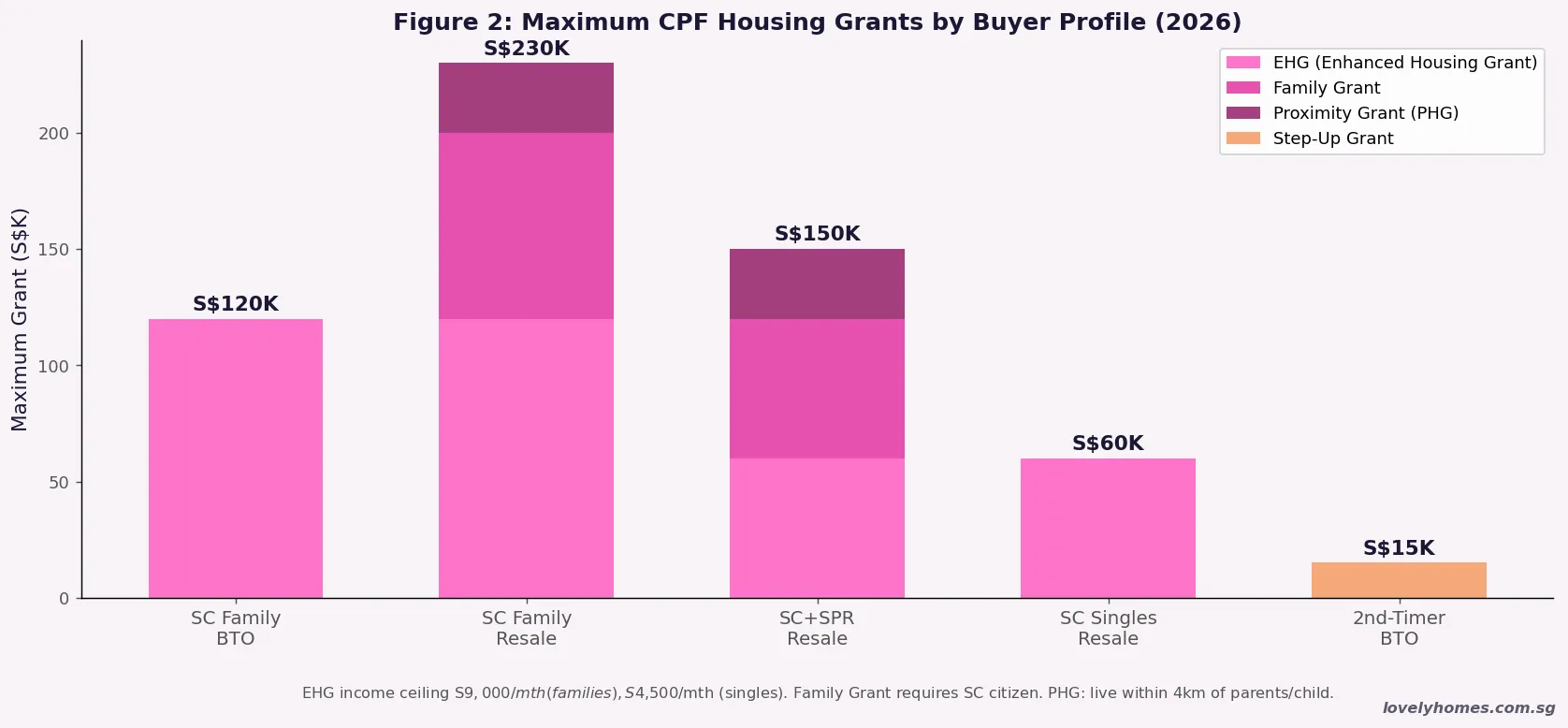
Figure 2: Maximum CPF Housing Grants by Buyer Profile (2026). Stacked from left: EHG, Family Grant, Proximity Grant, Step-Up Grant. Click to enlarge.

Key grants in 2026 (updated from August 2024 enhancements):

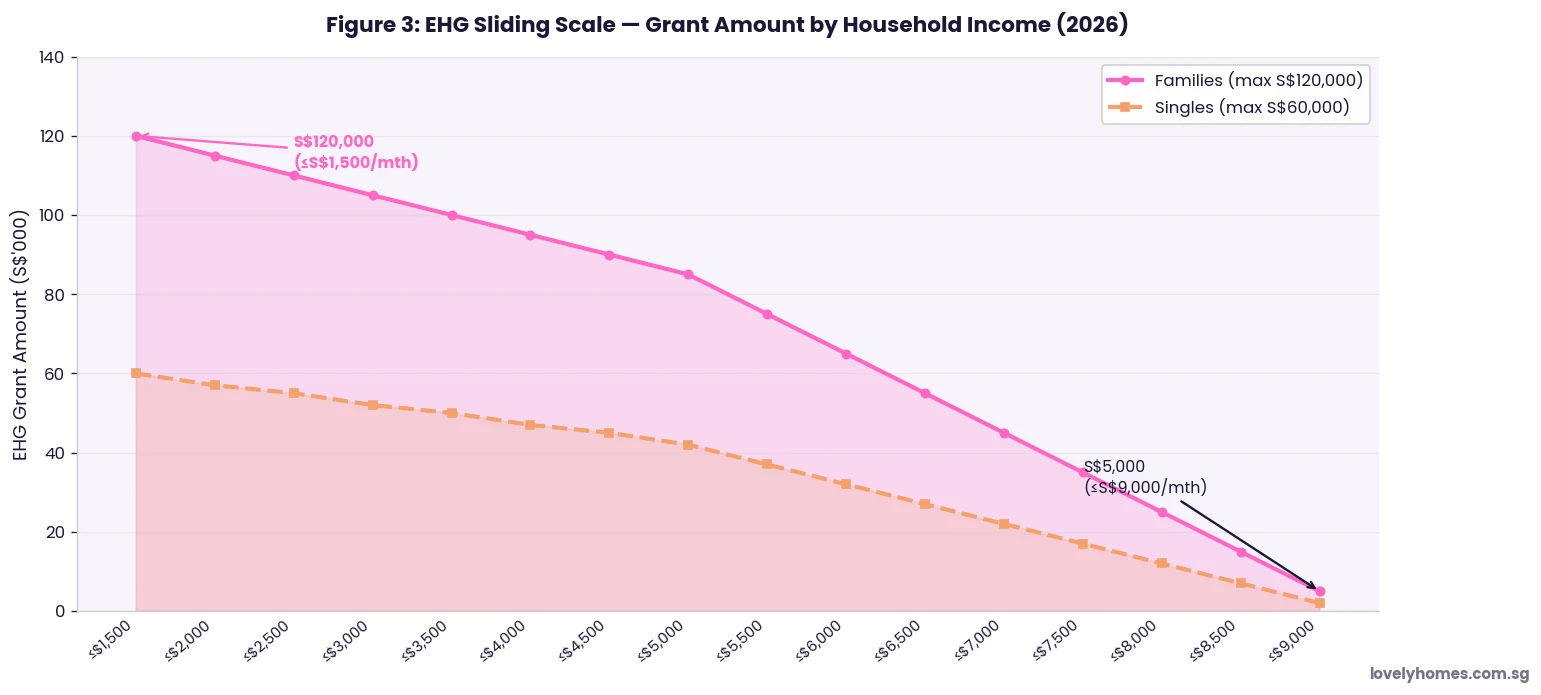
Enhanced Housing Grant (EHG) — income-tested grant of up to S$120,000 for families and S$60,000 for singles. Administered by HDB. The amount scales with income: households earning up to S$1,500/mth receive the full S$120,000; the grant tapers to S$5,000 at S$9,000/mth (families). For a full breakdown, see our CPF Housing Grant Guide 2026.

Family Grant — S$50,000–S$80,000 for SC couples buying resale HDB flats; S$40,000–S$60,000 for SC+SPR couples. Administered by HDB. Available on resale flats only (not BTO). Amount depends on whether both applicants are SC or one is SPR, and on the flat type purchased.

Proximity Housing Grant (PHG) — up to S$30,000 (living with parents) or S$20,000 (living near parents, within 4 km) for resale purchases. Both buyer and parent must be SC. Recipients must maintain the proximity arrangement for five years or refund the grant pro-rata.

Step-Up CPF Housing Grant — S$15,000 for second-timers who previously stayed in a 2-room flat and are upgrading to a 2-room or 3-room BTO flat. Not applicable for most typical first-time buyers.

Buyer’s Stamp Duty for First-Time Buyers

Every property purchase in Singapore is subject to Buyer’s Stamp Duty (BSD), administered by the Inland Revenue Authority of Singapore (IRAS). BSD applies to all buyers regardless of nationality or ownership count. First-time SC buyers pay 0% ABSD but still pay BSD.

BSD 2026 rates (on the higher of purchase price or market value):

Property Value Band BSD Rate BSD Payable on Band
First S$180,000 1% S$1,800
Next S$180,000 2% S$3,600
Next S$640,000 3% S$19,200
Next S$500,000 4% S$20,000
Next S$1,500,000 5% S$75,000
Amount above S$3,000,000 6% On remainder

On a typical resale 4-room HDB flat at S$480,000, BSD = S$1,800 + S$3,600 + (S$120,000 × 3%) = S$9,000. BSD must be paid within 14 days of the Option to Purchase (OTP) being exercised. IRAS levies a 5% penalty for late payment.

For a deeper dive into all stamp duty rules including ABSD and the SC upgrader remission, see our complete ABSD Singapore 2026 guide.

HDB BTO vs Resale vs New Launch: Which Is Right for You?

The fundamental decision for every Singapore first-time buyer is which housing type to pursue. There is no single right answer — it depends on your income, timeline, family situation, and priorities.

HDB BTO is almost always the best value proposition for eligible first-timers. With government subsidies baked in and CPF grants on top, a typical SC couple earning S$8,000/mth could buy a 4-room BTO flat in a non-mature estate for S$280,000–S$350,000 before grants — effectively S$160,000–S$230,000 net after an EHG+Family Grant stack of up to S$120,000. The downside is the wait: 3 to 5 years before you receive your keys, although Shorter Waiting Time flats (around 2.5–3 years) are now available in every BTO exercise.

HDB Resale offers immediacy — you can move in within 8–12 weeks of OTP exercise. Resale flats are eligible for the Family Grant and PHG (but not EHG for buyers above the income ceiling), and there is no income ceiling for the resale purchase itself. However, prices have appreciated significantly: a Tampines 4-room resale in Q1 2026 averages around S$498,000, and Central-area mature estate 4-room flats exceed S$700,000. Cash-over-Valuation (COV) is not covered by CPF and must be paid in cash.

New Launch Private Condo is the most flexible option in terms of nationality eligibility (SC, SPR, foreigners all qualify) but also the most expensive. With OCR new launches from around S$1.3M for a studio/1-bedroom unit in 2026, the cash outlay — 5% OTP in cash, 20% in CPF/cash, BSD ~S$28,600 — is substantial. There are no CPF grants. The advantage is that ABSD is 0% for a first-time SC buyer and the development is brand new, but you will wait 3–5 years for TOP. See our complete new launch condo buying guide 2026 for the full process.

Maximum affordable property price by gross income Singapore first-time buyer 2026
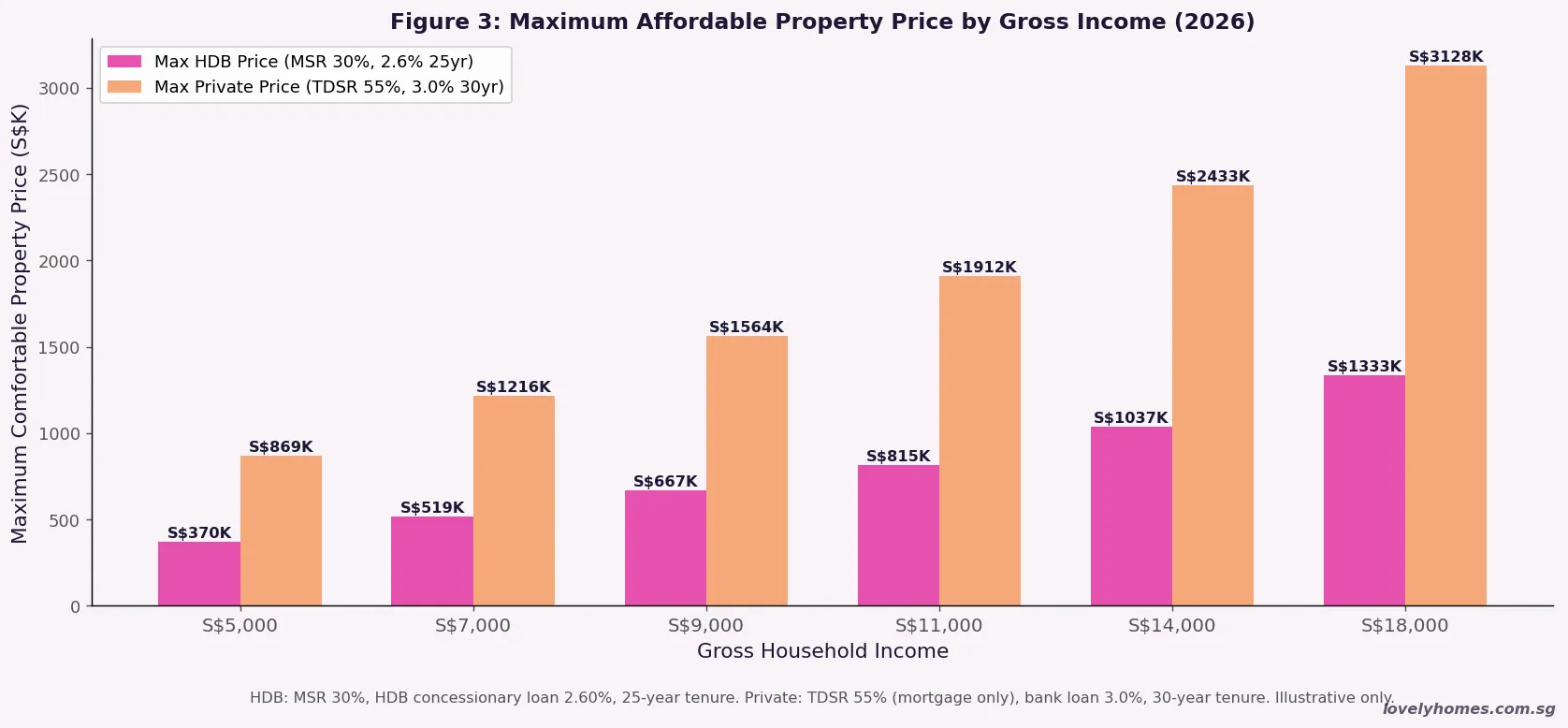
Figure 3: Maximum Affordable Property Price by Gross Household Income (2026). Based on MSR 30% for HDB and TDSR 55% for private. Click to enlarge.

Worked Example: The Tan Family

👤 Case Study: SC Couple, S$8,500/mth Combined, First-Time Buyers — Sengkang

Profile: Mr and Mrs Tan, Singapore Citizens, combined gross income S$8,500/mth, no existing debt. Looking for a 4-room flat in Sengkang, both aged 30.

Option A — HDB BTO (Sengkang, 4-Room, estimated S$310,000):

  • EHG: S$50,000 (income-tested at S$8,500/mth); Family Grant: S$50,000 — total grants S$100,000
  • Net price after grants: S$210,000
  • HDB loan (80% LTV): S$168,000 @ 2.60%, 25 years → monthly S$759/mth
  • MSR: S$759 ÷ S$8,500 = 8.9% ✓ Well below 30%
  • BSD on S$310,000: S$1,800 + S$3,600 + (S$130,000 × 3%) = S$9,300
  • Total cash outlay: S$9,300 (BSD) + S$42,000 (10% DP) = S$51,300 (mostly CPF)
  • Wait: ~3–4 years

Option B — HDB Resale (Sengkang 4-Room, S$480,000):

  • EHG (if S$8,500 ≤ S$9,000 ceiling): S$30,000; Family Grant: S$50,000; PHG: S$20,000 — total grants S$100,000
  • HDB loan (80% LTV on S$460,000 valuation): S$368,000 @ 2.60%, 25 years → S$1,664/mth
  • MSR: S$1,664 ÷ S$8,500 = 19.6% ✓ Below 30%
  • BSD: S$1,800 + S$3,600 + (S$120,000 × 3%) = S$9,000
  • COV (S$480K purchase − S$460K valuation): S$20,000 in cash
  • Total cash outlay: S$9,000 (BSD) + S$48,000 (10% DP) + S$20,000 (COV) = S$77,000
  • Available immediately

Option C — New Launch OCR Studio, S$1,350,000:

  • No CPF grants available
  • Bank loan (75% LTV): S$1,012,500 @ 3.0%, 30 years → S$4,270/mth
  • TDSR: S$4,270 ÷ S$8,500 = 50.2% ✓ Below 55% but stretched
  • BSD: S$1,800 + S$3,600 + S$19,200 + S$20,000 + (S$30,000 × 5%) = S$46,100
  • Cash outlay: S$67,500 (5% OTP cash) + S$270,000 (20% CPF/cash) + S$46,100 (BSD) = S$383,600
  • Wait: ~4 years for TOP

Verdict: For the Tan family at S$8,500/mth, Option A (BTO) offers the best value. Option B (resale) is viable with a higher cash outlay. Option C (new launch) is technically possible but leaves minimal financial headroom. The right choice depends on their urgency for housing and CPF savings available.

What This Means for First-Time Buyers in 2026

Singapore’s first-time buyer landscape in 2026 is shaped by three big forces. First, interest rates have fallen significantly — 3-month compounded SORA sits near 1.07% as at Q2 2026, down from a peak of 3.52% in late 2023. This meaningfully improves affordability for bank-loan borrowers. A S$500,000 HDB loan at 3.4% cost S$2,475/mth; at 1.65% it costs S$1,999/mth — a saving of S$476/mth.

Second, HDB supply has increased substantially. With 19,600 BTO flats across three 2026 exercises (February, June, October), competition ratios for non-mature town BTO flats have eased compared to the pandemic-era crush of 2020–2022. The June 2026 BTO exercise alone launched 6,952 units including the first Bishan flats in 40 years. However, mature-town and Prime/Plus-classified flats remain competitive.

Third, HDB resale and private property prices remain elevated. Private property values rose 3% in 2025 and a further 0.9% in Q1 2026, making affordability a genuine concern for first-timers targeting private condos. HDB resale prices moderated slightly — the Resale Price Index fell 0.1% in Q1 2026, the first dip since Q1 2023 — but headline prices in mature estates are still at record highs.

What Might Come Next for First-Time Buyers

Looking into 2H2026 and 2027, several policy and market developments are worth monitoring. URA’s Q2 2026 Flash Estimates are expected in early July 2026 and will indicate whether the mild Q1 2026 slowdown in private prices has continued. The October 2026 BTO exercise is the third and final major exercise of the year — buyers who missed June should prepare for October.

On the financing front, analysts expect MAS to maintain its current TDSR and MSR thresholds, though any renewed inflationary pressure could prompt review. The CPF Ordinary Account interest rate (currently 2.50% p.a., underpinning the HDB loan rate of 2.60%) is reviewed quarterly.

En-bloc activity is also expected to increase in 2026–2028 as older estates mature. This will release more resale units into the market but also reduce the supply of older affordable stock. First-timers watching the URA pipeline would note that 17,032 units from the 42,561-unit private residential pipeline remain unsold, which should moderate new launch price growth through 2026.

Frequently Asked Questions

Can a Singapore Citizen buy a HDB flat and a private property at the same time?

Yes, an SC may own both — but strict sequencing rules apply. If you buy a private property while still owning a HDB flat, you must sell the HDB flat within six months of the private purchase. Failure to do so means the ABSD remission for SC upgraders is not available and 20% ABSD on the second purchase is permanently forfeited. There is no restriction on owning a private property first and then buying an HDB flat, provided you sell the private property before or at the time of the HDB purchase (subject to HDB eligibility rules including MOP restrictions).

Do first-time buyers pay ABSD in Singapore?

Singapore Citizens buying their first residential property pay 0% ABSD. Singapore Permanent Residents (SPR) buying their first property pay 5% ABSD. Foreigners pay 60% ABSD regardless of purchase count. BSD (Buyer’s Stamp Duty) is payable by all buyers on every purchase. Note: if you have previously owned any residential property — including inherited property or overseas property — you are technically not a first-time buyer for ABSD purposes, and the relevant ABSD rates for your second or subsequent purchase apply.

Can I use CPF to pay for my downpayment and BSD?

For HDB flats with an HDB concessionary loan, you may use your CPF Ordinary Account (OA) balance to fund the full 10% downpayment and to pay BSD. No minimum cash is required beyond normal living expenses. For bank loans (HDB or private), the mandatory 5% cash OTP payment cannot be funded by CPF — it must come from cash. The remaining 20% of the downpayment may be paid from CPF OA, cash, or a combination. BSD may be paid via CPF for both HDB and private purchases, provided sufficient OA balance exists.

What is the HDB Flat Eligibility (HFE) letter and is it mandatory?

The HDB Flat Eligibility (HFE) letter is a document issued by HDB confirming your eligibility to purchase an HDB flat (BTO or resale), your indicative CPF grant quantum, and your indicative HDB loan eligibility. From May 2023 onward, the HFE letter replaced the old HDB Loan Eligibility (HLE) letter and CPF Housing Grant eligibility letter. It is mandatory — you cannot exercise an OTP for a resale flat, or apply for a BTO flat, without a valid HFE letter. An HFE letter is valid for 9 months from the date of issue. Apply via the HDB website with your Singpass account.

I earn above S$14,000/mth. Can I still buy an HDB flat?

The S$14,000/mth gross household income ceiling applies to BTO flat applications in most (non-PLH) exercises. For resale HDB flats, there is no income ceiling — any SC/SPR household may purchase a resale flat regardless of income, subject to standard eligibility rules (MOP, family nucleus, citizenship). However, CPF housing grants (EHG, Family Grant, PHG) all have income ceilings: the EHG phases out completely above S$9,000/mth, and the Family Grant is available up to S$14,000/mth. If you earn above S$14,000/mth, a resale HDB flat remains an option but you will not receive any CPF grants.

What happens to my CPF when I sell my first home?

When you sell your property, you must refund your CPF Ordinary Account for all CPF principal withdrawn plus accrued interest at the CPF OA rate of 2.5% per annum, compounded annually. This refund goes back into your CPF account — it is not lost, but it is no longer immediately accessible as cash. For example, if you withdrew S$200,000 from CPF over 10 years, you must refund approximately S$255,680 (principal + accrued interest at 2.5% compound). This significantly affects your net cash proceeds on sale. See our complete guide to CPF accrued interest for a full worked example.

Should I buy a HDB flat first or a private condo first?

This is the classic Singapore property question. Buying HDB first (with grants) and upgrading to private later is the conventional path: you maximise government subsidies, build CPF equity, and then use the HDB sale proceeds plus CPF refund as your private downpayment. The ABSD remission for SC couples buying their second property while still owning an HDB flat means you pay 20% ABSD upfront but receive it back (net of nil) provided you sell the HDB within 6 months of the private purchase — this is the standard upgrader route. Buying private first and then buying HDB is allowed, but you must sell the private property first; you also miss out on the HDB grants entirely if you have previously owned private property.

Disclaimer: This article is for general information only and does not constitute financial or legal advice. Property prices, stamp duty rates, CPF policies, and HDB rules are subject to change. Always verify current figures with official sources: HDB, IRAS, CPF Board, URA, and MAS. Seek advice from a licensed financial adviser or HDB-appointed housing agent before committing to any purchase.


Click anywhere to close

Singapore CPF Accrued Interest for Property 2026: What You Owe Your CPF When You Sell

Singapore CPF Accrued Interest for Property 2026: What You Owe Your CPF When You Sell

Quick Answer: CPF Accrued Interest for Property

  • CPF accrued interest is the interest your CPF Ordinary Account (OA) would have earned had you not withdrawn the funds to buy property — currently 2.5% per annum.
  • When you sell your property, the CPF Board requires you to refund both the principal withdrawn and the full accrued interest back to your CPF OA — not to your bank account.
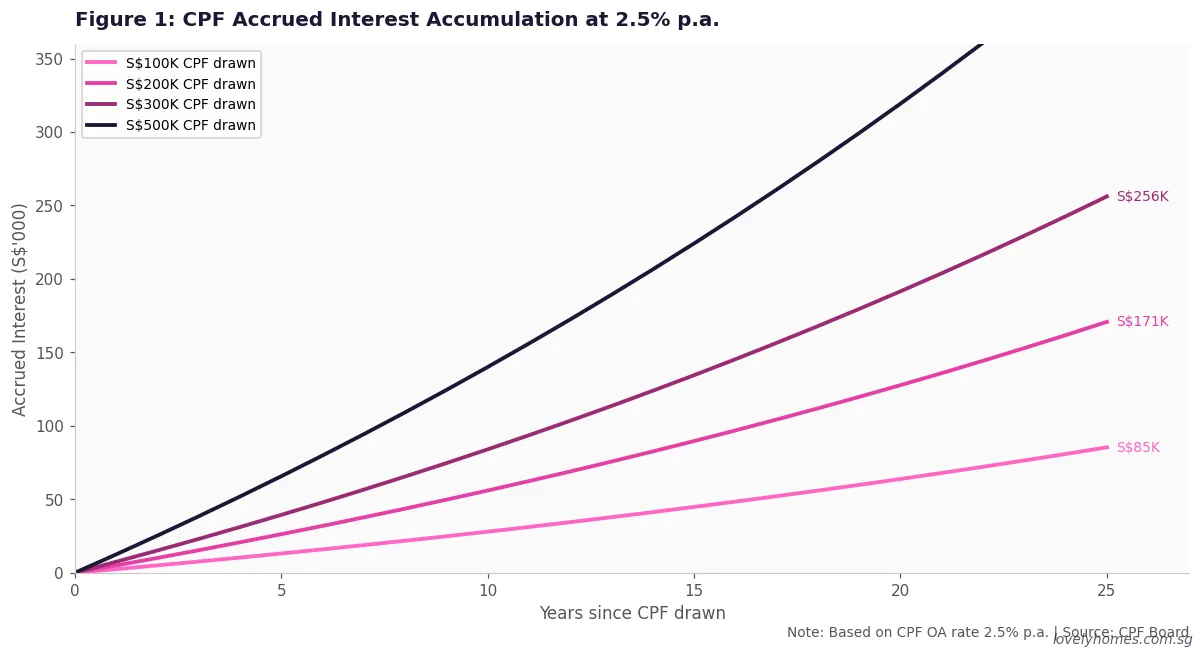
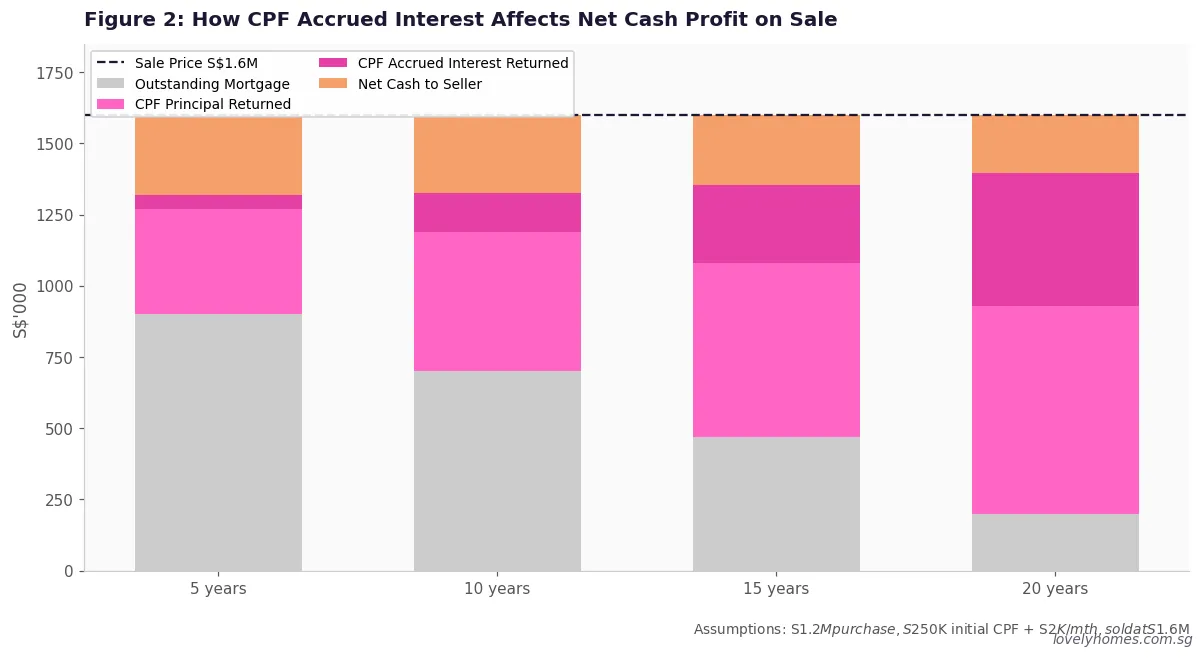
  • This reduces your net cash proceeds from the sale. A S$200,000 CPF draw held for 15 years accrues approximately S$84,600 in interest that must be returned to CPF.
  • The Valuation Limit (VL) caps total CPF usage at the lower of the property’s purchase price or current market value. A separate Withdrawal Limit (WL) may apply based on lease coverage to age 95.
  • Since September 2019, most buyers must set aside the Basic Retirement Sum (BRS — S$106,500 in 2026) before drawing CPF OA above the Valuation Limit.
  • CPF accrued interest exists to protect retirement adequacy: it ensures property investment does not permanently erode your retirement savings.
  • The refunded amount goes straight back into your CPF OA at 2.5%, where it continues compounding for retirement.

What Is CPF Accrued Interest?

Every Singaporean or Permanent Resident who uses Central Provident Fund (CPF) monies to buy property faces a concept that surprises many first-time sellers: accrued interest. The CPF Board does not charge you interest while you hold the property — but when you eventually sell, it expects the full opportunity cost of having used those retirement savings to be returned.

In plain terms, accrued interest is the amount your CPF OA would have grown at 2.5% per annum had you never withdrawn the funds. The Board administers this under the Central Provident Fund Act (Cap 36) and the associated CPF (Investment Schemes) Regulations. The policy exists for a straightforward reason: Singapore’s CPF is a compulsory retirement savings system. If property buyers could permanently deplete their OA without consequence, many Singaporeans would reach 65 with inadequate retirement savings.

The 2.5% floor rate has applied to CPF OA since January 2008 and is reviewed quarterly. As of the April–June 2026 quarter, the OA rate remains at 2.5% per annum. An additional 1% interest is earned on the first S$60,000 of combined CPF balances (capped at S$20,000 from OA), but this extra 1% does not apply to the CPF property withdrawal for accrued interest calculation purposes — only the base 2.5% accrues on property funds.

How Accrued Interest Is Calculated

The calculation is straightforward compound interest. For each CPF withdrawal used for property, accrued interest accumulates from the day of each payment until the date the funds are returned to CPF on sale or redemption:

Accrued Interest = Principal × ((1.025)n − 1)
where n = number of years since the withdrawal

In practice, most buyers make multiple CPF withdrawals over the loan tenure — each monthly CPF mortgage payment starts accruing interest from its withdrawal date. The total accrued interest is the sum across all individual withdrawals. The CPF Board’s My CPF portal provides a real-time running total under “Property” → “CPF Usage for Property.”

As an illustration, consider a buyer who drew S$150,000 from CPF at purchase and continued monthly payments of S$2,000 over 10 years. After 10 years, the initial S$150,000 would have accrued approximately S$40,900 in interest, while the monthly payments would each carry their own accrued interest based on how long ago they were drawn. The total CPF refund on sale would be well in excess of the S$174,000 principal drawn.

CPF accrued interest growth at 2.5% per annum over 25 years — Singapore property CPF rules
Figure 1: Accrued interest accumulation at 2.5% p.a. for four CPF principal amounts over 25 years. A S$300,000 CPF draw held for 20 years generates S$187,400 in accrued interest that must be returned to CPF on sale.

The Valuation Limit and Withdrawal Limit

Two separate caps govern how much CPF you can use on a property purchase. Understanding both prevents unpleasant surprises — particularly for buyers of older or shorter-lease properties.

Valuation Limit (VL)

The Valuation Limit is the lower of the purchase price or the property’s market value at the time of purchase. You may not use more CPF OA funds on the property than the VL, unless your combined CPF OA and Special Account balances meet or exceed the Full Retirement Sum (FRS — S$213,000 in 2026) — in which case you may draw up to 120% of VL. For most buyers who purchase below the FRS threshold, the VL effectively caps total CPF usage.

Why does this matter? If you overpay for a property — say you pay S$850,000 for a flat valued at S$820,000 — the VL is S$820,000, not your purchase price. Your CPF cannot bridge that S$30,000 gap in over-valuation; cash is required.

Withdrawal Limit (WL) for Properties Below 60 Years Remaining Lease

From May 2019, the CPF Board applies a further lease-based restriction. If the property’s remaining lease at the time of purchase does not cover the youngest buyer to at least age 95, the WL is pro-rated downward. For example, a 40-year-old buyer purchasing a property with 50 years of lease remaining would fall short of the age-95 threshold (50 years takes them to age 90, not 95). In such cases, the CPF withdrawal is pro-rated: the buyer can only use CPF up to an amount proportional to the lease years that do cover the household to age 95.

Properties with fewer than 20 years of remaining lease cannot use CPF at all. The CPF Housing Usage Calculator at cpf.gov.sg provides exact withdrawal limits for any property and buyer age combination.

BRS and FRS: The Retirement Set-Aside Rules

Since 1 September 2019, the CPF Board requires that before you can use CPF OA funds to service your mortgage beyond the Valuation Limit, you must have set aside the Basic Retirement Sum (BRS) in your CPF Special Account or Retirement Account. The BRS for 2026 is S$106,500. This rule was introduced specifically to ensure that frequent upgraders and investors do not repeatedly hollow out their retirement savings across successive property purchases.

For most first-time buyers well below the BRS threshold, this rule has little immediate impact — they are drawing CPF well within the VL, so the BRS set-aside is not triggered. The rule primarily affects buyers aged 35 and above who have made multiple property transactions and have significantly depleted their Special Account balances.

CPF accrued interest impact on net cash profit from property sale Singapore 2026
Figure 2: How CPF accrued interest erodes net cash profit over time. A property sold at S$1.6M after 20 years yields significantly less cash than the same property sold after 5 years, because a larger CPF refund (principal plus decades of accrued interest at 2.5% p.a.) must be returned to CPF.

Summary Table: CPF Property Rules at a Glance

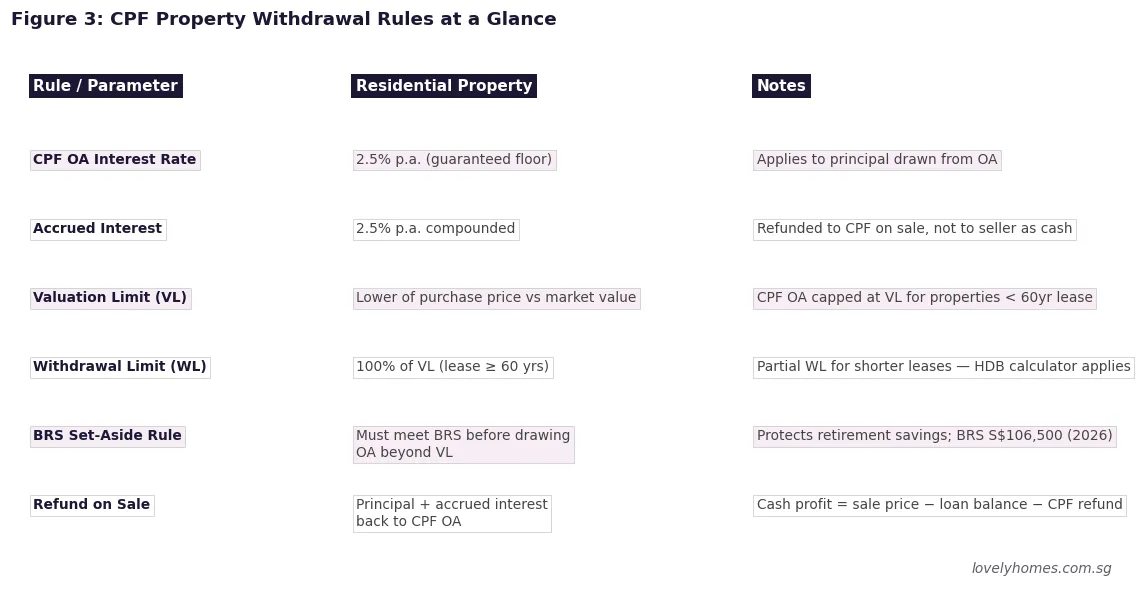
Parameter Rule / Rate Key Notes
CPF OA Interest 2.5% p.a. (floor) Guaranteed; reviewed quarterly
Accrued Interest Rate 2.5% p.a. (same) Compounds annually on each withdrawal from date drawn
Valuation Limit Lower of purchase price or market value Can draw up to 120% VL if FRS met (S$213,000 in 2026)
Withdrawal Limit Pro-rated for leases <60 yrs No CPF use for <20 yrs remaining lease
BRS Set-Aside S$106,500 (2026) in SA/RA Required before drawing OA beyond VL (from Sept 2019)
Refund on Sale Principal + accrued interest Refund goes to CPF OA, not to seller’s bank
Net Cash to Seller Sale price − loan − CPF refund Cash profit can be zero even if property appreciated
CPF property withdrawal rules Singapore 2026 valuation limit withdrawal limit BRS
Figure 3: CPF property withdrawal rules at a glance — valuation limits, withdrawal limits, and BRS requirements for Singapore property buyers in 2026.

Worked Example: The Chua Family’s CPF Reality

Mr and Mrs Chua (Singapore Citizens, joint purchasers) bought a three-bedroom condominium in Bishan in January 2014 at S$1,350,000. They took a bank loan of S$1,012,500 (75% LTV). At purchase, the property was valued at S$1,350,000, so the VL was S$1,350,000. Neither had met the FRS at that time, so the BRS rule did not restrict their withdrawal.

Over 12 years, their CPF usage breaks down as follows:

  • Initial lump-sum CPF payment (downpayment): S$180,000 drawn in January 2014
  • Monthly CPF mortgage payments: S$2,800/month × 144 months = S$403,200 drawn progressively
  • Total CPF principal drawn: approximately S$583,200

By January 2026 (12 years later), the accrued interest on the initial S$180,000 draw alone is approximately S$180,000 × (1.02512 − 1) = S$55,400. The 144 monthly payments also each carry accrued interest from their respective withdrawal dates. Using the CPF Housing Usage Calculator, total accrued interest on all withdrawals by sale date is approximately S$109,500.

The Chuas sell in February 2026 at S$1,820,000. Their net position:

Item Amount
Sale Price S$1,820,000
Outstanding Mortgage Balance − S$398,000
CPF Principal Refund − S$583,200
CPF Accrued Interest Refund − S$109,500
Agent Commission (1%) − S$18,200
Legal & Other Selling Costs − S$5,500
Net Cash to Chuas S$705,600
CPF Refund returns to OA (combined) S$692,700

The S$470,000 gain (S$1,820,000 − S$1,350,000) splits roughly S$705,600 cash and S$692,700 back into CPF. The Chuas are not “poorer” — they have more CPF — but their liquid cash gain is less than the headline appreciation might suggest. Planning this number in advance is essential for anyone considering whether to upgrade, downgrade, or hold.

Why This Matters for Your Property Decisions

CPF accrued interest is one of the most misunderstood elements of Singapore property finance. Several important strategic considerations flow from understanding it correctly.

The cash-poor paper-rich problem. Many long-term property owners are surprised to find that a flat they bought for S$350,000 and sold for S$620,000 yields minimal cash because decades of CPF mortgage payments — all accruing at 2.5% — consume most of the apparent gain. The gain is real, but it goes back into CPF, not the bank account. For owners approaching 55 who plan to withdraw CPF as cash, this distinction narrows considerably — once CPF is returned after sale, it becomes withdrawable from 55 at the applicable rates.

Upgrading strategy. The CPF refund that goes back into your OA after a sale can be used to fund the downpayment on the next property. This gives upgraders a mechanism to “recycle” their CPF through property. However, each successive property restarts the accrued interest clock, so the compounding effect accelerates with each transaction. Buyers planning to sell within 5 years should carefully model whether the expected price appreciation offsets BSD, SSD (if applicable), agent fees, and the lost opportunity cost of the CPF accrued interest refund.

Decoupling and joint ownership. Spouses who hold a property jointly and wish to decouple (one transfers their share to the other) are not selling in the conventional sense, but a partial transfer still triggers a partial CPF refund proportional to the share transferred. This is an important cost to factor into any decoupling calculation. The relevant guide on joint property ownership rules in Singapore covers the full decoupling arithmetic.

Cash versus CPF for later payments. Some buyers choose to service later monthly mortgage instalments with cash rather than CPF OA, deliberately slowing the growth of accrued interest. This strategy can be useful for buyers who plan to sell within 5–7 years and want to maximise cash proceeds. However, it also reduces OA balance, which affects retirement adequacy. There is no single right answer — it depends on the buyer’s retirement planning horizon, expected holding period, and cash flow.

What Might Come Next

This section reflects informed analysis; it is not official CPF Board policy and should not be relied upon as financial advice.

The CPF Board periodically reviews its housing withdrawal rules in response to Singapore’s ageing demographics and retirement adequacy concerns. A possible future direction is a further tightening of the BRS/FRS set-aside thresholds — particularly for owners in the 55–65 age bracket who are using CPF to fund investment properties. The 2019 BRS rule was itself a tightening of the prior “CPF Minimum Sum” framework, and the Board has signalled that retirement adequacy remains a policy priority.

Some commentators have suggested that Singapore could eventually move towards a tiered accrued interest rate that adjusts based on holding period — charging a lower notional rate for long-term owner-occupiers and a higher rate for investment properties. This would be a significant structural change and would require legislative amendment. As of June 2026, no such proposal has been announced by the CPF Board or the Ministry of Manpower.

For current policy, buyers and sellers should refer to the CPF Board’s Home Ownership pages and consult a licensed financial adviser for personalised guidance.

FAQ: CPF Accrued Interest for Property

If I sell my property at a loss, do I still have to repay the CPF accrued interest?

Yes — the CPF refund obligation is not conditional on making a profit. You must return the principal plus accrued interest regardless of the sale outcome. If the net sale proceeds after clearing the mortgage are insufficient to cover the full CPF refund, you return whatever is available (the CPF Board will accept a shortfall if the property was sold at market value). You cannot be required to top up from other assets to meet the shortfall, but the remaining CPF debt is tracked and offsets future CPF top-ups.

Does CPF accrued interest apply to HDB flats purchased with a HDB loan?

Yes, the same accrued interest rules apply to HDB flat purchases whether financed by HDB loan or bank loan. When you sell an HDB flat, all CPF OA withdrawals used — including the initial downpayment, monthly instalments, and any renovation top-ups charged to CPF — accrue at 2.5% p.a. The HDB portal and the CPF My Account portal both show the running accrued interest total. One distinction for HDB buyers: Medisave is separate and is not counted toward property accrued interest.

Can I voluntarily repay CPF ahead of a sale to reduce accrued interest?

You cannot make a partial voluntary repayment of CPF used for property in order to reduce future accrued interest — the CPF Board only accepts the full refund at the time of property disposal or mortgage redemption. Some homeowners repay their bank mortgage ahead of schedule and then allow the property to be ‘unencumbered’, but this does not return CPF; the accrued interest clock continues running until the formal CPF refund is processed. If you fully redeem your bank loan, you can voluntarily refund the CPF used at that point, which stops the accrued interest clock — check the CPF Board’s procedures for voluntary property CPF refund.

Does accrued interest affect my CPF retirement account once it is returned?

Yes — the refunded principal and accrued interest go into your CPF OA (or SA/RA if you are 55 and above). Once in the OA, the funds earn 2.5% p.a. (or higher if the combined-balance bonus applies). If you are 55 or above, funds in your Retirement Account earn 4% p.a., making the CPF refund on sale even more valuable for retirement purposes. The bottom line is that the accrued interest mechanism transfers wealth from liquid cash to locked-away retirement savings rather than destroying it.

My property has appreciated significantly — will my CPF refund really affect my cash profit?

For strong appreciations over a short holding period, the CPF refund has a proportionally smaller impact. A property bought at S$800,000 in 2020 with S$200,000 CPF used (accrued interest ~S$27,000 after 6 years) sold at S$1,100,000 yields net cash of roughly S$873,000 before selling costs — the S$227,000 CPF refund is real but the S$300,000 price gain still nets significant cash. The impact is most pronounced when (a) holding periods are very long, (b) the property has appreciated modestly relative to CPF drawn, or (c) the mortgage balance is still high. Modelling your own CPF-adjusted proceeds before committing to a sale timeline is always worthwhile.

Do foreigners or PRs face the same CPF accrued interest rules?

Permanent Residents who have CPF OA balances may use their CPF to buy HDB flats (subject to eligibility) and resale private property (subject to Withdrawal Limit rules). The accrued interest rules apply identically to PRs. Foreign nationals do not have CPF accounts and therefore have no CPF accrued interest to consider — their entire purchase and sale proceeds are in cash. However, foreigners pay 60% ABSD on residential property purchases, which is a far more significant financial consideration. See our guide on the ABSD Singapore 2026 complete guide for full details.

How do I find out exactly how much CPF I have used and how much accrued interest has accumulated?

Log in to your CPF My Account portal at cpf.gov.sg using Singpass. Navigate to ‘My Dashboard’ → ‘Home Ownership’ → ‘Properties with CPF Withdrawals’. The portal shows a property-by-property breakdown of total CPF principal drawn, total accrued interest to date, and the refund amount applicable if you were to sell today. The figure updates daily. Both buyers and co-owners can view this for jointly-held properties. The CPF Board’s Housing Usage Calculator at cpf.gov.sg also lets you model future accrued interest projections for planning purposes.

Related Articles

Disclaimer

This article is for general informational purposes only and does not constitute financial, legal, or investment advice. CPF rules, interest rates, BRS/FRS/ERS thresholds, and housing policy are subject to change. Always verify current CPF rules at cpf.gov.sg and current MAS guidelines at mas.gov.sg. For personalised advice on CPF planning for property, consult a CPF-accredited financial planner or a licensed property professional registered with the Council for Estate Agencies (CEA). LovelyHomes.com.sg accepts no liability for reliance on the information provided herein.


Click anywhere to close

HDB Ethnic Integration Policy (EIP) Singapore 2026: Quotas, Eligibility and What Buyers Must Know

HDB Ethnic Integration Policy (EIP) Singapore 2026: Quotas, Eligibility and What Buyers Must Know

⚡ HDB EIP at a Glance — Quick Answer

  • What it is: The HDB Ethnic Integration Policy (EIP) is a quota system introduced in 1989 to maintain racial integration in HDB estates by capping the proportion of each ethnic group in any given block and neighbourhood.
  • Who administers it: HDB (Housing & Development Board), under the Ministry of National Development.
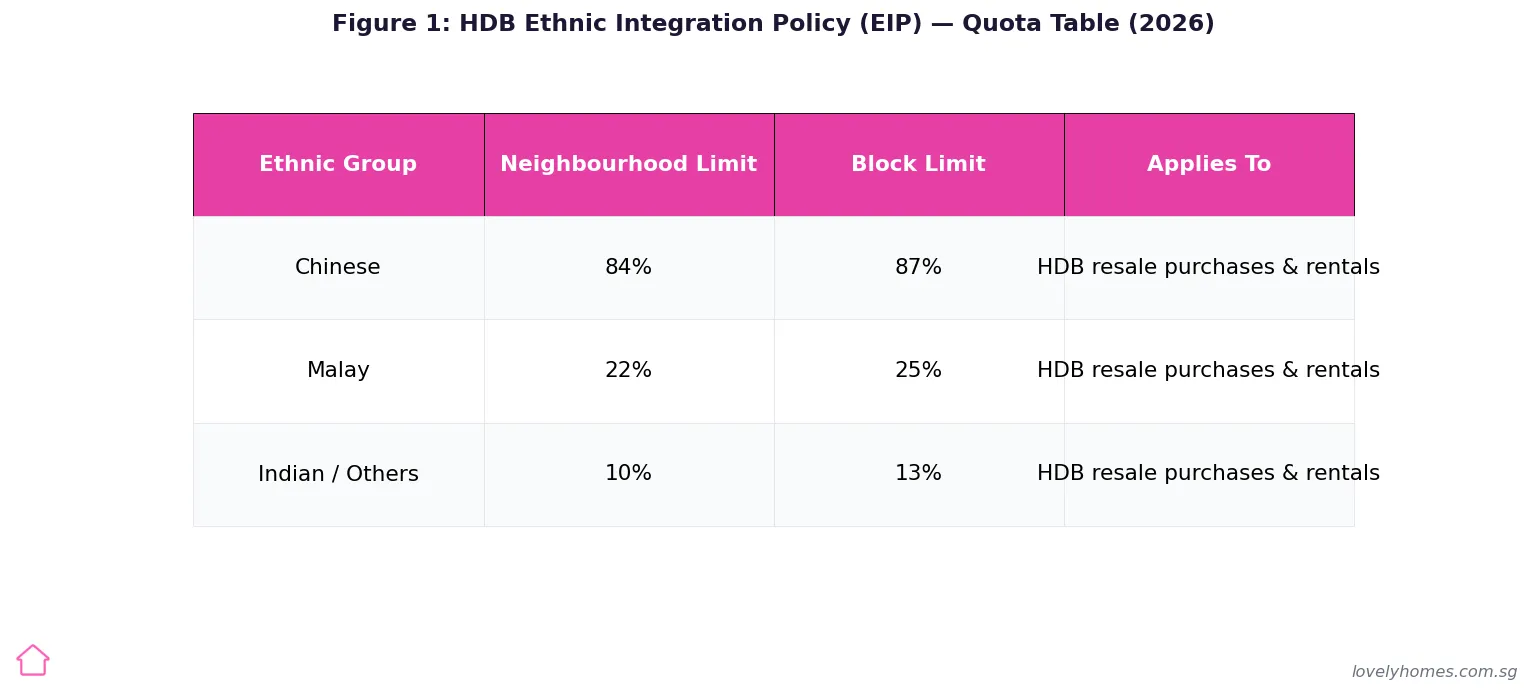
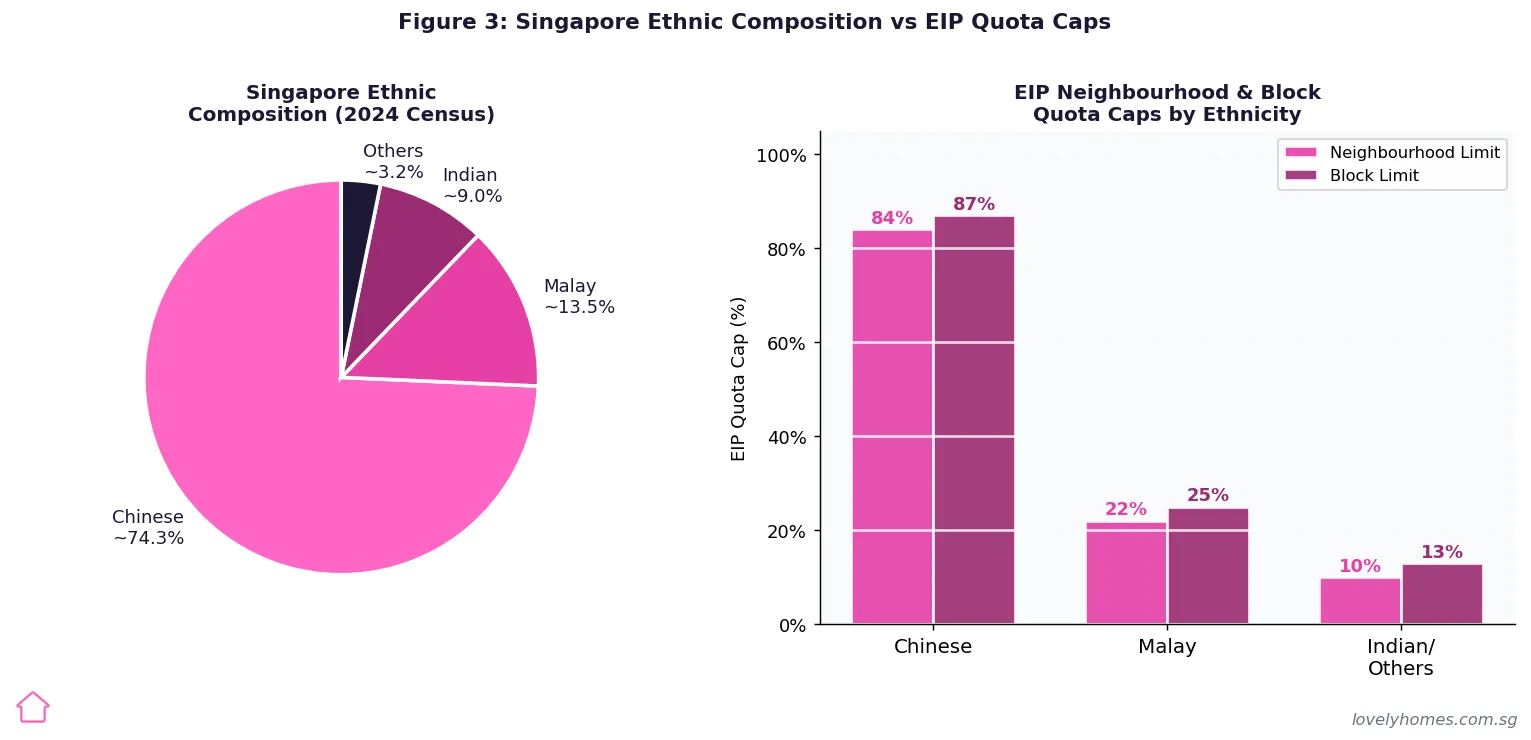
  • Quota limits: Chinese — 87% (block) / 84% (neighbourhood); Malay — 25% / 22%; Indian/Others — 13% / 10%.
  • Who is affected: Anyone buying or renting an HDB resale flat in Singapore — Singapore Citizens (SCs), Singapore Permanent Residents (SPRs), and HDB flat owners renting out.
  • Key risk: If a block or neighbourhood has reached the quota for your ethnic group, you cannot complete the resale purchase for that flat, even after exercising the OTP.
  • How to check: Via the HDB Resale Portal or by calling HDB directly — always check before signing any Option to Purchase (OTP).
  • SPR angle: SPRs face an additional SPR Quota (SPR households cannot exceed 5% of flats per block and 8% per neighbourhood) on top of the EIP.
  • Rental applies too: HDB flat owners must also comply with EIP quotas when renting out their flat or bedrooms.

When Singaporeans buy an HDB resale flat, most focus on price, lease, and proximity to amenities. Far fewer remember to check the Ethnic Integration Policy (EIP) — until they discover, after exercising the Option to Purchase, that the block has already met the quota for their ethnic group.

The EIP is one of Singapore’s most consequential yet least-explained housing policies. Introduced in 1 March 1989 by the HDB under the Ministry of National Development, it was designed to prevent the racial self-segregation that had been emerging in certain estates — a pattern the government concluded was contrary to Singapore’s long-term social cohesion. The policy works by capping the proportion of each ethnic community in any given HDB block and neighbourhood, effectively requiring that no single group dominates any residential area.

For property buyers and sellers, the EIP creates a real constraint: it can limit the pool of eligible buyers for your flat and, conversely, rule out flats you want to purchase. Understanding how it works — and how to check before you sign — is essential for anyone navigating the HDB resale market in 2026.

Figure 1: HDB Ethnic Integration Policy EIP quota table neighbourhood and block limits 2026
Figure 1: HDB Ethnic Integration Policy quota limits by ethnic group — neighbourhood and block levels (2026). Source: HDB.

Origins and Policy Background

By the late 1980s, HDB estates had begun to show ethnic clustering — not through any discriminatory housing allocation, but through the natural tendency of communities to live near one another. Surveys showed that certain blocks in Queenstown and Toa Payoh were becoming more than 90% Chinese or more than 80% Malay. The government, mindful of the 1964 and 1969 racial riots in Singapore’s early independence years, concluded that residential segregation — even voluntary — risked weakening inter-ethnic relationships over time.

The EIP was the policy response. From 1 March 1989, every HDB resale transaction required HDB’s approval, contingent on the buyer’s ethnicity not exceeding the established quota for that block and neighbourhood. The quota limits were set to approximate the national ethnic composition at the time: Chinese ~77%, Malay ~22%, Indian and others ~10% — with built-in flexibility at the block level to allow minor deviations.

The policy has remained largely unchanged in structure since 1989, though HDB reviews the specific quota percentages periodically. The last substantive adjustment was in 2010, when HDB reviewed the neighbourhood-level caps. In 2026, the figures remain: Chinese 84% / 87%, Malay 22% / 25%, Indian/Others 10% / 13% (neighbourhood / block).

How the EIP Works in Practice

The EIP operates at two levels simultaneously: the neighbourhood level and the block level. A buyer’s ethnicity must be within quota at both levels for a transaction to proceed.

Neighbourhood vs Block

A neighbourhood is a planning cluster of approximately 1,000–2,000 HDB households — roughly what most Singaporeans think of as a “precinct” or estate zone. A block is the individual HDB building. The block limit is slightly higher than the neighbourhood limit to give HDB flexibility in managing transitions.

If a Malay buyer wishes to purchase a flat in a block where Malay households already constitute 24% of the block’s flats, the block limit of 25% is not yet breached. However, if the neighbourhood (the surrounding cluster) already has 22% Malay households, the neighbourhood limit is met and the transaction cannot proceed — even though the block itself has room.

Who is Classified as What Ethnicity?

The classification follows the buyer’s (and co-buyers’) NRIC race declaration. For mixed-race individuals or couples, HDB uses the race of the primary buyer — generally the person listed first in the application. For joint purchases by couples of different ethnicities, HDB determines the applicable ethnicity based on its established criteria (generally the husband’s declared race in traditional family arrangements, though this has evolved to reflect modern applicant structures — buyers should check with HDB directly for their specific combination).

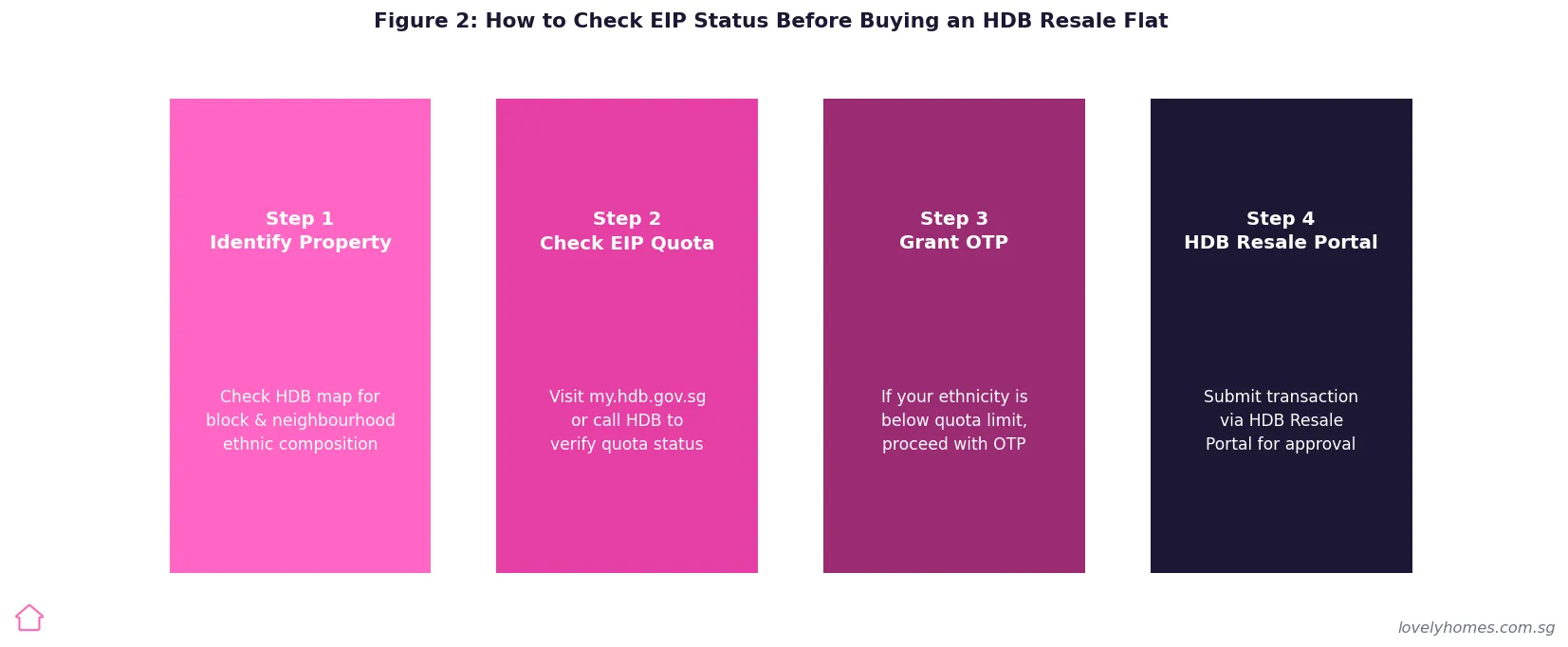
Figure 2: Step-by-step process to check HDB EIP status before buying a resale flat
Figure 2: How to check your HDB EIP status before buying a resale flat — a four-step process.

The SPR Quota: An Additional Layer for Permanent Residents

Beyond the ethnic-group quota, Singapore Permanent Residents (SPRs) face a separate SPR Quota. This quota caps the number of SPR households in any HDB block at 5% and in any neighbourhood at 8%. The rationale: HDB flats are subsidised public housing primarily for citizens, and excessive SPR concentration in any area is seen as inconsistent with that purpose.

Practically, this means SPR buyers face two quota checks before any resale purchase: (1) the ethnic-group EIP check, and (2) the SPR Quota check. Either can block a transaction. In more popular estates — Queenstown, Bishan, Toa Payoh, Tampines — SPR quotas can be reached at certain blocks, limiting options for SPR buyers even when the EIP quota is not an issue.

SPRs also cannot buy new BTO flats or Executive Condominiums during the initial launch period. Their housing options are largely confined to HDB resale flats (subject to both quotas) and private residential properties.

EIP Impact on HDB Resale Sellers

For sellers, the EIP can materially affect saleability. If a Chinese seller owns a flat in a block where the Chinese quota has already been met, the pool of eligible buyers is restricted to non-Chinese buyers only — significantly narrowing demand and potentially suppressing the resale price.

This dynamic is known informally as an “EIP-affected” flat. Industry data (from URA and HDB transaction records) suggests that EIP-affected blocks can see resale prices 5–12% below comparable non-affected blocks in the same estate, as the effective buyer pool is reduced. The discount reflects the liquidity premium buyers demand for taking on an asset with constrained future resalability.

Seller tip: Before listing your HDB flat for sale, check the current EIP status of your block and neighbourhood on the HDB Resale Portal. If your block’s dominant ethnic group quota is near its cap, consider whether a price adjustment is needed to attract buyers from the eligible pool, or whether to time your sale to coincide with demographic shifts in the block.

EIP and HDB Rentals

The EIP applies not only to resale transactions but also to approved whole-unit and bedroom rentals of HDB flats. When an HDB flat owner applies to rent out the entire flat or individual bedrooms, HDB checks whether the rental would cause the block or neighbourhood quota for the tenant’s ethnicity to be exceeded. If so, HDB will not approve the rental application for that particular tenant.

This has practical implications for landlords in popular rental estates. A Malay landlord renting to a Malay tenant in a block near its Malay quota limit may have the application declined, requiring them to seek tenants of other ethnicities. The rental EIP check is done through the HDB Resale Portal and typically takes 7–14 business days for approval.

EIP Compliance Summary for Buyers and Sellers (2026)

Scenario EIP Check Required? SPR Quota Check? How to Check Consequence of Breach
SC buying HDB resale Yes No HDB Resale Portal / call HDB Transaction cannot proceed
SPR buying HDB resale Yes Yes (both) HDB Resale Portal / call HDB Transaction cannot proceed
Foreigner buying HDB N/A N/A N/A Foreigners cannot buy HDB
SC/SPR renting out flat Yes (for tenant) Yes if tenant is SPR HDB Resale Portal (rental) Rental application declined
Flat owner listing for sale No — buyer’s responsibility No Inform buyers to check before OTP Buyer may back out post-OTP
New BTO purchase Not applicable Not applicable N/A HDB allocates based on ballot; no EIP for BTO

Worked Example: EIP Blocking a Resale Purchase

👥 The Rajan Family — Indian SC Couple, Tampines

Situation: Mr and Mrs Rajan (both SC, Indian, classified as “Indian/Others” under HDB’s ethnic categories) have identified a 5-room HDB resale flat at Tampines Street 81 for S$748,000. They have obtained an In-Principle Approval (IPA) from OCBC and are ready to exercise the OTP.

EIP check result: Before signing, Mr Rajan checks the HDB Resale Portal. He finds that Block 837, Tampines Street 81 has Indian/Others households at 12.8% of total flats — just below the 13% block limit. However, the neighbourhood ethnic composition shows Indian/Others at 10.2% — exceeding the 10% neighbourhood limit.

Outcome: Even though the block itself has not reached the 13% block cap, the neighbourhood cap of 10% has been breached. HDB would not approve the resale transaction if the Rajans proceed. They must look elsewhere.

Alternative strategy: Mr Rajan checks two neighbouring blocks in the same estate. Block 821 has Indian/Others at 8.9% (block) and the neighbourhood is at 9.6% — both within limits. The Rajans find a comparable 5-room flat there for S$742,000 and proceed with that transaction instead.

Key lesson: Always run the EIP check on the specific block and neighbourhood before exercising the OTP. HDB’s Resale Portal provides this check in real time. If in doubt, ask HDB to confirm in writing before you commit.

Why the EIP Matters for Property Buyers and Investors in 2026

The EIP is one of a small number of housing policies with no private-sector equivalent anywhere in the world — an active government intervention in the resale market to shape residential demographics. Its continued existence in 2026 reflects Singapore’s view that racial integration in housing is a public good that market forces alone will not maintain.

For buyers, this has three practical implications:

1. Pre-OTP due diligence is mandatory. Unlike stamp duty (which is always payable) or CPF usage (which always applies up to the withdrawal limit), the EIP can create an absolute bar to a transaction. There is no waiver, no appeal, and no workaround. The check is free and takes minutes on the HDB Resale Portal — there is no excuse for not doing it before any OTP is signed.

2. Resale value may be constrained. A flat in a block where one ethnic group’s quota is near saturation has a structurally smaller buyer pool. Over time, as Singapore’s ethnic composition shifts slightly (the 2020 and 2030 Censuses have shown gradual changes in distribution), these constraints may ease or tighten. Buyers should assess whether the block they are purchasing in is near any quota caps — not just for their own purchase, but for future resalability.

3. Rental yield could be affected. Landlords whose target tenant demographic is near the block quota may find their rental application declined and be forced to seek tenants from a different group — potentially limiting rental demand and yields in certain micro-locations.

What Might Change: Possible EIP Developments (Speculative)

The EIP has been in place for 37 years as at 2026 and has rarely been publicly debated in Singapore’s political discourse. However, several developments could prompt a policy review in the years ahead:

  • Shifting ethnic composition: Singapore’s 2020 Census showed modest shifts in ethnic composition — the Chinese share declined slightly from 76.8% (2010) to 75.9%; the Malay share remained at ~15%; Indian/Others grew slightly. If these trends continue, HDB may adjust quota caps to reflect the updated demographic baseline.
  • New citizen intake: Singapore’s naturalisation programme brings in citizens from a variety of ethnic backgrounds not represented in the original EIP framework. If new citizen categories grow significantly, HDB may need to refine how “Indian/Others” is classified.
  • Digital OTP reforms: HDB has been digitising the resale process. It is plausible that future HDB Resale Portal upgrades will integrate real-time EIP checks directly into the OTP workflow, reducing the risk of buyers unknowingly exercising an ineligible OTP.

Figure 3: Singapore ethnic composition vs EIP neighbourhood and block quota caps by ethnicity 2026
Figure 3: Singapore ethnic composition (2024 Census) vs HDB EIP quota caps (neighbourhood and block levels). Sources: Department of Statistics Singapore; HDB.

Frequently Asked Questions

Can I buy any HDB resale flat I want, regardless of the EIP?

No. The EIP creates a hard quota that HDB enforces at the point of resale approval. If your ethnic group’s quota has been reached at either the block or neighbourhood level, HDB will not approve the transaction. The OTP is a private agreement between buyer and seller, but HDB’s approval is required for the actual transfer of the flat — so exercising an OTP on an EIP-blocked flat effectively voids the transaction, and the buyer may lose the OTP option fee (typically 1% of the purchase price, capped at S$1,000). Always check before you sign.

Does the EIP apply to new BTO flats?

No. The EIP does not apply to HDB BTO (Build-to-Order) flat purchases. BTO allocation is managed through HDB’s ballot system, and HDB itself manages the ethnic balance during the initial allocation process. The EIP only becomes relevant when BTO flat owners subsequently sell in the open resale market during or after the Minimum Occupation Period (MOP). At that point, the resale flat enters the open market and EIP rules apply to the buyer’s purchase.

What happens if I am of mixed ethnicity?

HDB uses the race as declared on your NRIC for EIP purposes. For mixed-race individuals, the NRIC declaration (made at birth or at the point of citizenship registration) governs which quota is checked. If you have changed your race declaration on your NRIC (permissible under certain circumstances), the updated declaration applies. For couples where both buyers are of different ethnicities, HDB determines the applicable ethnic classification based on its guidelines — typically the primary applicant’s declared race. If this creates ambiguity for your situation, call HDB directly to confirm before exercising any OTP.

Can EIP quotas be waived or appealed?

Generally, no. The EIP is a statutory policy administered by HDB, and there is no formal waiver or appeal process for buyers who cannot meet the quota for a particular block or neighbourhood. The solution is to identify an alternative block or neighbourhood where the quota has not been reached. HDB occasionally adjusts the boundaries of planning neighbourhoods when redevelopment occurs, which can change quota calculations for affected blocks — but this is an administrative restructuring, not an individual waiver.

Does the EIP affect Executive Condominiums (ECs)?

ECs are a hybrid housing type — publicly developed by HDB but privately managed after completion. The EIP does apply to ECs during their public-housing phase (the first 5 to 10 years, prior to full privatisation). Once an EC has been privatised (after the 10-year mark), it is treated as private residential property and the EIP no longer applies to resale transactions. Given the EC MOP change in May 2026 (MOP extended from 5 to 10 years, privatisation extended from 10 to 15 years), the EIP-applicable period for new ECs has in effect been extended alongside these changes.

How do I check the EIP status before buying an HDB resale flat?

The fastest method is to log in to the HDB Resale Portal (resale.hdb.gov.sg) using your SingPass, navigate to the “Check Resale Conditions” section, and enter the block and street address of the flat you are interested in. The portal will return the current ethnic composition percentages and confirm whether your ethnic group is within the quota. Alternatively, you can call HDB at 1800-225-5432 (toll-free) and request an EIP check for the specific address. Always get confirmation in writing (via email or the portal’s printable report) before exercising your OTP.

Does the EIP affect the resale value of HDB flats?

It can. A flat in a block where the dominant ethnic group’s quota has been met effectively has a smaller eligible buyer pool — only buyers of the non-dominant ethnic groups can purchase. This structural limitation on demand can depress the flat’s market price relative to comparable flats in non-quota-affected blocks. The discount is hard to quantify precisely (it varies by estate, ethnic mix, and local demand), but it is a real consideration for buyers making a long-term investment decision. Before purchasing, assess not just your own EIP eligibility, but whether the block’s current composition suggests that future resalability may be constrained.

Disclaimer: This article is for general informational purposes only and does not constitute legal, financial, or property advice. The Ethnic Integration Policy (EIP) is administered by the Housing & Development Board (HDB) under the Ministry of National Development. EIP quotas and eligibility criteria are subject to change by HDB at any time. Readers must verify the current EIP status of any specific block and neighbourhood directly with HDB via the HDB Resale Portal (www.hdb.gov.sg) or by calling HDB at 1800-225-5432 before exercising any Option to Purchase. Ethnic classification rules may vary for individuals in specific circumstances — consult HDB directly for your situation. LovelyHomes recommends consulting a CEA-registered property agent and a qualified legal adviser before entering into any property transaction.

×

Click anywhere to close

Translate »