Singapore CPF Housing Grant Guide 2026: EHG, PHG, Family Grant and How to Apply

Singapore CPF Housing Grant Guide 2026: EHG, PHG, Family Grant and How to Apply

📌 Quick Answer: CPF Housing Grants in Singapore (2026)

  • Enhanced CPF Housing Grant (EHG): Up to S$120,000 for families earning ≤ S$9,000/month, or S$60,000 for singles earning ≤ S$4,500/month — available for both BTO and resale HDB flats.
  • CPF Housing Grant (Family Grant): Up to S$80,000 for new BTO or S$50,000 for resale flats; income ceiling S$14,000/month for SC+SC or SC+SPR couples.
  • Proximity Housing Grant (PHG): S$30,000 to live together with parents/children, or S$20,000 to live within 4 km — no income ceiling, resale flats only.
  • Step-Up CPF Housing Grant: S$15,000 for second-timer families upgrading from a 2-room subsidised flat to a 2–4 room BTO; income ceiling S$7,000/month.
  • Maximum stacking: A Singapore Citizen family buying a resale flat can receive up to S$230,000 by combining the EHG + Family Grant + PHG.
  • How to apply: All CPF housing grants are applied for through the HDB Flat Eligibility (HFE) letter — there is no separate application form; the grants are assessed automatically.
  • CPF OA for private property: Grants do not apply to private property purchases; however, your CPF Ordinary Account balance can be used for the down payment, monthly instalments, and stamp duties on private property — subject to the Valuation Limit and Withdrawal Limit.

What Are CPF Housing Grants?

CPF housing grants are cash subsidies administered by the Housing and Development Board (HDB) and funded from the government’s housing budget. They reduce the cash or CPF Ordinary Account (OA) outlay required to purchase a subsidised HDB flat, effectively lowering the loan quantum needed and the monthly instalment burden for eligible Singapore Citizens and Permanent Residents.

Unlike bursaries or income supplement schemes, CPF housing grants are credited directly into the buyer’s CPF Ordinary Account once the flat purchase is completed, and are applied first to reduce the purchase price at the point of resale or disbursed at key collection for BTO flats. They do not count as accrued interest and do not need to be repaid upon sale, but the grant amount — along with accrued interest at 2.5% per annum on any CPF used — must be refunded to CPF upon the sale or transfer of the flat.

The grant landscape was significantly reformed on 20 August 2024, when the EHG for families was raised from S$80,000 to S$120,000 and the singles grant doubled from S$30,000 to S$60,000. The Family Grant and PHG remain at their current levels as of June 2026.

CPF housing grants Singapore 2026 overview table — EHG PHG Family Grant Step-Up amounts eligibility
Figure 1: Singapore CPF Housing Grants at a Glance — Grant types, maximum amounts, income ceilings and eligible property types (2026).

Enhanced CPF Housing Grant (EHG): The Largest Grant

The EHG is the flagship CPF housing grant, designed to help lower-income Singaporeans purchase their first flat. It replaced the Additional CPF Housing Grant (AHG) and Special Housing Grant (SHG) in September 2019, combining them into a single, more generous scheme with a sliding scale tied to household income.

Key eligibility conditions for the EHG (2026):

  • At least one applicant must be a Singapore Citizen, and the household must include at least one other Singapore Citizen or Permanent Resident.
  • All applicants and occupants must be first-timer applicants (no prior ownership of an HDB flat or private property in Singapore).
  • Monthly household income must not exceed S$9,000 (families) or S$4,500 (singles buying a 2-room Flexi under the Single Singapore Citizen Scheme).
  • All working applicants must have been employed continuously for at least 12 months and must be working at the time of the HFE letter application.
  • The flat purchased must have a remaining lease of at least 20 years and must cover the youngest buyer until at least age 95.

The EHG amount is determined on a sliding scale: applicants at the lowest income bracket (≤ S$1,500/month) receive the maximum S$120,000, tapering down to S$5,000 for households earning close to the S$9,000 ceiling. See Figure 3 for the full sliding scale. This design ensures that the subsidy is proportionally larger for those who need it most.

The EHG applies to both new BTO flats and resale HDB flats, making it one of the few grants usable across the full flat type spectrum. It does not apply to Design, Build and Sell Scheme (DBSS) flats or Executive Condominiums (ECs).

CPF Housing Grant (Family Grant): The Mainstream Grant

The Family Grant is available to Singapore Citizen households with a broader income range, up to S$14,000 per month. Unlike the EHG, it is not means-tested on a sliding scale — eligible buyers receive the full amount or nothing.

Flat Type Grant Amount (SC+SC) Grant Amount (SC+SPR) Income Ceiling
New 2-room Flexi to 4-room BTO S$40,000 S$30,000 S$14,000/mth
New 5-room or larger BTO S$40,000 S$30,000 S$14,000/mth
Resale 2-room to 3-room S$40,000 S$30,000 S$14,000/mth
Resale 4-room and larger S$50,000 S$40,000 S$14,000/mth
Singles (2-room Flexi resale only) S$25,000 N/A S$7,000/mth

Source: HDB, effective as of June 2026.

The Family Grant for resale 4-room and larger flats was raised to S$50,000 (SC+SC) and S$40,000 (SC+SPR) in the same August 2024 revision. This reflects the government’s effort to keep resale HDB flats affordable as median prices in many towns have risen sharply since 2020.

Proximity Housing Grant (PHG): Living Near Family

The Proximity Housing Grant was introduced in August 2015 to incentivise multi-generational proximity — a social policy objective as much as a financial one. It is unique in having no income ceiling, meaning even higher-income families can benefit from it when buying resale flats near parents or children.

The PHG pays S$30,000 if the applicant purchases a resale flat to live in the same flat as their parents or child (joint application or within the same household). It pays S$20,000 if the resale flat is purchased within 4 kilometres of the parent’s or child’s residence. The 4 km is measured using the straight-line distance between the two postal addresses. It applies to resale HDB flats only — it cannot be applied to BTO flats or DBSS flats.

To receive the PHG, at least one of the parents or child must be a Singapore Citizen or Permanent Resident. The proximity requirement must be maintained for five years after the key collection of the resale flat; failure to do so may result in a clawback of the grant.

Step-Up CPF Housing Grant and Other Targeted Grants

The Step-Up CPF Housing Grant of S$15,000 is specifically targeted at second-timer Singapore Citizen families who previously purchased a 2-room subsidised flat (BTO) and wish to upgrade to a 2-room to 4-room BTO flat. The income ceiling is S$7,000/month and the household must not own any other private property. This grant acknowledges the financial difficulty of moving up the housing ladder on a modest income.

The Seniors’ Priority Scheme (SPS) is not a cash grant but provides elderly Singapore Citizens aged 55 and above with priority allocation in BTO exercises when they are purchasing a 2-room Flexi flat near their adult children. Priority is given to multi-generational applicants — parents applying together with children — further reinforcing the proximity-and-community theme across Singapore’s housing grant framework.

CPF housing grant combinations by buyer profile 2026 — EHG PHG Family Grant Step-Up maximum stacking
Figure 2: Maximum CPF housing grant combinations by buyer profile. A Singapore Citizen family purchasing a resale flat near parents can stack up to S$230,000 in grants.

How to Apply for CPF Housing Grants

All CPF housing grants are administered through a single gateway: the HDB Flat Eligibility (HFE) letter. Introduced in May 2023, the HFE letter replaced the previous system of separate Eligibility Letters for different grants. To apply, eligible buyers must log in to the HDB Flat Portal (flat.hdb.gov.sg) with their Singpass and submit an HFE application. The assessment is integrated with CPF and IRAS data and typically takes around 21 working days.

The HFE letter is mandatory before a buyer can:

  • Book a BTO flat during a sales launch exercise;
  • Exercise an Option to Purchase (OTP) for a resale HDB flat;
  • Apply for an HDB loan.

Once issued, the HFE letter is valid for nine months. It confirms the buyer’s eligibility, the specific grants they qualify for and their amounts, and the maximum HDB loan they may borrow. Buyers must obtain a new HFE letter if their circumstances change materially (e.g., income, marital status, property ownership) or if the existing letter expires.

Grant Summary Table: All CPF Housing Grants at a Glance

Grant Max Amount Min SC Required BTO? Resale? Income Ceiling
EHG (Families) S$120,000 1 SC S$9,000/mth
EHG (Singles) S$60,000 Applicant is SC S$4,500/mth
Family Grant (SC+SC) S$50,000 resale 4R+ 2 SC S$14,000/mth
Family Grant (SC+SPR) S$40,000 resale 4R+ 1 SC S$14,000/mth
PHG (living together) S$30,000 1 SC/SPR None
PHG (within 4 km) S$20,000 1 SC/SPR None
Step-Up Grant S$15,000 1 SC ✓ (2–4 Rm) S$7,000/mth

Note: Buyers must be first-timers for EHG and Family Grant. Grants are not available for EC (Executive Condo) or private property purchases. Source: HDB, June 2026.

Worked Example: How Much Can Mr & Mrs Tan Actually Save?

📄 Worked Example — SC Couple Buying Resale 4-Room Flat in Tampines

Profile: Mr & Mrs Tan, both Singapore Citizens, first-time buyers. Combined household income S$7,800/month. Mrs Tan’s parents live in Tampines, 1.2 km from the flat they are considering. They have been employed continuously for 14 months.

Flat: 4-room resale HDB flat in Tampines, asking price S$620,000.

Grants they qualify for:

  • EHG: Household income S$7,800/month → approximately S$35,000 (sliding scale; income ≤ S$7,500/month band).
  • Family Grant (SC+SC, resale 4-room): S$50,000.
  • PHG (within 4 km of Mrs Tan’s parents): S$20,000.

Total grants: S$35,000 + S$50,000 + S$20,000 = S$105,000

Effective purchase price after grants: S$620,000 − S$105,000 = S$515,000

Buyer’s Stamp Duty (BSD): On S$620,000 — 1% × S$180,000 + 2% × S$180,000 + 3% × S$260,000 = S$13,200

HDB Loan (at 80% LTV on effective price S$515,000): S$412,000 at 2.6% p.a. over 25 years → monthly instalment S$1,864/month (MSR: 23.9% — PASS at 30% ceiling).

Cash outlay at completion (5% cash + BSD + legal): 5% × S$515,000 + S$13,200 + S$2,500 (legal) = S$41,450 cash. Balance of CPF OA available for the remaining 15% down payment.

Note: Grant amounts are illustrative based on the published EHG sliding scale. Actual grant eligibility is confirmed via the HFE letter. BSD calculated on full purchase price (not after grants). CPF accrued interest at 2.5% p.a. applies to all CPF withdrawn.

Why CPF Housing Grants Matter: The Broader Policy Context

Singapore’s CPF housing grant framework is one of the most generous owner-occupier subsidy systems in Asia. In a city where median resale HDB flat prices have risen by roughly 40–55% since 2020, grants of S$100,000–S$230,000 provide meaningful relief for households in the S$4,000–S$9,000/month income band — the working and lower-middle class that earns too much for full public housing in many neighbouring countries but faces real affordability pressure in Singapore’s private market.

The August 2024 doubling of the EHG was a direct policy response to research showing that pre-grant affordability had deteriorated for first-timers in the S$5,000–S$9,000 income band since 2020. By front-loading the subsidy into the capital cost rather than the monthly instalment, HDB avoids the MAS mortgage stress-test complexity that would arise from an interest-rate subsidy model.

From a buyer’s perspective, the grants also have a leveraging effect: a S$120,000 EHG on a S$450,000 BTO flat reduces the loan quantum by 27%, lowering the debt-service burden by approximately S$540/month on a 25-year HDB loan — a meaningful improvement in household cash flow over the life of the mortgage.

EHG sliding scale by household income Singapore 2026 — families and singles grant amounts
Figure 3: The EHG sliding scale — grant amount decreases as household income rises, from S$120,000 at ≤S$1,500/month to S$5,000 at ≤S$9,000/month. Singles receive half of the family amount.

What Might Change Next: Grant Policy Outlook 2026–2028

The August 2024 EHG increase followed roughly four years of HDB price inflation, suggesting that grant levels are periodically reviewed against affordability indices rather than adjusted on a fixed schedule. The following is editorial speculation based on observable trends and is not government policy.

Given that the URA private residential price index has continued to rise modestly in Q1 2026 (+0.5% QoQ) and HDB resale prices remain elevated (RPI 216.3 in Q1 2026), a further grant increase would not be out of place if the next round of BTO supply does not materially ease affordability pressure. The income ceiling for the EHG (S$9,000/month for families) was last revised in 2019; with median household income now at approximately S$10,000–S$11,000/month, there is a structural argument for raising the ceiling to include more middle-income households — though this would carry a significant fiscal cost.

There is also industry discussion about whether the PHG’s 4-km definition should be relaxed to accommodate households in sprawling new towns (Tengah, Punggol North) where the road network means 4 km of air-line distance may correspond to a 15-minute drive. Whether HDB adjusts the proximity metric to a travel-time standard remains to be seen.

Frequently Asked Questions

Can I use CPF housing grants for an Executive Condo (EC)?
No. CPF housing grants — including the EHG, Family Grant, PHG, and Step-Up Grant — are not available for Executive Condo purchases. ECs are co-developed by private developers and are considered a hybrid between public and private housing. They are subsidised only indirectly: EC buyers enjoy a lower land cost embedded in the pricing, and second-timer EC buyers may use their CPF Ordinary Account balance. However, no cash grant is payable. The grants exclusively apply to HDB flats (BTO and resale).
If my income increases after receiving the grant, does HDB claw it back?
No. Grant eligibility is assessed at the time of the HFE letter application, and the grant amount is fixed at that point. A subsequent increase in income after the application date does not trigger a clawback. However, if you misrepresent your income on the HFE application — for example, by failing to disclose commission income or rental income — HDB may require repayment of the grant and impose penalties under the Housing and Development Act. It is important to declare all sources of income accurately at the time of application.
My parents live overseas. Can I still get the Proximity Housing Grant?
No. The PHG requires that the parents or children you are purchasing near are Singapore Citizens or Permanent Residents, and they must be residing in Singapore at the relevant address. The grant is specifically designed to encourage multi-generational proximity within Singapore’s social fabric and does not apply to buyers seeking to be near family members based overseas. If your parents are in the process of relocating to Singapore, they must be in residence at the qualifying address at the time of the HFE letter application.
Can the grants be used to pay Buyer’s Stamp Duty or legal fees?
Not directly. CPF housing grants are credited into the buyer’s CPF Ordinary Account. From there, CPF OA funds can be used to pay the Buyer’s Stamp Duty (BSD) on HDB resale flats or new BTO flats, as well as legal conveyancing fees. So while the grant does not directly pay these costs, it increases the CPF OA balance available to cover them. Additional Buyer’s Stamp Duty (ABSD) cannot be paid from CPF — it must be paid in cash within 14 days of signing the Option to Purchase or Sale and Purchase Agreement.
I previously sold an HDB flat and am buying again. Can I still get any grants?
Second-timer buyers have more limited grant access. The Family Grant and EHG are generally reserved for first-timers. However, you may be eligible for the Step-Up CPF Housing Grant (S$15,000) if you are upgrading from a 2-room Flexi BTO flat to a larger flat. The PHG also has no first-timer restriction, so if you are purchasing a resale flat near parents or children, you may still qualify for the PHG regardless of prior HDB ownership. Confirm your exact eligibility via the HFE letter portal.
What happens to the grants when I sell my flat?
When you sell your HDB flat, all CPF monies withdrawn for the flat — including the grant amount — must be refunded to your CPF Ordinary Account, along with accrued interest at 2.5% per annum. The grant itself is not repaid to HDB; it is simply treated as CPF OA funds that were used for the flat purchase. The refund reduces your cash profit from the sale. For example, if you received a S$120,000 EHG 10 years ago, the refund to CPF on sale would be S$120,000 × (1.025)^10 ≈ S$153,600. This is a common point of confusion among upgraders who expect a larger cash balance after sale.
Do foreigners or PRs qualify for CPF housing grants?
Singapore Permanent Residents (SPRs) have limited access to CPF housing grants. An SPR can be included as a co-applicant in an HFE application where the primary applicant is a Singapore Citizen, and the household can then qualify for the EHG and Family Grant at the SC+SPR rates (which are typically S$10,000–S$15,000 lower than SC+SC rates). SPRs applying alone do not qualify for any CPF housing grant, and they cannot purchase HDB flats without a Singapore Citizen co-applicant. Foreign nationals have no access to CPF housing grants and cannot purchase subsidised HDB flats.

Related Articles

Disclaimer: The information in this article is for general educational purposes only and reflects publicly available data from the Housing and Development Board (HDB) and Central Provident Fund Board (CPF) as of June 2026. Grant amounts, eligibility criteria, and income ceilings are subject to change by the government at any time. This article does not constitute financial, legal, or housing advisory advice. For a definitive assessment of your grant eligibility, apply for an HDB Flat Eligibility (HFE) letter at flat.hdb.gov.sg. For personalised financial guidance, consult a licensed mortgage broker or financial adviser regulated by MAS.

Yishun Neighbourhood Guide Singapore 2026: HDB Prices, CRL Phase 2 & Investment Outlook

Yishun Neighbourhood Guide Singapore 2026: HDB Prices, CRL Phase 2 & Investment Outlook

Quick Answer: Yishun in 2026 at a Glance

  • Location: District 27 (D27), Outside Central Region (OCR) — largest HDB town in Singapore’s north, adjacent to the Causeway corridor.
  • HDB resale prices (May 2026): 3-room S$230k–S$350k; 4-room S$310k–S$470k; 5-room S$420k–S$600k; EA/Jumbo S$540k–S$750k.
  • Private condo prices: 1BR S$650k–S$950k; 2BR S$900k–S$1.28M; 3BR S$1.2M–S$1.7M.
  • MRT: NSL — Yishun (NS13) and Khatib (NS14). CRL Phase 2 Yishun station expected ~2030, providing direct east-west connectivity.
  • Rental yield: Private condos 3.5–4.0%; HDB subletting gross 4.5–5.5% — among the highest in Singapore for public housing.
  • Affordability: One of Singapore’s most affordable OCR towns for families; median 4-room HDB resale ~S$440k as at Q1 2026.
  • Best for: First-time HDB buyers, young families prioritising budget and primary school proximity, and yield-focused investors.
  • Watch in 2026: CRL Phase 2 Yishun station land-use amendments and Northpoint City Phase 2 finalisation.

What Is Yishun and Where Is It?

Yishun is a large HDB new town in District 27 (D27), situated in the northern region of Singapore. It is bounded by Sembawang New Town to the north-west, Seletar Aerospace Park and Punggol to the east, Ang Mo Kio to the south, and the Woodlands corridor to the west. Developed by the Housing and Development Board (HDB) from the early 1980s following the demolition of the Nee Soon Kampung and rubber estates, Yishun was one of the original ring-towns planned under the Concept Plan 1971, designed to decentralise Singapore’s population away from the urban core.

Today, Yishun is home to approximately 220,000 residents across more than 65,000 HDB dwelling units, making it one of Singapore’s most populous single planning areas. The town is anchored by Northpoint City — the largest retail mall in Singapore’s north — and served by Khoo Teck Puat Hospital (KTPH), one of the country’s most modern general hospitals. For property buyers in 2026, Yishun represents a compelling entry point into the Singapore property market: HDB resale prices in D27 remain among the most affordable in the OCR, and the forthcoming Cross Island Line (CRL) Phase 2 is set to substantially upgrade the town’s east-west connectivity.

Property Prices in Yishun (D27): What You Can Expect in 2026

Yishun’s property market is dominated by HDB resale transactions, with private condominiums accounting for a smaller portion of the overall market than in other OCR towns. This supply structure keeps headline prices relatively affordable: the median 4-room HDB resale in Yishun was approximately S$440,000 in Q1 2026, compared to S$560,000 for the OCR average and S$800,000+ for Tiong Bahru.

Yishun District 27 property price ranges by type 2026 - HDB resale and private condo
Figure 1: Property price ranges for HDB (resale) and private condominiums in Yishun / District 27, May 2026. Source: HDB, URA Realis. Indicative transaction range. Prices in S$ thousands.

Private condominiums in Yishun include Eight Courtyards (D27, 99-year leasehold), Yishun Emerald, and North Park Residences — the last being an integrated development directly above Yishun MRT. North Park Residences commands a premium over standalone condos due to its MRT-integrated status, with 2BR units trading around S$1.1M–S$1.25M. Eight Courtyards, located off Yishun Avenue 6, offers more competitive pricing with 2BR units in the S$900k–S$1.1M range.

For buyers assessing the ABSD implications: Singapore Permanent Residents purchasing their first residential property pay 5% ABSD. Singapore Citizens pay no ABSD on their first property. On a S$1.1M Yishun condo, a SPR first-time buyer would pay BSD of S$29,400 plus ABSD of S$55,000 — a combined stamp duty outlay of S$84,400.

Property Type Indicative Range (May 2026) Notes
HDB 3-Room (resale) S$230k – S$350k Yishun Ring Road, Yishun Ave 4/6 clusters
HDB 4-Room (resale) S$310k – S$470k Median ~S$440k; newer 2000s blocks command upper range
HDB 5-Room (resale) S$420k – S$600k Yishun Ave 11 / Yishun St 61 larger blocks
HDB EA / Jumbo S$540k – S$750k Limited supply; higher demand from multi-gen families
Condo 1BR S$650k – S$950k North Park Residences premium at upper end
Condo 2BR S$900k – S$1.28M ~700–900 sqft typical
Condo 3BR S$1.2M – S$1.7M ~1,000–1,300 sqft

MRT, CRL Phase 2 and Transport in Yishun

Yishun is currently served by two North-South Line (NSL) stations: Yishun (NS13) and Khatib (NS14, 1.5km north of Yishun). The NSL provides direct access to Orchard (approximately 25 minutes from Yishun NS13), Raffles Place (31 minutes), and Jurong East (via the EWL from City Hall, approximately 55 minutes). While the NSL serves north-south travel well, Yishun has historically lacked direct east-west MRT connectivity — a journey to, say, Tampines requires a change at Bishan or Ang Mo Kio onto the Circle Line or a long bus ride.

The transformative development for Yishun transport is the Cross Island Line (CRL) Phase 2, which will add a Yishun station to the CRL network, providing a direct east-west connection to Ang Mo Kio (CRL), Serangoon, Pasir Ris, and eventually Changi Airport T5 at the eastern end, and to Tuah Merah and the western extension to Jurong. The Land Transport Authority (LTA) has indicated that CRL Phase 2 stations are targeted for opening around 2030. When complete, CRL Phase 2 will fundamentally change Yishun’s connectivity profile, making it accessible to both the eastern employment clusters (Changi Business Park, Tampines) and the western ones (one-north, Jurong Lake District) without changing trains.

Amenities, Schools and Lifestyle in Yishun

Yishun key amenities CRL connectivity schools and healthcare snapshot 2026
Figure 2: Yishun — MRT/transport, schools, retail, recreation, healthcare and key statistics snapshot for 2026. Source: LTA, HDB, MOH, URA. CRL Phase 2 = indicative opening 2030.

Schools: Yishun has a well-developed primary school ecosystem. Northland Primary (within 1km of many HDB blocks in the northern part of the estate), Yishun Primary, Ahmad Ibrahim Primary, and Huamin Primary are among the primary schools serving the town. For secondary education, Yishun Town Secondary, Ahmad Ibrahim Secondary, and Presbyterian High School are strong options. Yishun Innova Junior College (JC) is one of two JCs in the north, making Yishun a practical address for families with older children who wish to avoid long commutes to school. For polytechnic education, Republic Polytechnic is a 10-minute bus ride, and Singapore Polytechnic is accessible via the NSL to Jurong East.

Retail and dining: Northpoint City, completed in 2018 as an expansion and integration of the existing Northpoint and Yishun 10 retail nodes, is the anchor mall for the entire north of Singapore. With over 500 retail units, a Causeway Link bus terminal to Johor Bahru, a roof garden, a cinema, and a direct link to Yishun MRT, Northpoint City functions as a regional centre in its own right. The SAFRA Yishun clubhouse on Yishun Avenue 6 provides additional recreation, dining, and sports facilities for residents.

Healthcare: Khoo Teck Puat Hospital (KTPH), operated by the National University Health System (NUHS), is a 761-bed acute hospital on Yishun Central with a full suite of specialist services. KTPH is consistently ranked among Singapore’s highest-patient-satisfaction public hospitals and significantly enhances Yishun’s appeal for elderly residents and families with healthcare needs. The Yishun Polyclinic, operated by the Ministry of Health, provides primary healthcare at subsidised rates.

Nature and recreation: Lower Seletar Reservoir, a 640-hectare freshwater reservoir managed by PUB, forms the eastern boundary of Yishun town. The 6.5km Seletar Reservoir Park trail, Lower Seletar Reservoir Park, and the connector to the Northern Ridges park network give Yishun residents access to some of the most extensive green recreational space in Singapore’s public housing towns.

BTO Supply and Resale Price Trend in Yishun

Yishun BTO supply and HDB 4-room resale price trend 2019 to 2026
Figure 3: Yishun BTO units launched and HDB 4-room resale median price trend (2019–2026). Source: HDB. BTO units = indicative from launch announcements. 2026 = H1 2026 only.

HDB has been a consistent BTO supplier in Yishun, averaging approximately 1,000 units per launch exercise over the 2019–2025 period. This regular supply pipeline keeps the Yishun resale market relatively liquid: buyers who miss out on BTO ballots have a well-supplied resale market to turn to, and the resale price premium over BTO list prices (the so-called “BTO resale uplift”) in Yishun is more modest than in tighter-supply estates like Bishan or Queenstown. The median 4-room HDB resale price in Yishun rose from approximately S$340,000 in 2019 to S$440,000 in Q1 2026 — a 29% cumulative increase that broadly tracks the national HDB resale index growth over the same period, without the exceptional outperformance seen in central-region estates.

The 2023 HDB resale cooling measures — including the 15-month wait period for private property downgraders — impacted Yishun somewhat differently from other estates. As a popular destination for private-to-HDB downgraders seeking affordability, the wait period temporarily reduced a segment of Yishun’s buyer pool but did not cause sustained price decline because of broad-based demand from first-time HDB buyers in the north.

Worked Example: Buying an HDB 4-Room Resale Flat in Yishun

Buyer Profile: Lim couple (SC + SC, 31 + 29, combined monthly income S$9,200, first-time buyers)

Target: 4-room resale HDB at Yishun Avenue 11, asking S$440,000, remaining lease 73 years (built 2000).

CPF eligibility: Remaining lease 73 years + youngest buyer age 29 → 73 years well above the 95-year sum test. Full CPF OA withdrawal and full bank LTV (75%) available. HDB loan option available (up to 80% LTV at 2.60% p.a.).

Stamp duty: BSD on S$440,000 = S$4,200 (first S$180k @ 1%) + S$5,200 (S$260k @ 2%) = S$9,400. ABSD = nil (first property, SC buyers).

HDB loan scenario: Downpayment: 20% = S$88,000 (fully payable via CPF OA). Loan: S$352,000 @ 2.60% p.a. over 25 years → monthly instalment ≈ S$1,602. MSR: S$1,602 / S$9,200 = 17.4% — well within 30% cap.

Bank loan scenario: Downpayment: 25% = S$110,000 (min 5% cash = S$22,000; balance S$88,000 CPF). Loan: S$330,000 @ 3.10% fixed for 3 years, 25yr → monthly ≈ S$1,575. MSR: 17.1% PASS.

Total upfront cost (HDB loan): BSD S$9,400 + Conveyancing fees ~S$2,500 + Cash component (if any after CPF) ≈ S$11,900–S$22,000. This makes Yishun one of the most accessible entry points to HDB ownership in RCR/OCR Singapore.

CPF grant eligibility: Combined income S$9,200 ≤ S$14,000 cap → eligible for Enhanced CPF Housing Grant (EHG) of up to S$40,000 (SC-SC couple, no prior grants). EHG is credited to CPF OA and reduces cash outlay significantly. With EHG, effective purchase price is S$400,000.

Why Yishun Offers Structural Value for OCR Buyers

Several factors make Yishun a structurally sound OCR choice beyond pure affordability. First, as noted above, the CRL Phase 2 Yishun station is a genuine connectivity step-change that the market has not yet fully priced in. Historically, the completion of new MRT lines in Singapore has consistently resulted in a 5–15% price uplift for properties within 500m of new stations in the 12–18 months following announcement and opening. While CRL Phase 2 is still 4 years away, astute buyers who enter the market ahead of station opening can potentially benefit from this pre-completion re-rating.

Second, Yishun benefits from a strong anchor institution in KTPH, which functions as a major employer in the north and generates a stable rental demand base from healthcare professionals and visiting families. Third, Northpoint City’s status as a regional centre means that Yishun is less dependent on the CBD for employment and retail services than smaller OCR towns, creating a degree of local economic self-sufficiency that supports residential demand in a downturn.

When compared to international peer markets, Yishun’s median 4-room HDB at ~S$440k is remarkably affordable relative to household income. The median household income in Yishun’s planning area is approximately S$8,500–S$9,500/mth (SingStat census data), implying a price-to-income ratio of approximately 4.4x — one of the lowest in Singapore and far below the ratios in London, Sydney, or Hong Kong for comparable-quality public housing.

What Might Come Next for Yishun Property (2026 and Beyond)

The headline catalyst is, of course, CRL Phase 2. Beyond that, the HDB has flagged continued BTO supply in Yishun through its longer-term development pipeline, which may moderate further resale price appreciation relative to tighter-supply estates. However, CRL Phase 2 has the potential to offset this supply effect by widening the catchment of residents for whom Yishun is a practical address — particularly those employed in eastern Singapore, who currently find Yishun impractical due to the long NSL-plus-transfer journey times.

There is also a longer-term story around the Yishun Industrial Park corridor and the Seletar Aerospace Park (approximately 4km east), where ongoing industrial upgrading and the expansion of aerospace MRO (maintenance, repair and overhaul) activities create a specialised professional tenant base that could sustain private condo rentals in D27. Industry estimates suggest that Seletar Aerospace Park employs over 6,000 workers; as this corridor grows, demand for residential accommodation in the northern belt will grow with it.

Frequently Asked Questions about Yishun

Is Yishun safe and what is its reputation?

Yishun is a safe neighbourhood with crime rates in line with Singapore’s national average. Over the years, Yishun has attracted some negative social-media characterisation that overstates actual incidents; Singapore Police Force data consistently shows Yishun’s crime statistics to be unremarkable relative to similarly sized HDB towns. The neighbourhood has seen significant urban renewal in the last decade, with Northpoint City’s expansion, KTPH’s growth, and new BTO blocks replacing older stock. Residents and community groups have noted a positive shift in the town’s energy and demographic mix as younger families move in.

When will the CRL Phase 2 Yishun station open?

The Land Transport Authority (LTA) has indicated that Cross Island Line Phase 2, which extends the CRL from Bright Hill (Phase 1 western terminus) east and north to serve Ang Mo Kio, Serangoon North, Yishun, and eventually Changi Airport Terminal 5, is targeted for completion around 2030. The exact opening date is subject to construction progress and LTA’s rolling announcements. CRL Phase 2 will give Yishun residents a direct east-west connection that currently requires a multi-leg journey (NSL to Bishan, then CCL east, or NSL to Novena, then DTL). Property buyers considering Yishun specifically for the CRL uplift should note that the station has been confirmed by LTA in planning documents; however, station-opening date risk remains.

What CPF Housing Grants are available for Yishun HDB buyers?

First-time HDB buyers in Yishun can access the Enhanced CPF Housing Grant (EHG) of up to S$40,000 (for incomes up to S$4,500/mth per person or S$9,000/mth for couples), the Family Grant of up to S$50,000 for resale flats (SC-SC couple, first-timer), and the Proximity Housing Grant (PHG) of up to S$30,000 if buying near or with parents. For the latest grant amounts and income ceiling tables, refer to the HDB official portal and our CPF Housing Grants Guide 2026. Grants are credited to CPF Ordinary Account and reduce the cash outlay on purchase.

What are the best areas to buy within Yishun?

Buyers who prioritise MRT proximity and integrated living should focus on blocks near Yishun MRT (NS13) and North Park Residences (directly above the station). Blocks within 400m of the station command a 5–8% premium but offer the most walkable lifestyle. Families who prioritise quiet greenery and proximity to Lower Seletar Reservoir should look at Yishun Avenue 6 and the Yishun Street 61 cluster, which are set back from the main road and close to the reservoir park. Buyers looking for newer stock (post-2010 BTO) should target the Orchid Spring and Harmony Village BTO clusters in the southern part of Yishun near Khatib station.

How does Yishun compare to Sembawang for property buyers?

Yishun and Sembawang are neighbouring northern OCR towns with broadly similar price levels and demographics. The key differences are: Sembawang has a more village-like character with lower-density blocks and proximity to the Sembawang Hot Spring Park; Yishun has larger scale, better retail infrastructure (Northpoint City vs Sun Plaza), and the upcoming CRL Phase 2 connectivity advantage. Sembawang is slightly cheaper on a per-unit basis for 4-room HDB but has less retail and amenity depth. Buyers who value lifestyle completeness and transport connectivity tend to favour Yishun; those who want a quieter, more suburban feel at marginally lower cost tend to prefer Sembawang. For our full guide to Sembawang, see the Sembawang Neighbourhood Guide 2026.

Is Yishun a good area for rental investment in 2026?

Yishun private condominiums yield 3.5–4.0% gross rental income as at Q1 2026, slightly above the national average of 3.2% for private condos. Rental demand is anchored by KTPH healthcare workers, Seletar Aerospace Park professionals, and north-region families who prefer to rent before buying. Vacancy rates in Yishun are moderate, and the town’s affordability relative to central Singapore means it can attract tenants priced out of higher-cost areas. For property investment analysis including yield, capital growth, and exit-liquidity considerations, see our Singapore Property Investment Guide 2026.

What HDB flats can Malaysia workers who commute via the Causeway buy in Yishun?

Singapore Permanent Residents (SPRs) who commute from Johor Bahru can purchase HDB resale flats in Yishun provided they meet the standard eligibility criteria: the flat must be their primary residence in Singapore, and they must form a valid family nucleus. SPRs cannot purchase HDB new BTO flats (BTO is restricted to SC-SC or SC-SPR couples). Note that under the HDB non-citizen SPR quota scheme, each block and neighbourhood is subject to a cap on the proportion of flats owned by SPR households — this quota is checked at point of sale. As Yishun is a large town, SPR quota availability is generally not a constraint, but buyers should confirm with HDB at the time of purchase. The Causeway Link bus from Northpoint City to Johor Bahru takes approximately 45–60 minutes, making Yishun one of the more practical Singapore residential addresses for Malaysian commuters.

Related Articles

Disclaimer

The information in this article is intended for general educational purposes and reflects publicly available data and analysis as at June 2026. Property prices, grant amounts, stamp duty rates, CPF rules, and financing limits are subject to change and should be verified against official sources including the Urban Redevelopment Authority (URA), Housing and Development Board (HDB), Inland Revenue Authority of Singapore (IRAS), the CPF Board, the Land Transport Authority (LTA), and the Monetary Authority of Singapore (MAS). This article does not constitute financial, investment, or legal advice. Readers are advised to consult a licensed financial adviser, a HDB-registered solicitor, or a licensed property agent registered with the Council for Estate Agencies (CEA) before making any property decision.
Singapore HDB BTO Guide 2026: Eligibility, Grants, Step-by-Step Process and Prices Explained

Singapore HDB BTO Guide 2026: Eligibility, Grants, Step-by-Step Process and Prices Explained

Quick Answer — HDB BTO 2026 at a Glance

  • HDB Build-To-Order (BTO) is Singapore’s primary scheme for first-time buyers to purchase a new public flat directly from HDB at a subsidised price, with a 3–5 year construction wait.
  • Since October 2024, all BTO flats fall into one of three tiers — Standard, Plus, or Prime — with progressively tighter resale restrictions as location value increases.
  • The Minimum Occupation Period (MOP) is 5 years for Standard and 10 years for Plus and Prime flats before you can sell or rent out the whole flat.
  • Eligible first-timer families can receive the Enhanced CPF Housing Grant (EHG) of up to S$80,000; singles can receive up to S$40,000.
  • The Proximity Housing Grant (PHG) adds up to S$30,000 for resale buyers living near parents; the Step-Up CPF Housing Grant adds S$15,000 for 2-room Flexi to 3-room upgraders.
  • A valid HDB Flat Eligibility (HFE) letter is mandatory before applying for any BTO or Sale of Balance Flats exercise (introduced May 2023).
  • HDB will launch approximately 19,600 BTO flats in 2026 across four exercises (February, June, October; the fourth in Q4 2026).
  • First-timer applicants who do not book a flat in their first or second ballot receive additional chances through the First-Timer Priority scheme.
  • The Tenants’ Priority Scheme (TCPS) was raised to 10% from the June 2026 BTO exercise, giving current HDB rental tenants a better chance of balloting a flat.
  • BSD applies on all property purchases including BTO; ABSD is nil for Singapore Citizens buying their first residential property.

What Is HDB Build-To-Order (BTO)?

The Build-To-Order scheme is the Housing & Development Board’s main mechanism for selling new public flats to Singaporeans. Unlike the earlier system where HDB built flats speculatively before putting them on the market, BTO works in reverse: HDB announces a project, collects applications for approximately one month, then — only if take-up is sufficient — awards a construction contract and begins building. This demand-driven model, introduced progressively in the early 2000s, reduces the risk of unsold inventory and allows HDB to calibrate supply to genuine demand across Singapore’s towns.

The practical consequence for buyers is a waiting time of three to five years between balloting and key collection, though HDB has been actively piloting shorter-wait BTO projects with waiting times of under three years. As of 2026, projects like Tampines Nova and selected Woodlands projects have offered sub-three-year waiting times under the Short Waiting Time (SWT) initiative.

BTO flats are priced at a discount to the open market to ensure affordability. The subsidy is built into the purchase price — not paid as a separate cheque — and is “clawed back” when you sell the flat by requiring CPF refunds and, in the case of Plus and Prime flats, a percentage of the resale price to be returned to HDB.

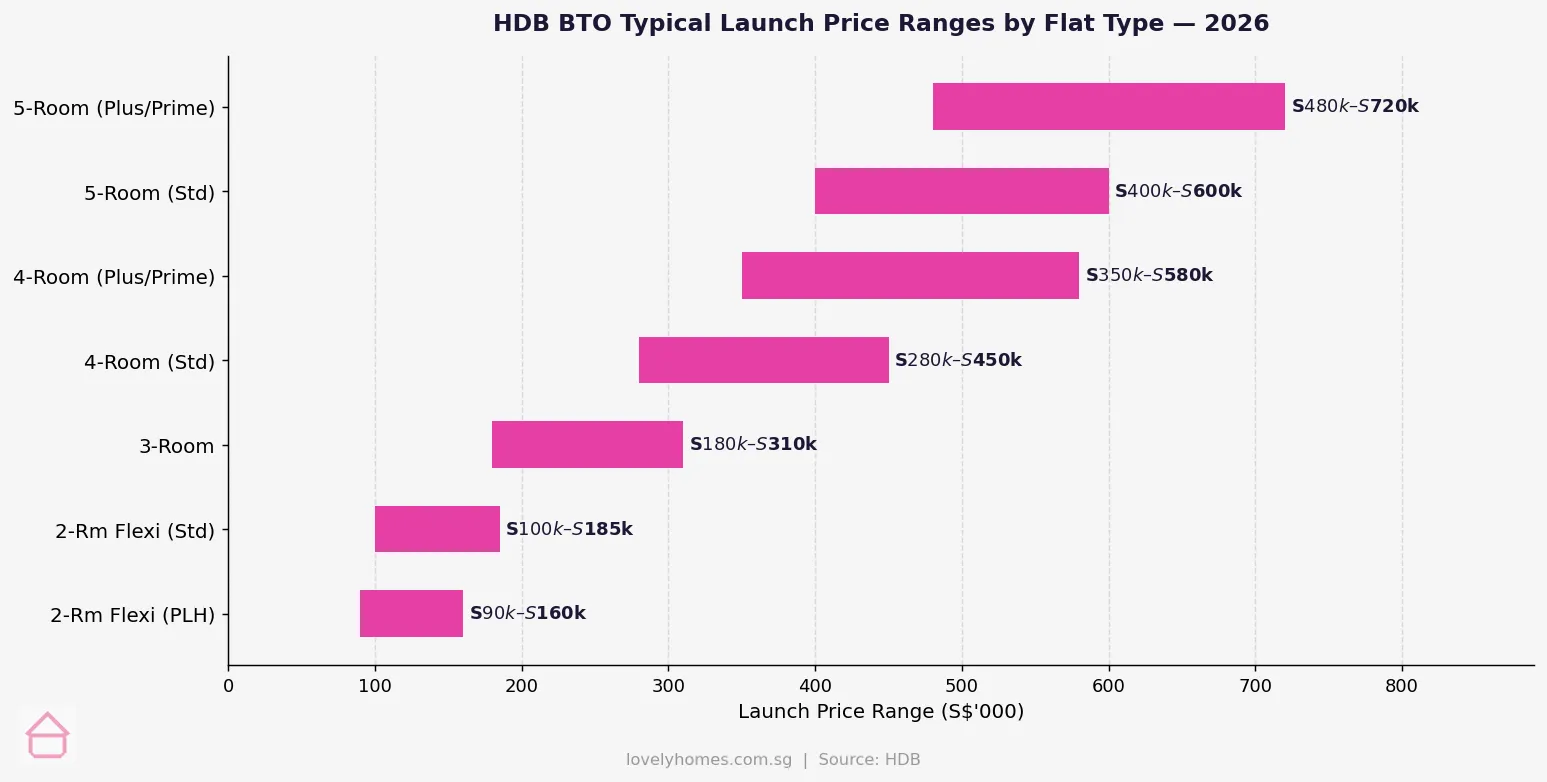
HDB BTO flat type price ranges Singapore 2026 — 2-Room Flexi to 5-Room Plus Prime Standard
Figure 1: Typical HDB BTO launch price ranges by flat type — 2026. Source: HDB. Indicative; actual prices vary by project and location.

Standard, Plus and Prime — The October 2024 Framework

The biggest structural change to the BTO system since the scheme’s launch was the introduction of the Standard, Plus and Prime classification framework in October 2024. The framework replaced the older Build-To-Order and Prime Location Public Housing (PLH) Model and applies to all BTO projects from the October 2024 exercise onwards.

Standard flats are in suburban locations with no exceptional accessibility advantage. They carry the existing 5-year MOP, can be rented out in whole after MOP, and carry no clawback on the resale price. Most estates — Woodlands, Choa Chu Kang, Sembawang, Sengkang — will be Standard designation.

Plus flats are in locations with better-than-average accessibility and amenities — typically mature towns or well-served suburban sites. They carry a 10-year MOP, may not be rented out in whole before the end of MOP, carry a clawback of a percentage of the resale price returned to HDB, and have an income ceiling of S$14,000 per month (identical to Standard in 2026). Bishan, Ang Mo Kio, and many Bukit Merah BTO sites now fall under Plus.

Prime flats are in the most central and accessible locations, including city-fringe and central-area sites such as Queenstown, Kallang/Whampoa, and Henderson. They carry the same 10-year MOP and clawback as Plus, have stricter subletting restrictions, and apply a higher clawback rate. The June 2026 BTO exercise includes Bukit Merah Berlayar, widely expected to be classified as Prime.

The rationale is that public housing subsidies should be appropriately scaled to how choice a location is. A flat at Queenstown — where resale prices touch S$1,000 per square foot — receives a larger implicit subsidy than a flat in Woodlands. The clawback is the mechanism for recapturing some of that subsidy when owners eventually sell at market prices.

Grants: EHG, PHG, Step-Up CPF and More

Singapore’s housing grants form a multi-layered system designed to ensure that the effective cost of a first BTO flat is within reach of lower- and middle-income families. The key grants available in 2026 are:

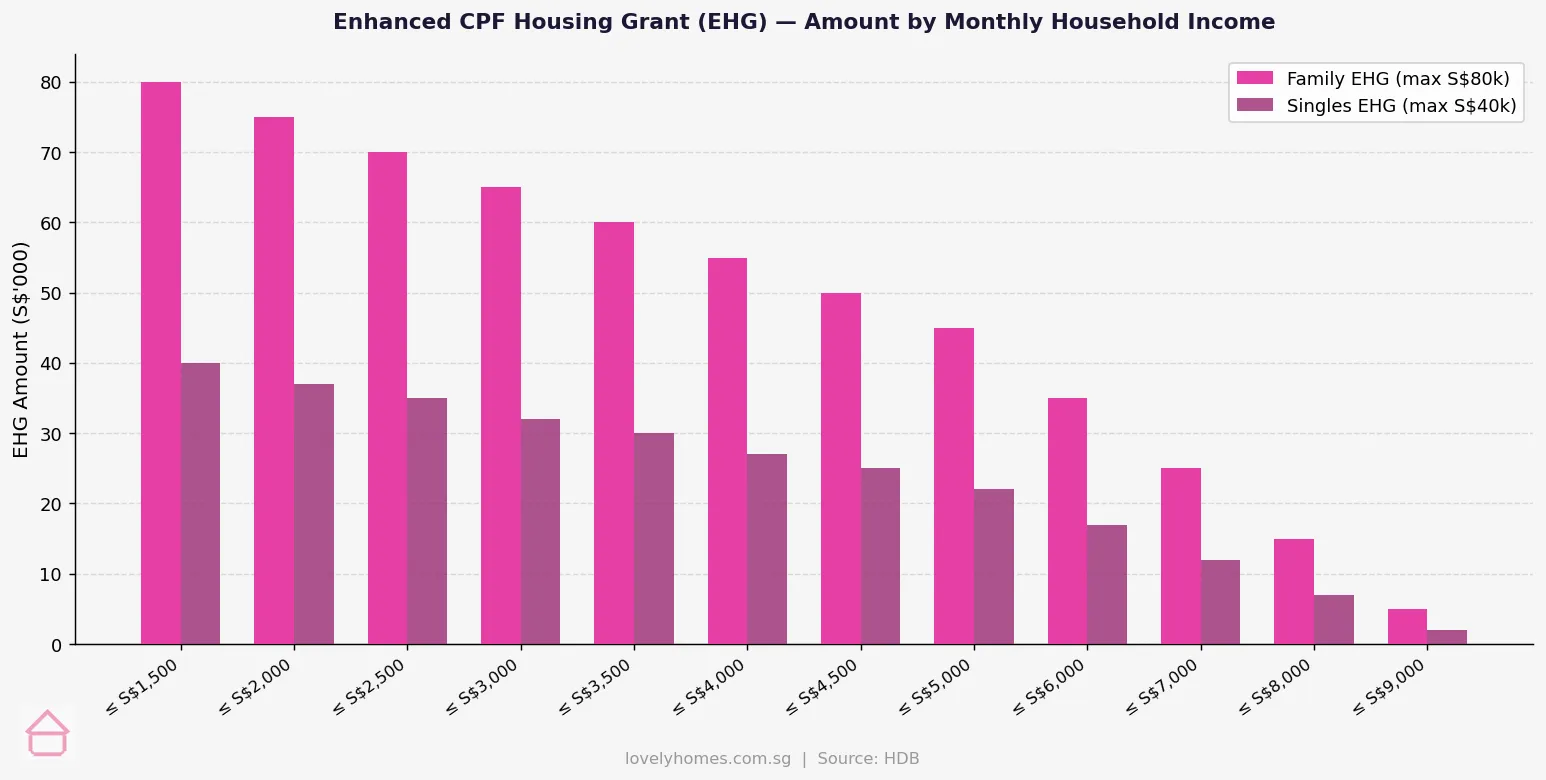
Enhanced CPF Housing Grant (EHG). Administered by CPF Board and HDB jointly, the EHG replaced the Additional CPF Housing Grant and Special CPF Housing Grant in September 2019. It is means-tested against average gross monthly household income over the preceding 12 months. For families, EHG ranges from S$5,000 at an income of S$9,000/month to S$80,000 at an income of S$1,500/month or below. Singles buying a 2-room Flexi flat receive half the family rate. EHG is paid into your CPF Ordinary Account (OA) and can be used for the flat’s purchase price and mortgage payments; it is not a cash grant.

Proximity Housing Grant (PHG). The PHG is available for resale flat purchases (not BTO directly, but relevant to those who buy resale instead of BTO). It pays S$30,000 if you live with parents/children or within 4 km of them, and S$20,000 if you live with or near a sibling. Singles receive half the family rate.

Step-Up CPF Housing Grant. For second-timer applicants who currently live in a 2-room HDB flat (rental or owned) and wish to buy a 2-room Flexi or 3-room BTO flat, the Step-Up Grant provides S$15,000. It recognises that some residents need a nudge rather than a full subsidy to upgrade from the smallest flat types.

Enhanced CPF Housing Grant EHG amount by monthly household income Singapore 2026 families and singles
Figure 2: EHG grant amount by monthly household income — families (max S$80k) vs singles (max S$40k). Source: HDB / CPF Board.

Eligibility: Who Can Apply for a BTO Flat?

BTO eligibility is governed by several overlapping criteria under the Housing and Development Act (Cap. 129). The main conditions in 2026 are:

Citizenship. At least one applicant must be a Singapore Citizen. Singapore Permanent Residents may only apply under the Public Scheme together with a Citizen family member. Foreigners are not eligible to buy new HDB flats.

Age. Applicants must be at least 21 years old for family schemes. Singles may apply from age 35 under the Single Singapore Citizen (SSC) Scheme, but only for 2-room Flexi flats in non-mature estates.

Family nucleus. Eligible family units include married couples, fiancé/fiancée (Option to Purchase granted on condition of marriage within 3 months), parents with children, and orphaned siblings. Singles must buy alone (no co-applicant outside of parents or siblings if orphaned).

Income ceiling. For Standard and Plus flats, the gross monthly household income ceiling is S$14,000 (S$7,000 for singles). For 2-room Flexi flats in non-mature estates, there is no income ceiling for some schemes.

Ownership restrictions. Applicants must not own or have recently sold private residential property in Singapore or overseas, and must not have enjoyed a previous housing subsidy (e.g., a previous BTO purchase) within the applicable waiting period.

HFE letter. Since May 2023, all applicants must obtain a valid HDB Flat Eligibility (HFE) letter before applying for any BTO or Sale of Balance Flats (SBF) exercise. The HFE letter confirms your eligibility, loan eligibility, and grant amounts in a single integrated assessment. It is valid for 9 months and should be obtained well before any exercise opens.

The Application and Balloting Process

HDB opens BTO application windows for approximately one month, typically twice a year (February and June/July, with an October exercise since 2022). During the window, eligible buyers submit a single application for one project of their choice, along with their preferred flat type. There is no fee to apply.

After the application window closes, HDB runs a computerised ballot to determine the order in which applicants may choose their units. Priority queues exist within the ballot: Married Child Priority Scheme (MCPS) for applicants buying near parents, Multi-Generation Priority Scheme (MGPS) for two households applying together, Tenants’ Priority Scheme (TCPS) for existing HDB rental tenants (raised to 10% from June 2026), and First-Timer Families Priority ensuring first-timers get precedence.

Applicants who are balloted but do not find a flat they want, or who miss their booking appointment, are deemed “unsuccessful” and may re-apply in future exercises. After a first unsuccessful ballot, first-timers receive one additional ballot chance in subsequent applications. After two unsuccessful ballots, they receive priority queue status, significantly improving their odds. HDB has indicated that the median waiting time for a first-timer to successfully book a BTO flat is approximately two application exercises.

Upon selection, applicants pay a booking fee of S$500 to S$2,000 (depending on flat type) and sign the Agreement for Lease, committing to buy the flat. The balance of the purchase price, plus BSD, is paid in tranches as construction milestones are met.

What Does a BTO Flat Actually Cost?

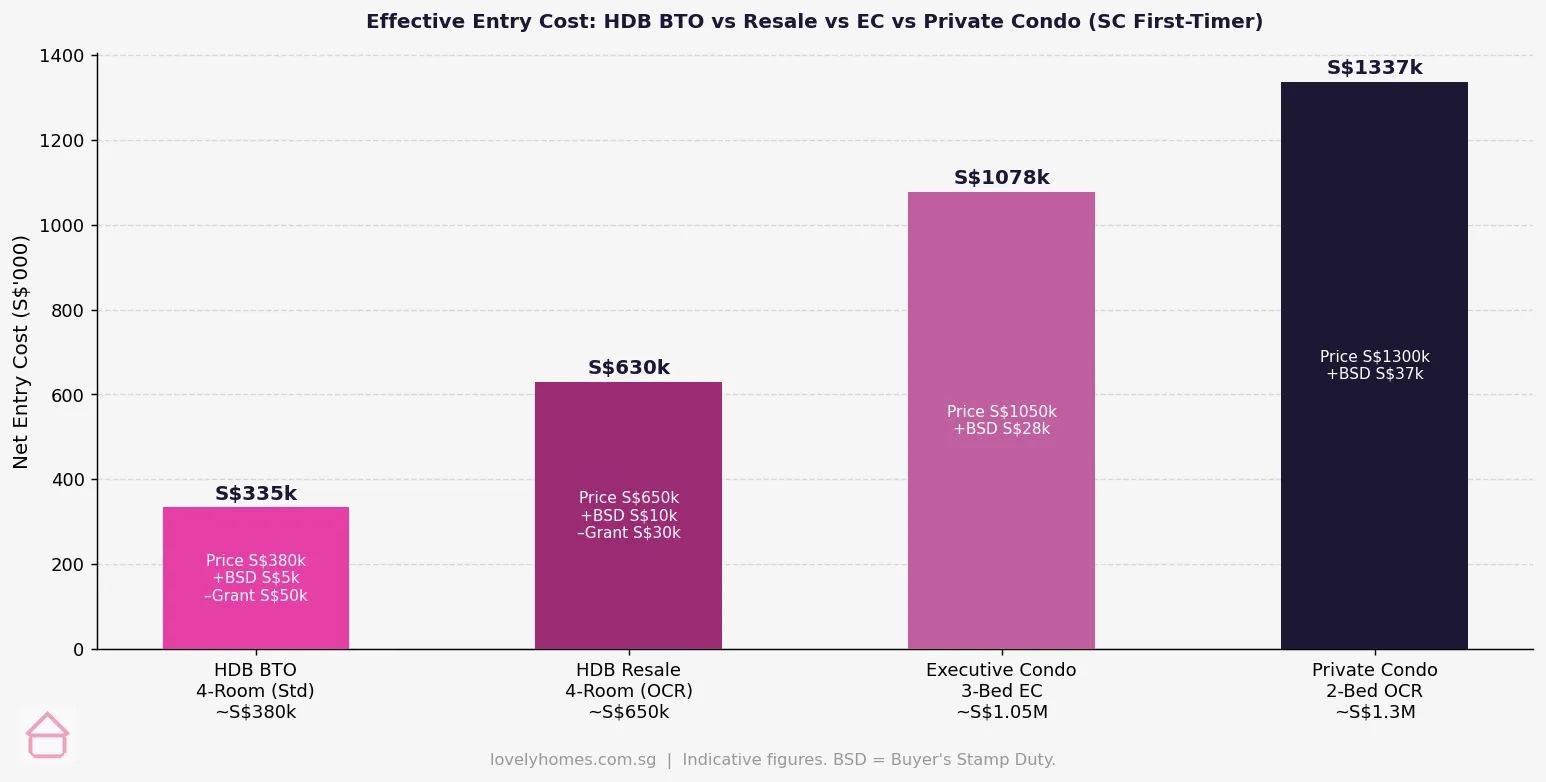
The out-of-pocket cost of a BTO flat depends on flat type, location (Standard vs Plus vs Prime), income-linked grants, whether you use a HDB concessionary loan or a bank loan, and CPF OA balances. The figures below represent the after-grant purchase prices for a typical Singapore Citizen first-timer family with a joint monthly income around S$6,000–8,000.

Net entry cost comparison HDB BTO vs resale vs EC vs private condo Singapore 2026 first-timer buyer
Figure 3: Effective entry cost (after grants, including BSD) — HDB BTO vs resale vs EC vs OCR private condo for a SC first-timer. Indicative figures.

Summary Comparison Table

Parameter Standard BTO Plus BTO Prime BTO HDB Resale
Location Non-mature estates Mature / well-served towns Central / city-fringe Any estate
MOP 5 years 10 years 10 years 5 years (existing MOP)
Whole-unit rental after MOP Yes Yes (after 10yr MOP) Restricted Yes
Resale clawback No Yes (% of resale price) Yes (higher %) No
EHG applicable? Yes Yes Yes Yes
PHG applicable? No No No Yes (up to S$30k)
Typical 4-Room price (2026) S$280k – S$450k S$350k – S$580k S$400k – S$700k S$500k – S$900k
Waiting time 3–5 years 3–5 years 3–5 years Immediate

Worked Example — Mr & Mrs Lim, Bishan Standard 4-Room BTO

Mr and Mrs Lim are a Singapore Citizen married couple in their late 20s. Their combined gross monthly income is S$7,200. They apply for a 4-Room Standard BTO flat in a Bishan project priced at S$395,000 (hypothetical launch price).

Grant calculation: At a household income of S$7,200, EHG for families is S$25,000. The flat is a BTO (not resale), so PHG does not apply. Net purchase price: S$395,000 − S$25,000 = S$370,000.

BSD: On S$370,000 — first S$180,000 at 1% = S$1,800; next S$180,000 at 2% = S$3,600; balance S$10,000 at 3% = S$300. BSD = S$5,700. ABSD: nil (SC first property).

Financing: HDB concessionary loan LTV 80% → loan = S$370,000 × 80% = S$296,000 (subject to HFE eligibility and credit assessment). The couple must fund at least 20% (S$74,000) from CPF OA and/or cash. Monthly instalment on a S$296,000 HDB loan at 2.6% over 25 years: approximately S$1,345 per month. MSR check: S$1,345 / S$7,200 = 18.7% — within the 30% MSR limit. TDSR: 18.7% — well within 55%.

Upfront cash: Booking fee (4-room) S$2,000 + BSD S$5,700 + balance of 20% downpayment via CPF OA S$72,000. If CPF OA balance is below S$72,000, the shortfall must be paid in cash.

Outcome: The Lims can feasibly service the flat on their combined income. The total effective entry cost of S$335,700 (after grants) is S$364,300 less than the equivalent OCR private condo — illustrating the ongoing role of BTO as Singapore’s primary affordability tool.

What Might Come Next — BTO Pipeline for 2026–2028

HDB has confirmed approximately 19,600 BTO flats for 2026 across the four exercises. Noteworthy launches expected in the second half of 2026 and beyond include the Toa Payoh West BTO project slated for the October 2026 exercise — the first significant public housing release in central Toa Payoh in over a decade and almost certain to attract oversubscription as a Standard or Plus project. Pearl’s Hill — a large site in the Chinatown/Outram Park corridor — is expected to yield approximately 1,700 new homes in a future exercise, potentially as a Prime project given its proximity to the CBD.

HDB is also studying the gradual release of land in the Greater Southern Waterfront (GSW) area for public housing over the longer term, and the Tengah “forest town” BTO pipeline will continue with further phases through 2027–2028. Buyers who miss the current exercises should monitor the HDB website for upcoming announcements and apply for an HFE letter in advance.

Frequently Asked Questions

Can I rent out my BTO flat before MOP?

No. You are not permitted to rent out the entire flat before the end of your MOP (5 years for Standard, 10 years for Plus/Prime). You may, however, rent out individual rooms within your flat at any time, subject to HDB’s approval and occupancy limits. Renting out the whole flat before MOP is a breach of the Housing & Development Act and can result in HDB compulsorily acquiring the flat at below-market value.

What happens if I miss my BTO booking appointment?

If you do not attend your booking appointment or decline to select a flat during your appointed slot, your application is cancelled. You forfeit your booking priority for that exercise. You may re-apply in future exercises, but your first-timer queue advantage resets. HDB does not guarantee a rescheduled appointment.

Is a HDB loan or a bank loan better for a BTO flat?

The HDB concessionary loan offers a rate of 0.1 percentage points above the CPF OA rate — currently 2.6% per annum — and is generally lower than bank rates, which were around 3.0–3.5% per annum in 2026. The HDB loan allows an LTV of 80% and does not require a cash downpayment; the full 20% downpayment can come from CPF OA. However, if you take a bank loan, you must pay at least 5% of the purchase price in cash (with the remaining 20% from CPF or cash), and LTV is capped at 75%. For most first-time buyers with limited cash savings, the HDB loan is generally more accessible.

What is the Minimum Occupation Period and does it restart if I sell?

The MOP begins from the date you receive your keys. For Standard BTO flats, MOP is 5 years; for Plus and Prime BTO flats launched from October 2024 onwards, it is 10 years. When you sell and buy a second HDB flat, the MOP for the second flat runs from the date of that flat’s key collection — it does not inherit or carry over from the first flat. Crucially, you must have satisfied the MOP before you are eligible to sell on the open market or purchase a private residential property concurrently with HDB flat ownership.

Can PRs buy a BTO flat?

Singapore Permanent Residents (PRs) cannot buy new BTO flats on their own. A PR can only buy a BTO flat if they are applying together with a Singapore Citizen spouse or family member under an eligible scheme (e.g., Public Scheme). The Citizen must be a co-applicant, not just a supporting document. PRs buying alone may purchase HDB resale flats (but not new BTO units), subject to their own eligibility conditions and a minimum 3-year PR residency requirement.

What is the TCPS and how does it help current HDB tenants?

The Tenants’ Priority Scheme (TCPS) allocates up to 10% of BTO flat supply across all exercises — raised from 5% in the June 2026 BTO exercise — to eligible existing HDB rental flat tenants. To qualify, the applicant must have been living in an HDB rental flat for a minimum period and meet all standard BTO eligibility criteria. The scheme is designed to give long-term rental tenants a pathway to home ownership with a statistical advantage in the ballot. Applications under TCPS count alongside other priority schemes (MCPS, MGPS, First-Timer Priority) where multiple schemes apply.

Related Articles

Disclaimer: This article provides general information about the HDB Build-To-Order scheme and housing grants as at 3 June 2026. It is not financial, legal, or housing advice. Eligibility criteria, grant amounts, income ceilings, and BTO project details are subject to change by HDB and CPF Board. Always verify your eligibility and loan limits with the official HDB website, the CPF Board, and your preferred financial institution before making any property purchase decision.

HDB Minimum Occupation Period (MOP) Singapore 2026: Standard, Plus and Prime Rules Explained

HDB Minimum Occupation Period (MOP) Singapore 2026: Standard, Plus and Prime Rules Explained

Quick Answer

  • The HDB Minimum Occupation Period (MOP) is the mandatory period you must physically occupy your HDB flat before you can sell it on the open market, rent out the entire flat, or purchase a second private residential property without incurring the full ABSD burden. MOP is administered by HDB (Housing and Development Board).
  • For Standard BTO flats, the MOP is 5 years from the date of key collection. For Plus and Prime BTO flats (introduced for BTO exercises from May 2023), the MOP is 10 years.
  • During the MOP, you cannot sell the flat, rent out the entire unit, or transfer ownership. You can, however, rent out individual rooms with HDB approval, and you may purchase private property (subject to ABSD).
  • After the MOP, Standard flat owners may sell to any eligible HDB buyer (SC or SPR). Plus flat owners must sell to SC or SPR buyers whose household income is within the prevailing income ceiling. Prime flat owners may only sell to Singapore Citizens whose household income is within the income ceiling.
  • Whole-flat rental after MOP is permitted for Standard flats (subject to HDB approval). It is not permitted at any time for Plus or Prime flats.
  • A subsidy clawback applies when Plus and Prime flats are sold on the open market — HDB recovers a portion of the housing grant and pricing subsidy. The clawback amount is higher for Prime flats.
  • The MOP clock starts from the date of key collection — not the date of BTO application, booking fee payment, or Temporary Occupation Permit (TOP). A flat collected in June 2024 has its Standard MOP expiry in June 2029.

What Is the MOP and Who Administers It?

The Minimum Occupation Period (MOP) is a statutory requirement under the Housing and Development Act, administered by the Housing and Development Board (HDB). It requires owners of HDB flats to physically occupy their flat for a minimum period before certain rights become available — primarily the right to sell on the open market, rent out the entire unit, or purchase a second private residential property.

The MOP exists for two complementary policy reasons. First, it ensures that subsidised HDB flats are used as genuine owner-occupied homes rather than short-term investment instruments. Second, it moderates the supply of resale HDB flats that enter the market at any one time, which helps to stabilise resale prices. The requirement has been part of Singapore’s public housing policy for decades, and HDB enforces it through its ownership records, which are cross-referenced against the buyer’s NRIC address for SC/SPR buyers.

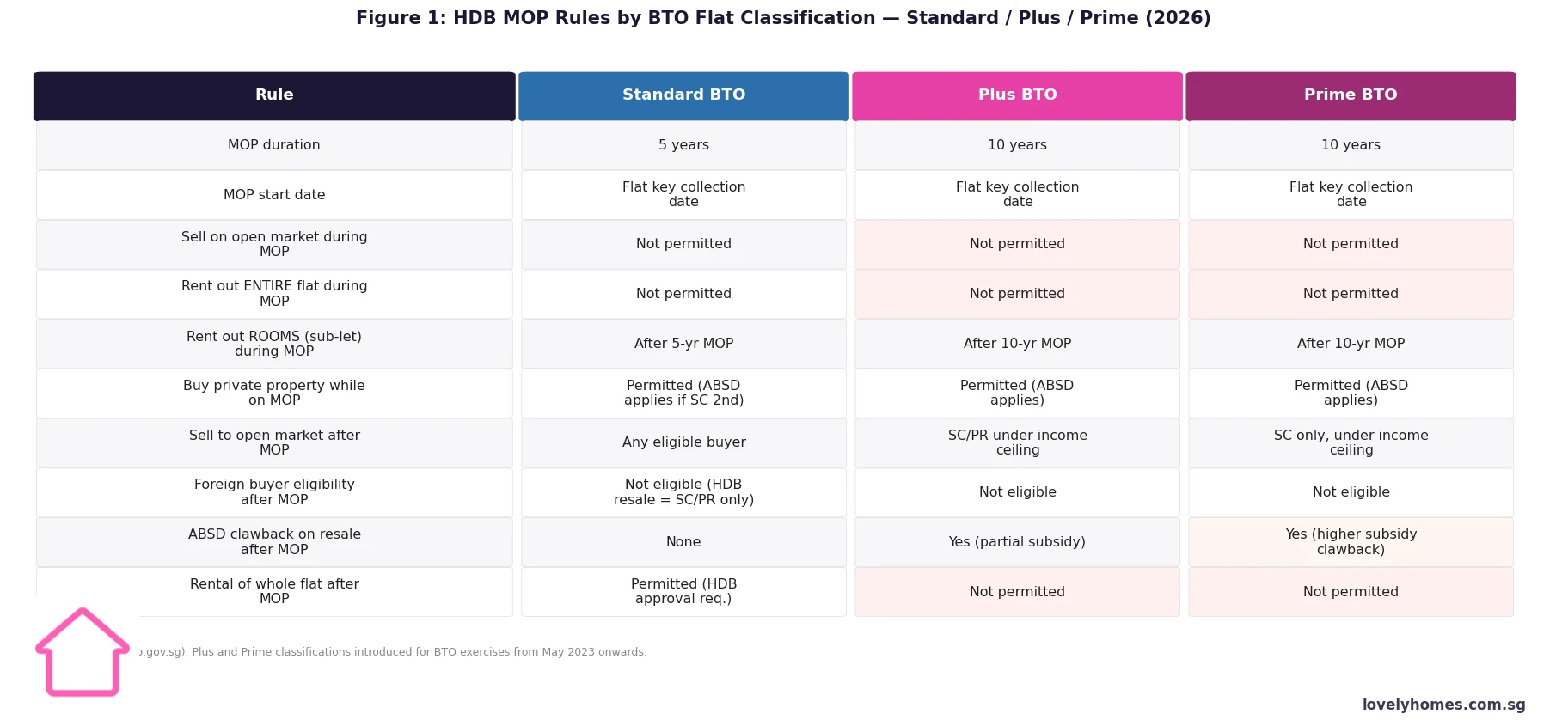
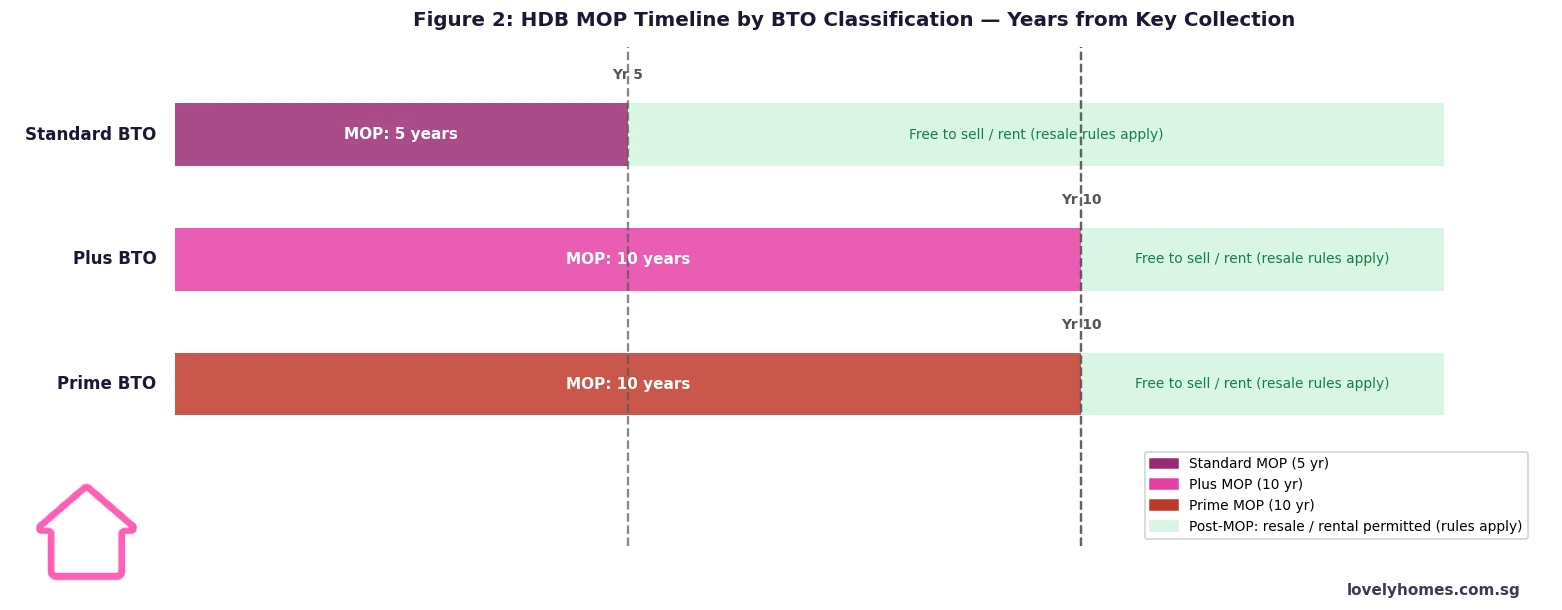
HDB MOP rules by BTO classification Standard Plus Prime Singapore 2026 comparison table
Figure 1: HDB MOP Rules by BTO Classification — Standard, Plus and Prime (2026) | Source: HDB

Standard, Plus and Prime: The Three BTO Classifications

From the May 2023 BTO exercise onwards, HDB classifies all new BTO flats into one of three tiers based on location and subsidy level. This classification directly determines MOP length, post-MOP resale eligibility, rental rights, and subsidy clawback:

  • Standard flats are located in non-central, typically suburban estates (such as Tengah, Woodlands, Sembawang, and Punggol). They carry the lowest subsidies relative to market value and have the most permissive rules: 5-year MOP, resale to any eligible SC/SPR buyer, and whole-flat rental allowed after MOP with HDB approval.
  • Plus flats are located near transport nodes or commercial hubs, in estates that would otherwise be too pricey for first-timer buyers without additional subsidy. They come with a 10-year MOP, resale restricted to SC/SPR buyers within the prevailing income ceiling, and no whole-flat rental at any time.
  • Prime flats are located in the choicest sites — city-fringe, waterfront, or mature central estates like Kallang, Toa Payoh, and Marina South — where HDB provides the heaviest subsidies. They carry a 10-year MOP, SC-only resale (SPR buyers are ineligible), income ceiling restrictions, no whole-flat rental at any time, and the highest clawback rate.

Buyers are told which classification a flat falls under at the time of BTO application. The classification is permanently attached to the flat and does not change over time, even after resale. A Prime flat remains a Prime flat in every subsequent transaction.

HDB MOP timeline by BTO classification Standard 5 years Plus Prime 10 years Singapore 2026
Figure 2: HDB MOP Timeline by BTO Classification — Years from Key Collection (Singapore 2026)

What You Can and Cannot Do During the MOP

The MOP does not mean you are locked away from all activity — it specifically restricts disposal and whole-unit rental. The table below summarises key permitted and prohibited actions:

Activity During MOP After MOP (Standard) After MOP (Plus/Prime)
Sell flat on open market Not permitted Permitted (SC/SPR buyers) SC/PR (Plus); SC only (Prime); income ceiling applies
Rent out entire flat Not permitted Permitted (HDB approval) Not permitted (ever)
Rent out rooms (sub-let) Not permitted during MOP Permitted (HDB approval) Permitted (HDB approval)
Buy private property Permitted (ABSD applies if SC 2nd property: 20%) Permitted Permitted
Transfer ownership (gift / divorce / death) HDB approval case-by-case Yes Yes (subject to Plus/Prime resale rules)
Renovate / alter the flat Permitted (HDB renovation permit) Permitted Permitted

Buying Private Property During the MOP

One of the most common questions from HDB flat owners is whether they can buy a private condominium before their MOP is up. The answer is yes — you are allowed to purchase private residential property in Singapore while your MOP is running. However, there are important financial consequences to consider.

If you are a Singapore Citizen owning an HDB flat (which counts as your first residential property) and you buy a private condo during the MOP, you are buying a second property. This means you pay 20% ABSD on the private property purchase. If you are an SPR, your second-property ABSD is 30%. The HDB flat itself remains subject to the MOP and cannot be sold until the MOP expires.

This means you will be servicing two housing loans simultaneously until the HDB can be sold — which requires careful TDSR planning. The TDSR cap of 55% applies across all outstanding loans. HDB loans (from HDB directly) and bank loans on HDB flats are both counted in TDSR. If the combined debt servicing ratio exceeds 55% when adding the private mortgage, financing for the private property may be declined.

What Happens When You Sell After the MOP

Once the MOP is fulfilled, the key restrictions are lifted — but resale rules still apply, especially for Plus and Prime flats:

  • Standard flats: May be sold to any eligible HDB resale buyer — SC or SPR, subject to standard HDB eligibility criteria (Ethnic Integration Policy quotas, family nucleus requirements, etc.). No income ceiling on the buyer.
  • Plus flats: May only be sold to buyers whose household income does not exceed the prevailing income ceiling (currently S$14,000/month for families, S$7,000 for singles). SPR buyers are eligible. A subsidy clawback is deducted from the sale proceeds on the first open-market resale.
  • Prime flats: May only be sold to Singapore Citizen buyers (SPR buyers are not eligible) whose household income does not exceed the income ceiling. The subsidy clawback rate is higher than for Plus flats and is also deducted from the first open-market resale proceeds.

The subsidy clawback is calculated as a percentage of the resale price (or market value, whichever is higher) and is paid to HDB at the point of resale. HDB has not publicly released a fixed clawback percentage table; the exact rate is determined and communicated at the time of application. This is intended to recover some of the subsidy advantage enjoyed by Plus/Prime buyers while still allowing them a fair profit on genuine capital appreciation.

The MOP and CPF Accrued Interest

When you sell an HDB flat after the MOP, any CPF funds used to purchase the flat (including the option fee, downpayment, and monthly mortgage instalments paid from your CPF Ordinary Account) must be refunded to your CPF accounts — along with accrued interest at the CPF OA interest rate (currently 2.5% per annum). This accrued interest represents what your CPF savings would have earned had they not been used for housing. On a long MOP (10 years), accrued interest can be substantial and reduces the net cash proceeds from the sale.

Worked Example: The Wong Family and the MOP Decision

Mr and Mrs Wong, both Singapore Citizens, purchase a 4-room BTO flat in Bishan (classified as a Plus flat) in June 2024. Key collection is in June 2024. Their household income is S$9,000/month. The purchase price is S$550,000.

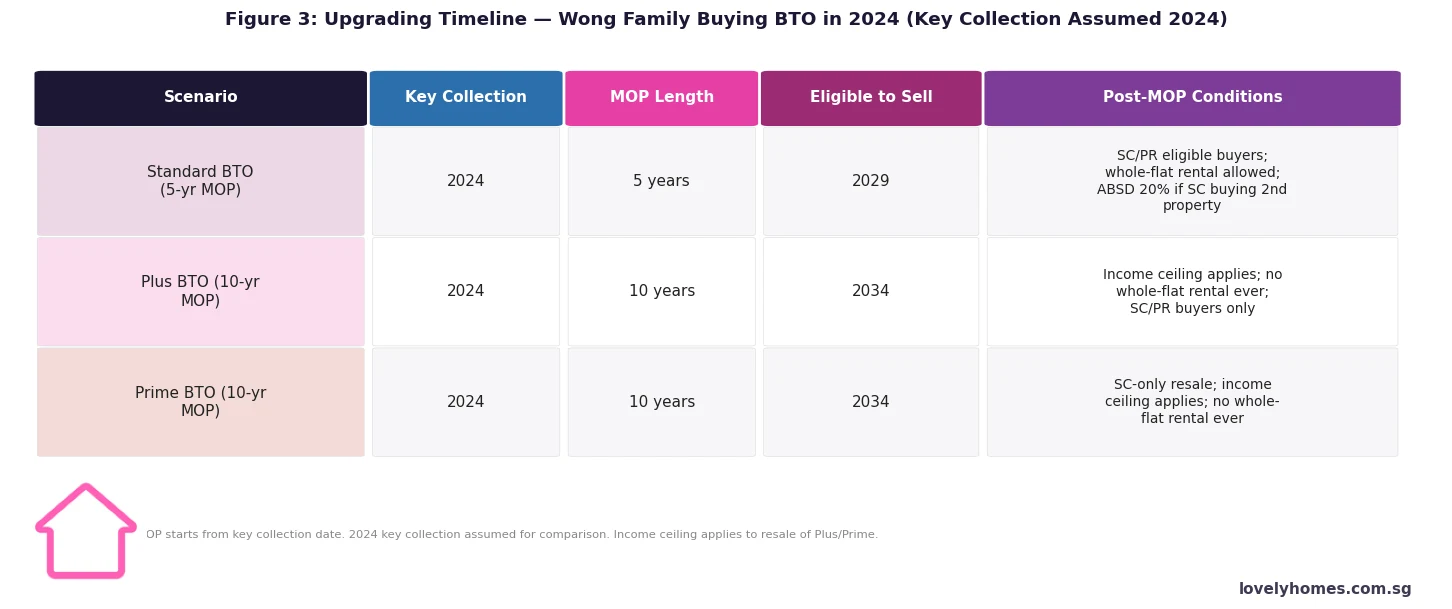
HDB upgrading timeline Wong family Standard Plus Prime BTO scenarios Singapore 2026
Figure 3: HDB Upgrading Timeline — BTO Scenario Comparison (Singapore 2026)
Scenario Event Year Notes
Plus BTO — Bishan Key collection 2024 MOP clock starts
Buy private condo (2nd property, if desired) Any time 20% ABSD applies; TDSR must clear; HDB MOP still running
MOP expires — eligible to sell HDB 2034 10-year MOP; income ceiling on buyer (S$14k); clawback on sale proceeds
Can rent out rooms (sub-let) From 2034 HDB approval required; cannot rent entire flat (ever)

Over the 10-year MOP, if the flat appreciates from S$550,000 to S$800,000 (a not unreasonable assumption for a Plus-classified Bishan flat), the Wongs would make a nominal gross gain of S$250,000. From this, HDB deducts the clawback (amount TBD at point of sale), plus CPF refund with accrued interest. On a S$550,000 purchase with 25% CPF downpayment (S$137,500) at 2.5% CPF OA rate over 10 years, accrued interest alone would be approximately S$38,700 — reducing net cash-in-hand from the sale. This is still a solid return, but buyers should model it carefully before factoring in the Plus flat subsidy as pure profit.

What This Means for HDB Buyers in 2026

The 10-year MOP for Plus and Prime flats is a significant commitment. A buyer collecting keys in 2026 cannot sell their Plus or Prime flat until 2036 at the earliest. Over that decade, Singapore’s property market will go through multiple cycles, interest rate shifts, and policy changes. Buyers who select Plus or Prime flats primarily because of the lower purchase price — and not because they genuinely intend to occupy the flat for 10 years — may find themselves in a difficult position if circumstances change (job relocation overseas, family expansion, divorce).

For those who do plan to stay, the Plus and Prime schemes deliver real value. A Prime flat in a central location at a subsidised price, occupied for 10 years with a no-rental restriction, is likely to appreciate meaningfully in absolute terms even after clawback. The restriction is the price of the subsidy.

What Might Come Next

The May 2023 introduction of Plus and Prime classifications represented a significant shift from the old Mature/Non-Mature estate binary. The April 2023 announcement also removed the ability of EC buyers to use the Deferred Payment Scheme from May 2026 — suggesting the government continues to tighten across all public and quasi-public housing tiers. Any further changes to MOP duration are unlikely in the near term given that the 10-year Plus/Prime MOP is relatively new and the government will want to assess its impact before adjusting. The resale income ceiling may, however, be revised upwards over time to track median income growth in Singapore.

Related Articles

Frequently Asked Questions

When does the MOP start — from key collection or from BTO ballot application?

The MOP starts from the date of key collection — not the date of BTO application, not the ballot exercise date, and not the date you pay the option fee or sign the lease agreement. The key collection date is when you physically receive the keys to your flat and formally take possession. This date is recorded by HDB and serves as the MOP commencement date. For a Standard flat collected in July 2024, the MOP expires in July 2029. For a Plus or Prime flat collected in the same month, it expires in July 2034.

Can I rent out rooms in my HDB flat while the MOP is running?

No. During the MOP, you may not rent out any part of your flat — neither the entire unit nor individual rooms. Room rental (sub-letting) is only permitted after the MOP has been fulfilled and only with HDB’s prior written approval. After the MOP, Standard flat owners may rent out rooms or the entire flat (with HDB approval); Plus and Prime flat owners may rent out rooms after the MOP but may never rent out the entire flat under any circumstances.

What happens if I need to move overseas for work during the MOP?

If you need to work overseas temporarily, you must continue to maintain your HDB flat as your Singapore residence — meaning a family member must continue to reside in the flat, and you must return periodically. You cannot rent out the flat during the MOP even if you are overseas. If your overseas stint is long-term and the flat will genuinely be unoccupied, you should consult HDB directly. Abandoning the occupancy requirement during the MOP can result in HDB compulsorily acquiring the flat at a below-market price under the Housing and Development Act — a severe consequence that buyers should be aware of.

Can I buy a private condo while my HDB MOP is still running?

Yes. Purchasing a private residential property while your HDB MOP is outstanding is permitted. However, since your HDB flat counts as your first residential property, the private condo purchase is classified as a second property for ABSD purposes. A SC pays 20% ABSD on the private condo. An SPR pays 30%. You must also have the financial capacity to service both housing loans simultaneously and remain within the 55% TDSR cap. Many HDB owners choose to exercise this option a year or two before their MOP expires, so the HDB can be sold shortly after the MOP milestone — reducing the period of dual-loan exposure.

What is the subsidy clawback for Plus and Prime flats, and when is it paid?

The subsidy clawback for Plus and Prime flats is paid to HDB at the point of the first open-market resale (i.e., the first resale transaction after the MOP). It is deducted from the sale proceeds before any balance is paid to the seller. The clawback is calculated as a percentage of the resale price or market valuation (whichever is higher). HDB has not published a fixed percentage table publicly; the exact rate is communicated in the flat purchase document at the time of BTO booking and is specific to the flat’s classification and location. The clawback only applies to the first open-market resale — subsequent owners of a Plus or Prime flat do not face an additional clawback when they eventually sell.

Do MOP rules apply to HDB flats purchased on the open resale market?

Yes. When you purchase an HDB resale flat — whether Standard, Plus, or Prime — the MOP requirement applies afresh from the date you collect the keys. A Standard resale flat has a 5-year MOP from your key collection date; a Plus resale flat has a 10-year MOP; and a Prime resale flat has a 10-year MOP. The classification (Standard, Plus, Prime) of the flat follows it through all transactions. You cannot shorten the MOP on a resale flat because the previous owner already fulfilled their MOP.

Can an SPR buyer purchase a Plus or Prime HDB flat on the open resale market?

For Plus flats: yes, subject to the income ceiling (S$14,000/month household income) and standard SPR eligibility criteria. For Prime flats: no — Prime flats may only be resold to Singapore Citizens (not SPR). This restriction applies to every resale of a Prime flat in perpetuity, not just the first resale. SPR buyers wishing to purchase Plus flats must also form an eligible family nucleus (e.g., SC/SPR family or SPR household of two or more) to qualify under HDB’s resale eligibility framework.

Disclaimer: This article is for general information only and does not constitute legal or financial advice. HDB rules, MOP durations, clawback rates, and eligibility criteria are subject to change by HDB and the Ministry of National Development. Always verify the latest requirements at hdb.gov.sg and consult HDB directly or a licensed HDB resale agent for guidance specific to your situation. All figures and scenarios are illustrative and based on publicly available data as at 16 May 2026.

HDB Resale Levy Singapore 2026: Who Pays It, How Much, and How to Avoid It

HDB Resale Levy Singapore 2026: Who Pays It, How Much, and How to Avoid It

HDB resale levy Singapore 2026 — full guide hero image
HDB Resale Levy Singapore 2026 — who pays, when, and how to plan around it.

Quick answer — the resale levy in 30 seconds

  • The HDB resale levy is a one-off charge on second-timer households who take a second housing subsidy from HDB (BTO, Sale of Balance Flats, or a new Executive Condominium).
  • It does not apply if you sell your subsidised flat and buy on the open resale market without claiming any fresh HDB grant.
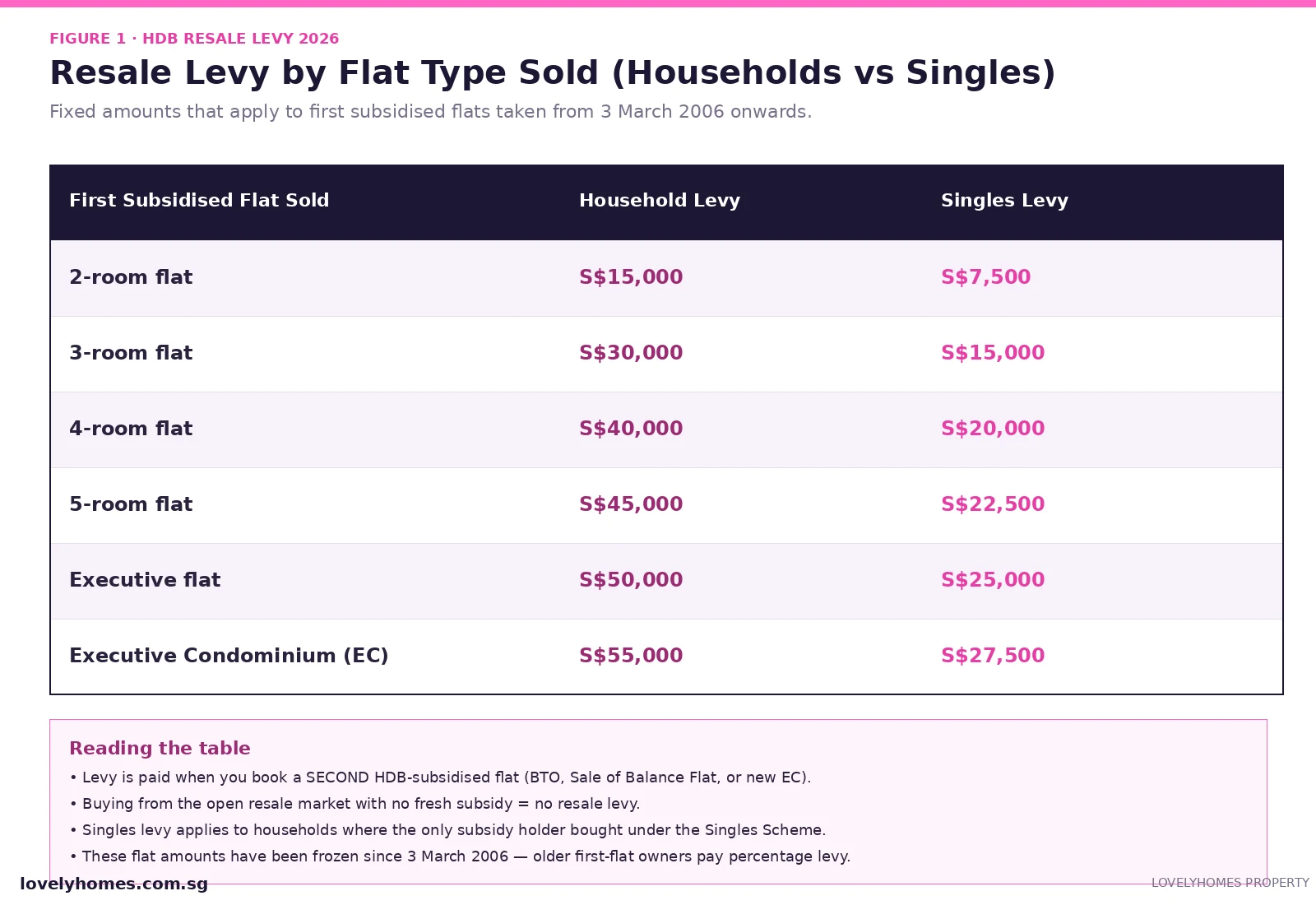
  • For first subsidised flats taken from 3 March 2006, the levy is a fixed amount — S$15,000 for a 2-room sold up to S$55,000 for an EC.
  • Households who got their first subsidy before 3 March 2006 pay a percentage levy of 10–25% of the resale price instead.
  • Singles Scheme buyers pay half the household amount.
  • The levy is paid in cash (or net cash proceeds from selling the first flat) — CPF cannot be used.
  • Payment is collected at the point of booking the second subsidised flat, before key collection.
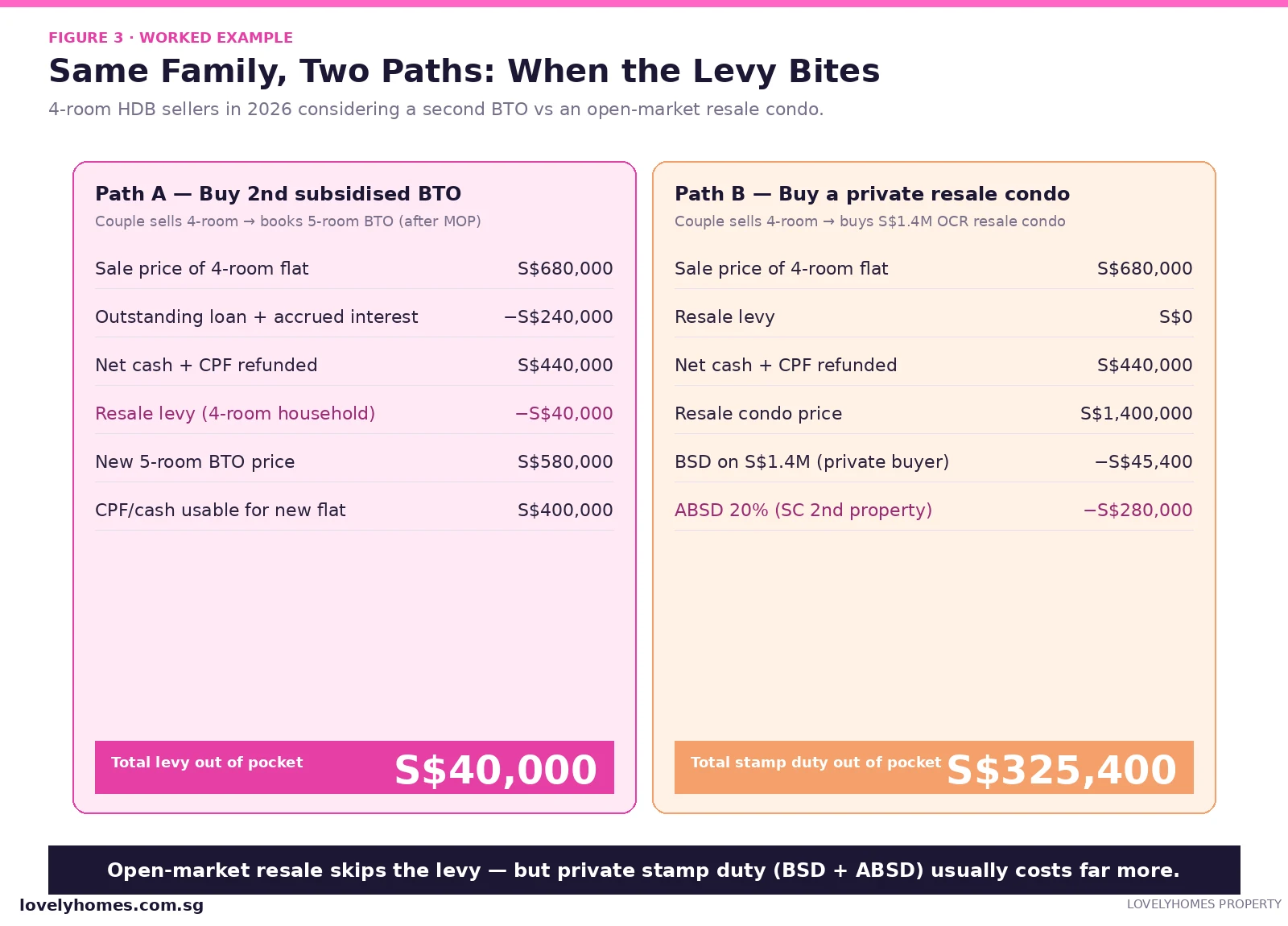
  • Buying on the open market means no levy, but you still face BSD, ABSD (where applicable) and SSD if you sell within three years.

What is the HDB resale levy?

The resale levy is a charge that the Housing & Development Board (HDB) imposes on a household which has already enjoyed a housing subsidy and now wants a second bite at one. The Government’s logic is straightforward: public housing subsidies are taxpayer-funded, and a household should not collect them twice without contributing back. Selling the first subsidised flat is fine; what triggers the levy is the act of booking another subsidised flat — a fresh BTO, a Sale of Balance Flat, an open booking unit, or a brand-new Executive Condominium directly from the developer.

Crucially, the levy is administered by HDB, not IRAS. It is separate from Buyer’s Stamp Duty, ABSD, and Seller’s Stamp Duty. You can owe stamp duties and a resale levy in different scenarios, and they are calculated, paid, and tracked independently.

HDB resale levy Singapore 2026 — fixed levy amounts by flat type for households and singles
Figure 1 · Fixed-dollar resale levy amounts in force since 3 March 2006. Source: HDB.

Who actually pays the levy?

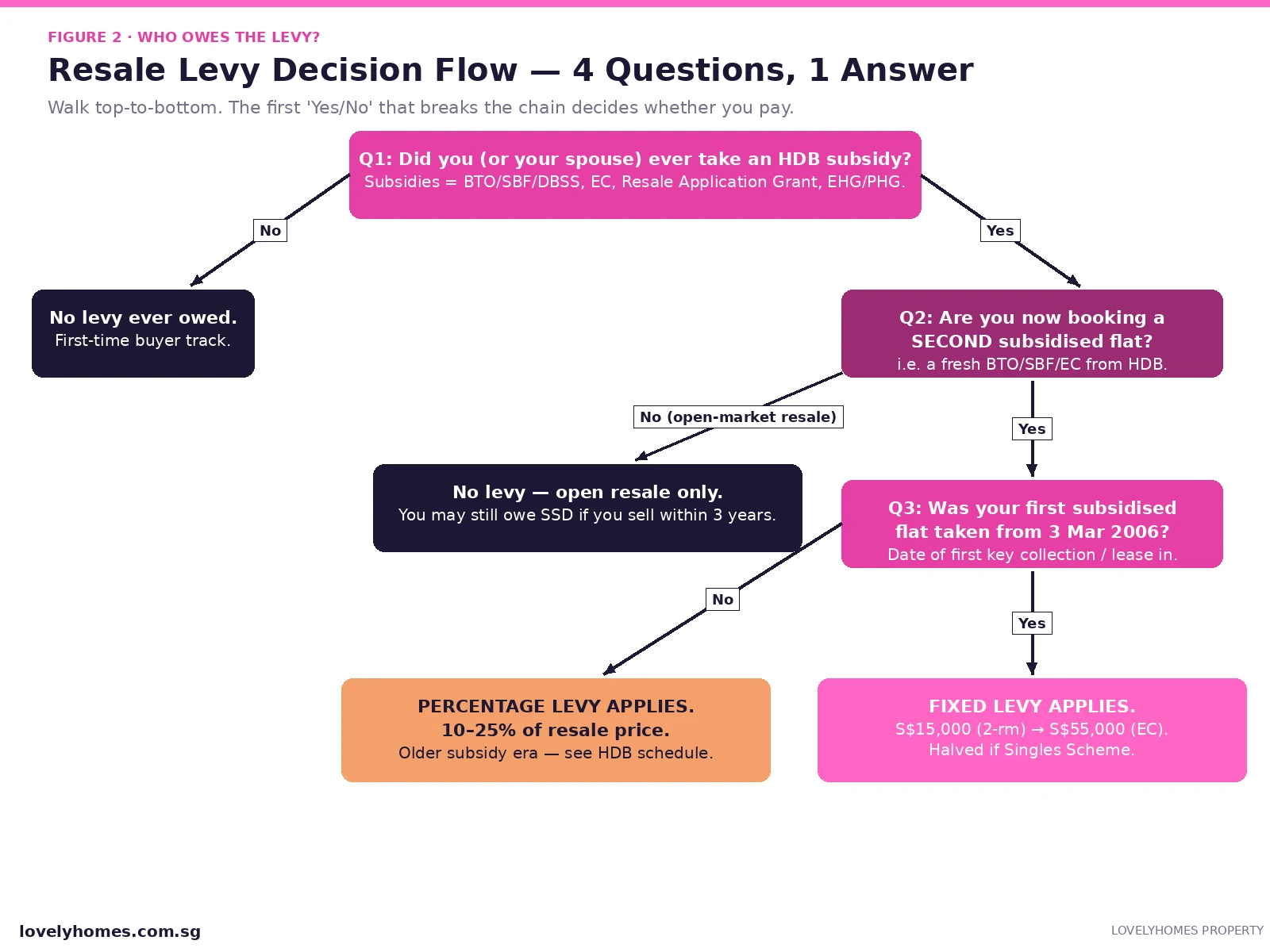
The resale levy travels with the household, not the property. If at any point in your housing history you (or your spouse, or your essential occupier) have already enjoyed an HDB subsidy, you are a second-timer in HDB’s eyes the next time you approach them for a fresh subsidy. The subsidies that count include:

  • A new flat purchased directly from HDB (BTO, Sale of Balance Flats, Re-Offer of Balance Flats, open-booking flats).
  • A Design, Build and Sell Scheme (DBSS) flat bought from a private developer.
  • An Executive Condominium bought directly from the developer (first hand).
  • A resale flat bought with one of the older Resale Application Grants — CPF Housing Grant for Family, Singles Grant, or Half-Housing Grant — taken before changes to the levy rules.
  • HUDC flats and SERS replacement flats taken under HDB schemes count similarly.

If your only subsidy was the Enhanced CPF Housing Grant (EHG) or the Family Grant on a resale flat purchased after 3 March 2006, you are not automatically deemed a levy-paying second-timer for the purpose of a future resale flat purchase — but you do pay the levy if you next buy a new flat or new EC.

How the levy is calculated

Two regimes apply, and the dividing line is the date of your first subsidised flat’s key collection (or in the case of an EC, the date you signed the Sale & Purchase Agreement).

Fixed-dollar levy (first flat from 3 March 2006)

This is the regime almost every modern buyer falls under. The amount is locked to the type of flat you sold:

First subsidised flat sold Household levy Singles Scheme levy
2-room flat S$15,000 S$7,500
3-room flat S$30,000 S$15,000
4-room flat S$40,000 S$20,000
5-room flat S$45,000 S$22,500
Executive flat / HUDC S$50,000 S$25,000
Executive Condominium S$55,000 S$27,500

The fixed amount does not move with property prices, which is good news for households whose first flat appreciated heavily in resale. A 4-room sold today for S$700,000 still owes only S$40,000 in levy — about 5.7% of the resale price.

Percentage levy (first flat before 3 March 2006)

Older second-timers face the legacy regime. Levy is set as a percentage of the higher of the resale price or 90% of the market valuation:

First subsidised flat sold Household levy % Singles Scheme levy %
2-room flat 10% 5%
3-room flat 20% 10%
4-room flat 22.5% 11.25%
5-room flat 25% 12.5%
Executive flat / HUDC 25% 12.5%

For a household that sold a 4-room legacy flat for S$650,000, the percentage levy lands at S$146,250 — markedly higher than the modern fixed levy. This is one reason long-time HDB owners often choose to remain in the resale market rather than ballot for a fresh BTO.

When and how the levy is paid

HDB collects the resale levy at the point of booking the second subsidised flat. In practice this means:

  1. You sell your first subsidised flat. CPF is refunded with accrued interest; the cash balance is yours.
  2. You ballot for, queue, and book a second BTO/SBF/SBF or sign for an EC.
  3. HDB issues a payment notice for the levy, payable in cash only. CPF cannot be used.
  4. Levy is paid before signing the lease agreement / S&P. Failure to pay forfeits the booking.

If the second flat is booked before the first has been sold, HDB defers the levy to the resale completion date and may require an undertaking. Some buyers structure it this way to avoid being homeless between sale and BTO completion, especially in long-build projects.

HDB resale levy 2026 decision flow — who owes the levy
Figure 2 · Walk the four questions in order — the first answer that breaks the chain decides your outcome.

Who is exempt or partially relieved?

HDB allows a small set of waivers and concessions, and these matter most for older households and downgraders:

  • Buying a 2-room Flexi flat on a short lease (45 years or less) at age 55 and above. The resale levy is waived in full to encourage right-sizing.
  • Buying a Studio Apartment / Community Care Apartment. No resale levy applies (these are senior-targeted typologies).
  • Divorce settlements where one party retains the existing flat. No levy event; only one of the parties may face a levy if they later buy a fresh subsidised flat.
  • Sub-letting income or rental of bedrooms does not trigger the levy. The levy only fires when the subsidised flat is sold and a new subsidised flat is booked.
  • Open-market resale purchases without grants are not levy events. You can move from a 4-room HDB to another resale 5-room without grant, and no levy is triggered.

Resale levy vs CPF refund vs stamp duty — separating the bills

It is easy to confuse three different cash flows that all hit a second-timer household at roughly the same time. They are independent and add up:

What you pay Who collects Triggers Source of funds
Resale levy HDB Booking second subsidised flat Cash only
CPF accrued interest CPF Board (refund into your OA) Sale of any flat Auto-deducted from sale proceeds
Buyer’s Stamp Duty IRAS Any property purchase Cash + CPF allowed
Additional Buyer’s Stamp Duty IRAS Second / third / foreign buyer purchase Cash + CPF allowed
Seller’s Stamp Duty IRAS Sale within 3-year holding period From sale proceeds

The CPF accrued interest is not a fee — it is your own money being returned to your OA — but it shrinks the cash you can deploy on the next purchase. Plan around it the same way you plan around the resale levy.

Worked example — same family, two paths

Take a Singapore Citizen couple, married 12 years, who bought a 4-room BTO in Punggol for S$320,000 in 2014 with a Family Grant. In 2026 they have hit the 5-year MOP, the flat is valued at S$680,000, and they are deciding whether to upgrade through a fresh BTO or to buy a private resale condo.

HDB resale levy worked example 2026 — second BTO vs private resale condo cost stack
Figure 3 · Whichever way they go, the resale levy is small relative to private stamp duty.

Path A — buying a 5-room BTO — costs S$40,000 in levy plus the new flat price of S$580,000. Path B — buying an S$1.4M open-market resale condo — skips the levy entirely but adds S$45,400 in BSD and S$280,000 in ABSD at the 20% citizen-second-property rate, totalling S$325,400 in stamp duty. The headline conclusion: the resale levy is real money, but it is dwarfed by ABSD whenever the alternative is a private-market upgrade. Couples often see this comparison only after they put pen to paper, which is why it pays to model both routes early.

Why the levy exists at all

Singapore’s housing model rests on two policy pillars: keeping public housing affordable to first-timers, and rationing taxpayer subsidies. Without a levy, a household could ride the BTO market repeatedly — cashing in on resale price growth at each cycle and stepping up to bigger flats with full subsidies each time. The levy is the friction that makes a second BTO a deliberate choice rather than a default. It also keeps queues for new BTOs balanced — first-timers always get priority, but second-timers compete for the remaining quota and pay the levy if they win one.

Compared with peer markets, the Singapore approach is unusual. Hong Kong’s Home Ownership Scheme uses a price clawback rather than a flat levy. Australia’s First Home Owner Grant has no second-time levy because grants there are smaller and time-limited. The Singaporean fixed-dollar approach is a useful piece of housing-policy plumbing that most buyers only encounter once.

What this means for you

If you are a current HDB owner thinking about your next move, the levy reshapes the decision in three concrete ways. First, it makes the open resale route surprisingly competitive — for many flat types the levy is comparable to the lawyer-and-valuer fees on a private resale and is comfortably under the BSD on a S$1.5M condo. Second, because the levy is fixed, smaller flat owners (2-room, 3-room) face a friendlier upgrade path than larger flat owners; the household that sold a 5-room or EC pays the most. Third, the levy is cash-only — that imposes a real liquidity hit at exactly the moment you are also funding the down-payment, legal fees, and renovation on the next home.

A common mistake is to treat the levy as one of many transaction costs and bake it into the budget late. Run the numbers up front, ideally on the same spreadsheet you use for down payment and LTV planning. If you are upgrading to a private property, the right comparison is the levy versus the ABSD and BSD on the alternative — almost always a smaller bill, in absolute terms, than the stamp duties on a S$1.5M+ condo.

What might come next

The fixed-dollar regime has been frozen since March 2006. Construction costs and median flat prices have roughly tripled since then, which has progressively eroded the real value of the levy. There has been periodic public commentary that the Government may reconsider the schedule — either by indexing it to a property price benchmark or by raising the EC and 5-room amounts. In the same vein, the percentage-based legacy regime continues to age out as pre-2006 first-flat owners exit the market.

Two policy directions are plausible from here. One is a recalibration that pushes the larger-flat levies upward to keep relative ratios stable as flat prices move. The other is a structural rethink that ties the levy to the resale price like the legacy regime, but capped to avoid punishing strong resale gains. Either direction would arrive with notice and a generous grace period for booked transactions; speculation is not a reason to rush a BTO ballot. The forward-looking view here is that some upward adjustment is likely over the next several years, but transparency and lead time are part of HDB’s playbook.

Frequently asked questions

Does the resale levy apply if I sell my HDB and buy a private condo?

No. The levy only triggers when you book another subsidised flat from HDB (BTO, SBF, fresh EC). Buying a private resale condo or a new condo from a developer does not engage the levy at all — although you will face full BSD plus ABSD where applicable.

Does the resale levy apply when I buy a resale flat with a CPF grant?

For first subsidised flats taken from 3 March 2006 onwards, second-timer households who buy a resale flat with grants are subject to a smaller adjustment rather than a full resale levy. Historically (pre-March 2006) a percentage levy did apply. Always check HDB’s resale flat eligibility letter for your specific case before you make an offer.

Can I pay the resale levy from my CPF Ordinary Account?

No. The levy is payable in cash. The cash you have on hand from the sale of your first flat — after CPF is refunded with accrued interest — is the typical source of funds. Some households top up with a small bridging loan to cover the gap between flat sale completion and second-flat booking.

What if my spouse and I both owned subsidised flats before marriage?

HDB looks at the household, not the individual. If either of you previously took an HDB subsidy, the next subsidised flat the new household books is treated as a second purchase. Only one resale levy is owed per household per flat sold.

Will the levy be waived if I am buying a smaller flat to right-size?

Only in tightly defined cases — chiefly the 2-room Flexi short-lease flat at 55+, and Studio Apartment / Community Care Apartment purchases. Right-sizing into a longer-lease 2-room or 3-room generally still triggers the levy if it is a fresh subsidised flat.

Does the resale levy apply to Executive Condominium buyers?

Yes — and it is the largest category, S$55,000 for households who previously sold an EC. Crucially, the levy fires on the first hand EC purchase only. After the EC’s 5-year MOP and 10-year privatisation, subsequent buyers are private-market buyers and never face the levy.

If I divorce and one of us keeps the flat, does the other party still owe the levy?

The party who retains the flat keeps the subsidy attribution; if they later remarry and book another subsidised flat, the levy applies. The other party’s eligibility is reviewed against their new household status — the levy is only assessed at the point of booking a fresh subsidised purchase.

Disclaimer: This article summarises the resale levy regime as administered by the Housing & Development Board (HDB) of Singapore. Levy amounts, eligibility rules and waivers may be updated by HDB from time to time. Always verify the current schedule against the HDB resale levy page on hdb.gov.sg, your eligibility letter, and where relevant the Inland Revenue Authority of Singapore (IRAS), the Central Provident Fund (CPF) Board, the Monetary Authority of Singapore (MAS), and SingStat for housing market data. This article does not constitute legal, financial or tax advice — speak to a licensed conveyancing lawyer, a HDB-listed mortgage advisor, or a registered financial adviser before transacting.

Translate »