Singapore HDB Resale Checklist 2026: Complete Step-by-Step Buying Guide
Quick Answer — HDB Resale Checklist 2026: Key Takeaways
- You must obtain an HDB Flat Eligibility (HFE) letter before exercising any Option to Purchase (OTP) for an HDB resale flat; the HFE letter is valid for six months.
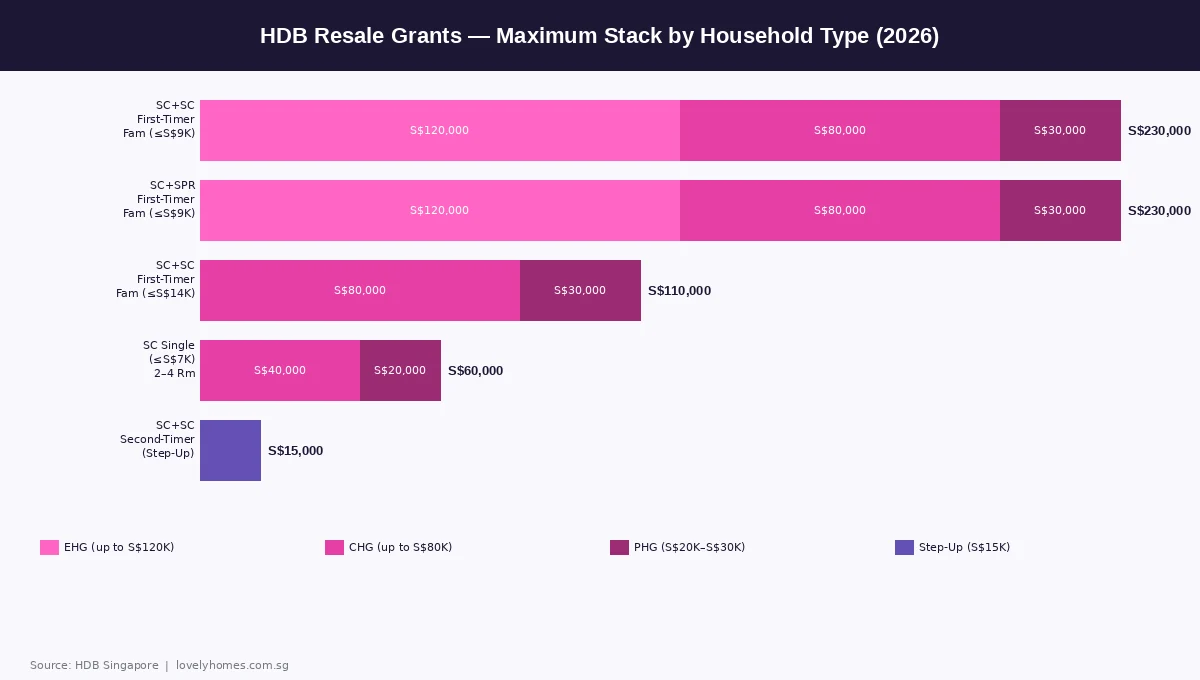
- Eligible first-timer SC households can receive up to S$200,000+ in combined grants (EHG S$120K + CHG S$80K + PHG S$30K), subject to income ceilings and proximity conditions.
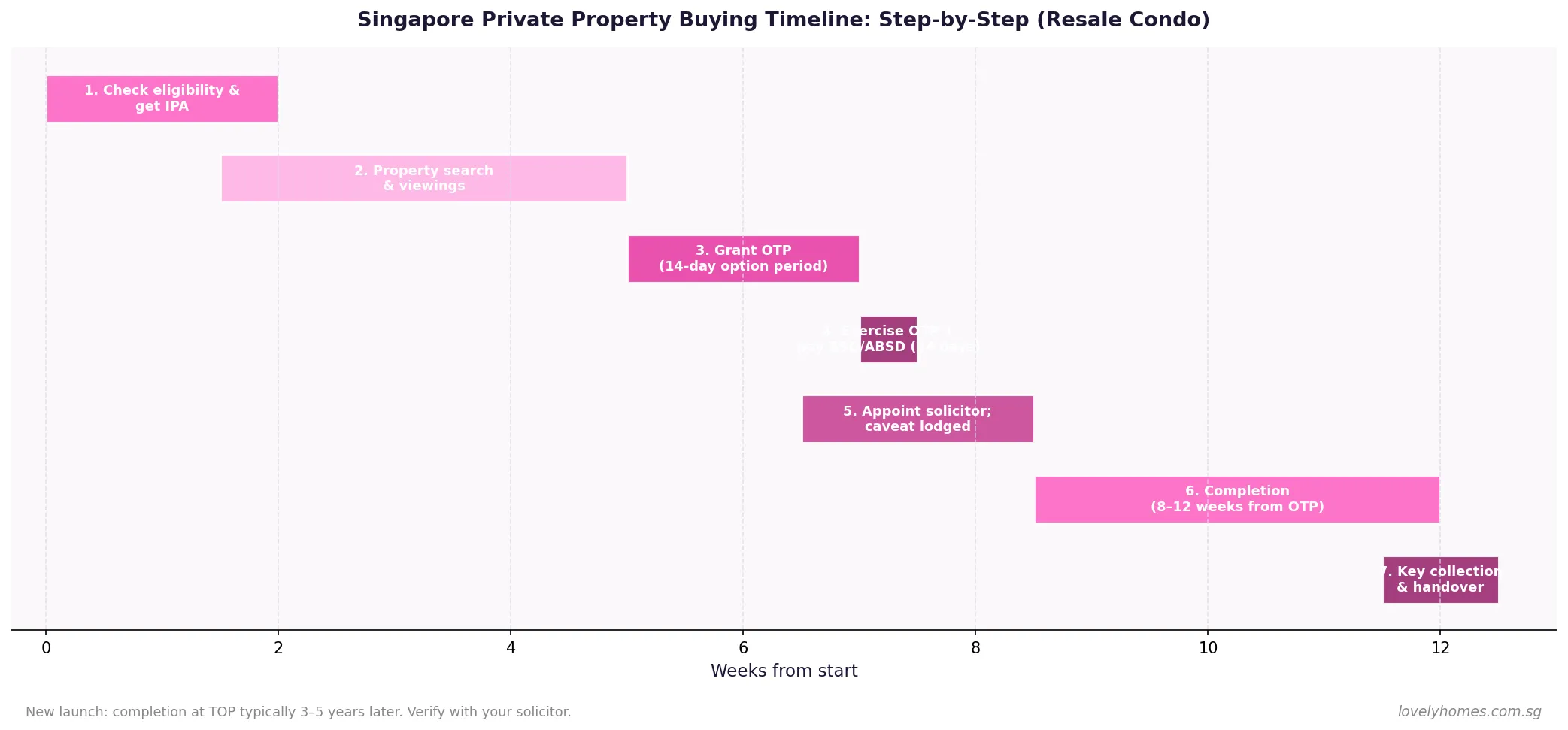
- The full buying process — from eligibility check to key collection — typically takes 12 to 18 weeks (three to four months).
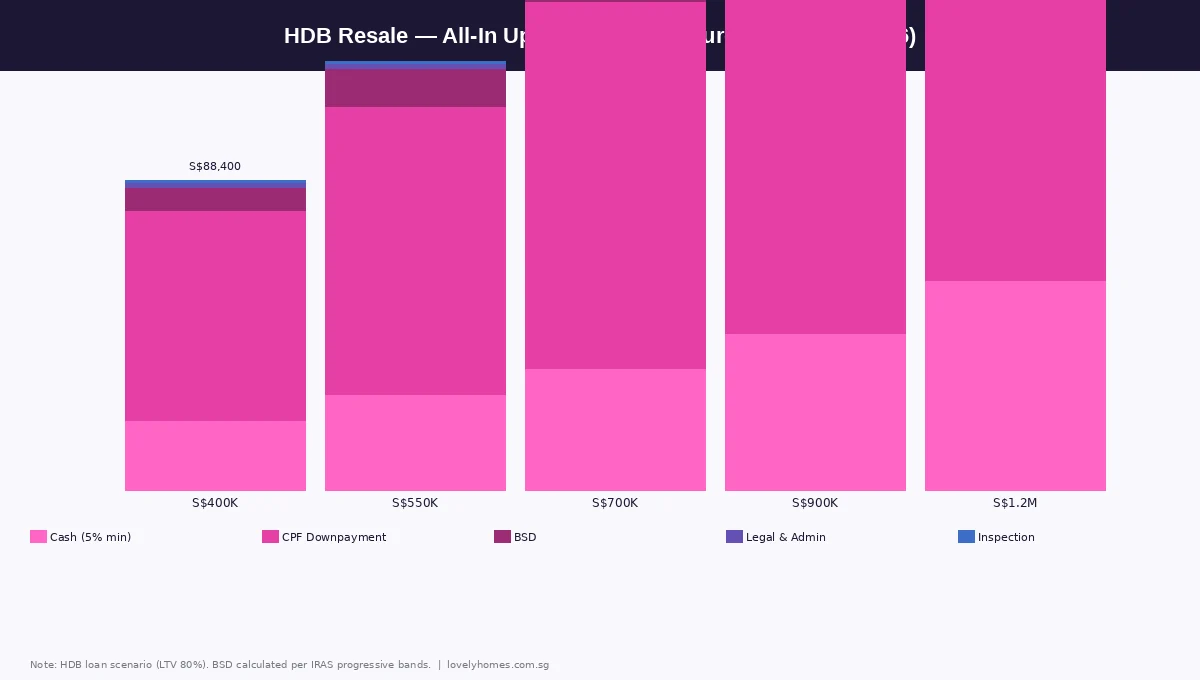
- Buyer’s Stamp Duty (BSD) is payable within 14 days of exercising the OTP; it ranges from S$4,200 (on a S$400,000 flat) to S$31,100 (on a S$900,000 flat).
- The Ethnic Integration Policy (EIP) quota may restrict which buyer profiles can purchase a specific block or neighbourhood; check the HDB EIP/SPR Quota Check before negotiating.
- HDB resale flats carry a five-year Minimum Occupation Period (MOP) — counted from the date you collect the keys — before you can sell or rent out the entire flat.
- The Resale Levy applies if you previously received a direct housing subsidy; it ranges from S$15,000 (2-room) to S$50,000 (5-room or Executive flat).
What Is an HDB Resale Flat?
An HDB resale flat is a Housing and Development Board (HDB) public housing unit previously owned by another Singapore household and now offered on the open market. Unlike a Build-To-Order (BTO) flat — which is purchased directly from HDB at a subsidised price with a ballot — a resale flat is transacted between private parties at a negotiated price, with no ballot and no waiting period for construction.
HDB administers the resale process through its Resale Portal. The transaction remains governed by a comprehensive set of rules covering eligibility, financing limits, grants, and the Minimum Occupation Period — all aimed at preserving the public housing system’s social objectives while allowing households flexibility to move.
As of Q2 2026, the HDB Resale Price Index (RPI) stood at 202.7, marginally lower than the Q4 2025 peak of 203.4, reflecting modest cooling after several years of strong appreciation. Over 25,000 resale transactions were recorded in 2025, and demand has remained robust, particularly for well-located mature-estate units. Understanding the full end-to-end checklist — eligibility, financing, grants, the OTP process, and post-completion obligations — is essential for any buyer entering this market.
Phase 1 — Eligibility and Financial Planning
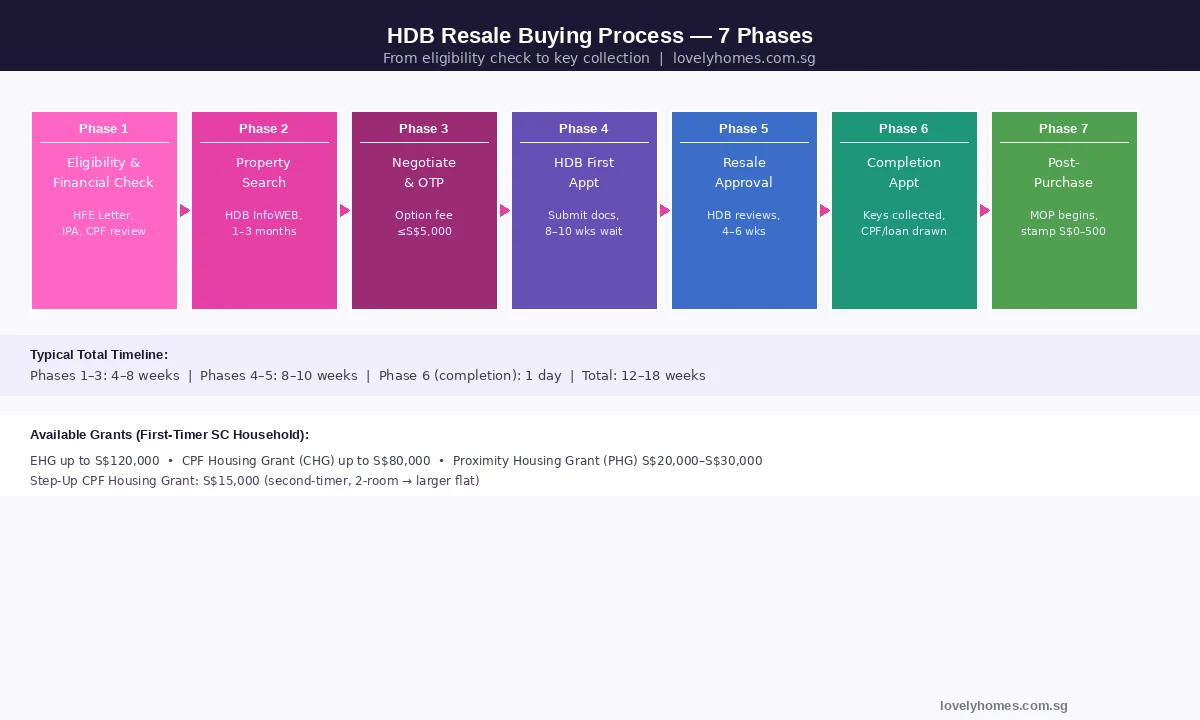
Before you begin your property search, you must first confirm that you are eligible to purchase an HDB resale flat and obtain your financing paperwork. The HDB Flat Eligibility (HFE) letter, introduced in May 2023, consolidates the old HDB Loan Eligibility (HLE) letter and eligibility assessment into a single online application. You must have an in-principle HFE letter before you can exercise any OTP.
Who is eligible? At least one buyer must be a Singapore Citizen (SC). Singapore Permanent Residents (SPRs) may purchase jointly with an SC spouse, but an SPR household alone may only purchase after a minimum three-year residency in Singapore. Buyers must be at least 21 years old. You must not currently own or have a legal interest in any private residential property locally or overseas. If you previously purchased a direct-subsidised flat (BTO or Sale of Balance Flat), you must have completed your existing flat’s MOP before buying a resale flat in certain circumstances. The Public Scheme (SC plus spouse/children/parents), Fiancé/Fiancée Scheme, Single Singapore Citizen Scheme (age 35+, up to 5-room), and Non-Citizen Family Scheme each carry additional conditions.
Financial pre-checks: Apply for an HFE letter at HDB InfoWEB. This tells you your HDB loan eligibility, CPF housing grant quantum, and maximum flat price. Separately, if you intend to use a bank loan, obtain an In-Principle Approval (IPA) from your bank; banks will assess your Total Debt Servicing Ratio (TDSR, capped at 55% of gross monthly income) and apply a stress-test rate of 4% per annum. For HDB loans, the Mortgage Servicing Ratio (MSR) must not exceed 30%.
Check your CPF Ordinary Account (OA) balance — this is the primary source for the downpayment and BSD. If using an HDB loan (Loan-to-Value 80%), the minimum downpayment is 20%, of which 5% must be in cash; the remaining 15% may be from CPF OA. For a bank loan (LTV 75%), the downpayment is 25% — again minimum 5% cash, with 20% from CPF.
Phase 2 — Property Search and EIP Quota Check
Search for resale flats on the HDB Resale Flat Listings portal or property portals. Before making any offer, check the EIP/SPR Quota for the specific block: each HDB block and neighbourhood has ethnic quotas under the Ethnic Integration Policy (administered by HDB since 1989) to maintain racial harmony. If the quota for your ethnic group is full in that block or neighbourhood, you cannot purchase that unit. Check at HDB’s EIP/SPR Quota website.
Also review the remaining lease on the flat. HDB leases are 99 years; older flats have shorter remaining tenures. CPF usage is prorated if the remaining lease is less than 60 years (and cannot be used below 20 years). Financing restrictions also apply: HDB will not grant a loan for a flat where the remaining lease does not cover the youngest buyer to age 95; banks have similar policies. Use the remaining lease to plan your CPF withdrawal ceiling carefully.
Phase 3 — Negotiating Price and Issuing the OTP
Once you agree on a price, the seller issues an Option to Purchase (OTP). The option fee is capped by HDB based on the agreed price: up to S$1,000 for flats priced at S$500,000 or below; up to S$2,000 for flats between S$500,001 and S$1,000,000; and up to S$5,000 for flats above S$1,000,000. The OTP is valid for 21 calendar days. During this period, you must exercise the OTP (by signing and paying the option exercise fee, typically the balance 9–10% of the negotiated price) or allow it to lapse and lose the option fee.
Check the HDB resale transaction records on the HDB Resale Statistics portal to understand recent transacted prices in the block and town. The Cash Over Valuation (COV) — the amount you pay above HDB’s assessed valuation — must be paid entirely in cash; CPF cannot be used for COV.
Phase 4 — Registering the Resale Application (First Appointment)
After exercising the OTP, both buyer and seller independently submit their respective portions of the resale application on HDB’s Resale Portal. This triggers the First Appointment with HDB (now conducted online via the portal). At this stage, you submit your HFE letter, confirm your financing (HDB loan letter or bank’s Letter of Offer), and provide supporting documents: NRIC, marriage certificate (if applicable), birth certificates of children (if applying under the Parenthood Priority Scheme), and any grant-related documents. HDB will assess the application, verify eligibility, and send notification of the Second Appointment date — typically four to eight weeks later.
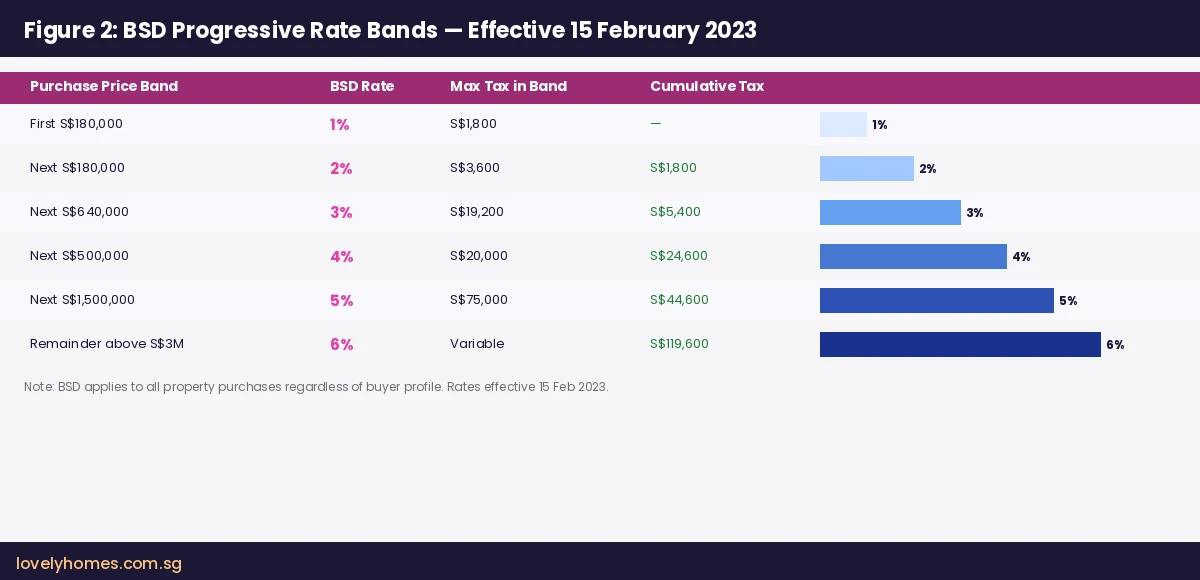
BSD payment: Buyer’s Stamp Duty must be paid to IRAS within 14 days of exercising the OTP. BSD is calculated on the higher of the purchase price or HDB’s assessed valuation using IRAS’s progressive bands: 1% on the first S$180,000; 2% on the next S$180,000; 3% on the next S$640,000; 4% on the next S$500,000; 5% on amounts from S$1.5 million; and 6% for amounts above S$3 million. There is no Additional Buyer’s Stamp Duty (ABSD) for first-time SC and SC-SPR couple buyers of HDB resale flats.
Phase 5 — Grant Assessment and Resale Approval
During this phase, HDB assesses your eligibility for housing grants. The three main grants for resale flat buyers are:
Enhanced CPF Housing Grant (EHG): Up to S$120,000 for households earning S$9,000 or below per month (first-timer couples or families). The EHG scales down with income in eight tiers: at ≤S$1,500/mth the grant is S$120K; at S$8,501–S$9,000/mth it is S$5K. The EHG is deposited directly into CPF OA and applied towards the flat purchase. Singles (age ≥35) may receive up to S$60,000 (income ≤S$4,500/mth). Both buyer and spouse must not have received the EHG or its predecessor grant previously.
CPF Housing Grant (CHG): Up to S$80,000 for first-timer families purchasing a 4-room or smaller resale flat (income ≤S$14,000/mth); S$40,000 for 5-room and Executive flats. Singles buying 2–4 room resale flats under the Single Singapore Citizen Scheme receive up to S$40,000 (mature estates) or S$40,000 (non-mature estates) depending on the scheme. The CHG is available to both first-timer couples and, in some scenarios, second-timer families.
Proximity Housing Grant (PHG): S$30,000 for buyers living with their parents (within the same household); S$20,000 for buyers living near their parents (within 4km). The PHG also applies if you are buying to live near a married child. The PHG is not means-tested but requires the buyer and the qualifying family member to maintain the proximity for at least five years after the purchase (i.e., through the MOP).
Step-Up CPF Housing Grant: S$15,000 for second-timer SC households moving from a 2-room flat to a larger resale flat (3-room or bigger), subject to income ≤S$7,000/mth.
HDB will issue a Resale Approval letter once all checks are complete. This approval confirms that the transaction can proceed to completion.
Phase 6 — Second Appointment and Key Collection
The Second Appointment is the completion of the transaction. You, the seller, and (if applicable) CPF Board and the bank’s lawyer attend (or the process is handled through HDB’s online system for straightforward cases). At this appointment: the outstanding purchase price is settled (from your CPF OA and bank loan drawdown); the seller receives their sale proceeds net of any outstanding HDB loan, CPF refund obligation, and HDB administrative fees; and HDB transfers the flat to you. You collect the keys on the same day.
HDB charges an administrative fee of S$80 (1-room/2-room flat) to S$640 (5-room or Executive flat) for registering the resale. The legal conveyancing for HDB resale transactions is handled by HDB’s own in-house legal team, so you do not need to engage a private solicitor for the conveyancing — though you may wish to seek independent legal advice for any non-standard aspects.
Phase 7 — Post-Purchase Obligations
After key collection, the five-year Minimum Occupation Period begins. During the MOP you may not sell the flat or rent it out in its entirety (though you may rent out individual rooms with HDB’s approval). You may not own private residential property in Singapore during the MOP. Violations of MOP rules are taken seriously: HDB may compulsorily acquire the flat and impose financial penalties.
If you later wish to purchase a second subsidised HDB flat (BTO or SBF), the Resale Levy will apply, ranging from S$15,000 (2-room BTO) to S$50,000 (5-room or Executive flat) depending on the first flat type. This levy is deducted from your CPF proceeds or paid in cash at the point of purchasing the second subsidised flat.
Property tax is payable annually to IRAS. For owner-occupied HDB flats, the effective property tax rate is well below the non-owner-occupied rate; a typical 4-room flat has an Annual Value of approximately S$12,000–S$20,000, resulting in an owner-occupier tax of just S$160–S$900 per year at the progressive owner-occupier rates in force from 1 January 2024.
Summary Checklist Table
| Phase | Key Action | Who / Where | Deadline |
|---|---|---|---|
| 1 — Eligibility | Apply for HFE letter | HDB InfoWEB | Before OTP exercise; valid 6 months |
| 1 — Finance | Get bank IPA (if bank loan) | Your bank / mortgage broker | Before property search |
| 2 — Search | Check EIP/SPR quota for target block | HDB EIP/SPR Quota portal | Before making offer |
| 2 — Search | Review remaining lease and CPF cap | HDB InfoWEB / SLA | Before making offer |
| 3 — OTP | Pay option fee (≤S$5,000) | To seller | Day of OTP |
| 3 — OTP | Exercise OTP (sign + pay exercise fee) | Return to seller | Within 21 calendar days of OTP |
| 4 — BSD | Pay Buyer’s Stamp Duty to IRAS | IRAS e-Stamping portal | Within 14 days of exercising OTP |
| 4 — Application | Submit resale application on HDB portal | HDB Resale Portal | Within 7 days of OTP exercise |
| 5 — Documents | Submit supporting docs for grant assessment | HDB Resale Portal | As directed by HDB (First Appt) |
| 6 — Completion | Attend Second Appointment; collect keys | HDB Hub / online | As scheduled by HDB (8–12 wks) |
| 7 — Post | Comply with 5-year MOP | N/A (ongoing) | From key collection date |
| 7 — Tax | Pay annual property tax | IRAS | January each year |
Worked Example — The Tan Family, Tampines 4-Room Resale
Scenario
Mr and Mrs Tan are a Singapore Citizen couple, both aged 34. They earn a combined gross income of S$8,000 per month. They are first-time buyers purchasing a 4-room resale flat in Tampines (a non-mature estate) at a negotiated price of S$620,000. The flat has 68 years remaining on its lease.
Eligibility
Both are SC; combined income S$8,000 qualifies them for the EHG (≤S$9,000 ceiling). First-timer status confirmed (no prior subsidised flat). Mrs Tan’s parents live 2.5km away, qualifying for the PHG (within 4km). EIP quota for the block is open for their ethnic group.
Grants Applied
- EHG (S$8,001–S$9,000 income tier): S$10,000 (lowest tier; if income were ≤S$1,500 it would be S$120,000)
Note: At S$8,000/mth combined income the EHG is S$20,000 (tier S$7,501–S$8,000). Let us use a cleaner example: if combined income were S$6,000/mth, EHG = S$60,000.
Using combined income S$6,000/mth for illustration:
- EHG: S$60,000 (income tier S$5,501–S$6,000)
- CHG (4-room, non-mature estate): S$50,000
- PHG (within 4km): S$20,000
- Total grants: S$130,000 (deposited to CPF OA)
Financing (HDB Loan, LTV 80%)
- Purchase price: S$620,000
- BSD: S$12,600 (1%×S$180K + 2%×S$180K + 3%×S$260K)
- HDB Loan (80%): S$496,000 at 2.60% p.a., 25-year tenure = S$2,256/mth
- MSR: S$2,256 ÷ S$6,000 = 37.6% — exceeds 30% MSR; reduce tenure or loan amount
- Adjusted (20-year tenure): S$496,000 at 2.60% = S$2,666/mth → 44.4% MSR — still exceeds 30%
- HDB Loan adjusted (MSR 30% = max S$1,800/mth): max HDB loan ≈ S$396,000 at 2.6%/25yr; downpayment must be S$224,000
- Grants cover S$130,000; remaining CPF OA needed: S$94,000 — feasible with working years of contributions
Lesson: At S$620,000 and S$6,000/mth income, the MSR constraint bites hard. The couple should consider a more affordable flat or a higher income before committing.
Timeline
HFE letter applied → 7 days; EIP quota confirmed → same day; OTP negotiated and signed 3 August 2026; OTP exercised 18 August 2026 (day 15); BSD S$12,600 paid to IRAS 25 August 2026; resale application submitted 19 August 2026; HDB First Appointment 26 August 2026; Resale Approval expected 10–20 October 2026; Second Appointment (key collection) estimated 25–30 October 2026. Total timeline: approximately 12 weeks.
Why This Matters — the Resale Premium and Market Context
The Singapore resale market offers an immediate supply of completed flats across all mature and non-mature estates, with no waiting period and the full range of flat types (2-room to Executive Maisonette). Unlike BTO flats — which have experienced waiting times of four to six years for most projects since 2021 — resale flats allow buyers to move in within three months of exercising the OTP.
The trade-off is price. Resale flats transact at market rates, and the COV (if any) must be paid in cash; BTO prices remain deeply subsidised. Industry figures show that a typical 4-room BTO in a non-mature estate launched in 2024 prices at S$340,000–S$400,000, while comparable resale units in the same estate trade at S$480,000–S$550,000 — a gap of S$100,000–S$150,000 or more. However, the generous grant stack (EHG + CHG + PHG totalling up to S$230,000 for the most grant-eligible households) substantially narrows this premium, particularly for lower-income buyers.
What Might Come Next
HDB is expected to continue ramping up BTO supply through 2026 and 2027, with approximately 19,600 BTO flats offered in 2026 and a further 19,000 in 2027. Increased supply typically moderates resale price growth, particularly in non-mature estates where BTO competition is strongest. The Resale Price Index declined marginally in Q2 2026 (-0.3% quarter-on-quarter), suggesting the market may have peaked for the current cycle. Whether cooling continues into H2 2026 will depend on interest rate movements, BTO ballot ratios, and employment conditions. Buyers who are not grant-constrained by income ceilings should monitor the BTO calendar as an alternative before committing to the resale premium.
Frequently Asked Questions
Can I purchase an HDB resale flat if I already own a private property?
No. You must dispose of all private residential properties — in Singapore and overseas — before or on the date of completing the HDB resale purchase. This applies to both the main applicant and their spouse (if included in the application). You should allow sufficient time to sell your private property before the HDB resale completion date. Note that the completion of the HDB resale transaction is typically 8–12 weeks after the OTP exercise, so if your private property has not been fully sold and transferred by then, the resale application will not proceed.
What happens if the EIP quota is full for my ethnic group when I want to buy?
If the Ethnic Integration Policy quota is full for your ethnic group in the target block or neighbourhood, you simply cannot purchase that specific unit under your profile. You must look for a unit in a different block or neighbourhood where the quota is not yet full. The EIP quota is checked in real time on HDB’s portal. This situation most commonly affects buyers of Chinese ethnicity in blocks with a high concentration of Chinese households, or Malay/Indian buyers in blocks where their group’s quota has been reached. There is no appeal mechanism to override the EIP quota.
Can I use CPF to pay the Cash Over Valuation (COV)?
No. COV — the portion of the agreed purchase price that exceeds HDB’s assessed valuation — must be paid in cash. CPF funds can only be applied up to the assessed valuation (subject to the Withdrawal Limit). If you are buying at a significant COV, plan your cash reserves accordingly. It is prudent to confirm the valuation before exercising the OTP so you know the cash commitment upfront.
Can I rent out my HDB resale flat after I move in?
You may rent out individual bedrooms to approved occupants from the day you receive the keys, subject to HDB’s rental conditions (no more occupants than the approved flat capacity, no short-term rentals under three months). However, you may not rent out the entire flat during the five-year MOP. After completing the MOP, you may apply to HDB for approval to sublet the whole flat, subject to income and citizenship conditions. The HDB subletting guide covers the full conditions, including the 3-year subletting approval period and the subletting income declaration requirement.
Does the Resale Levy apply to my purchase?
The Resale Levy applies only if you are a second-timer — meaning you previously purchased a subsidised BTO, Sale of Balance Flat, or DBSS flat from HDB. Buying an HDB resale flat at market price does not trigger the Resale Levy. If you have previously purchased a subsidised flat, the levy ranges from S$15,000 (2-room BTO) to S$50,000 (5-room or Executive flat). It is deducted from CPF OA or paid in cash at the point of purchasing a second subsidised flat in the future. Purchasing a resale flat (which is not subsidised by HDB) after selling your first subsidised flat does not in itself trigger the levy, but any subsequent return to the subsidised market will.
What is the difference between an HFE letter and an HDB Loan Eligibility (HLE) letter?
The HDB Flat Eligibility (HFE) letter replaced the HLE letter in May 2023. The old HLE letter confirmed only your loan eligibility. The new HFE letter is a consolidated assessment that covers both your eligibility to purchase an HDB flat and your eligibility for HDB housing loans and grants. It replaces the separate grant application process that previously required multiple steps. You apply for the HFE letter at HDB’s website, and it is processed within 21 working days. The HFE letter is valid for six months, during which you can exercise any OTP.
What documents do I need to submit at the First Appointment?
The First Appointment for HDB resale is now largely conducted via the online Resale Portal, but you should have the following documents ready: NRIC (buyer and all occupants), marriage certificate (if applicable), birth certificates of children (if applying under family or priority schemes), latest CPF statement, HFE letter, bank IPA or bank letter of offer (if using a bank loan), proof of employment or self-employment income, and any documents supporting your grant applications (e.g., payslips for EHG income assessment, proximity documents for PHG). HDB’s portal will specify the exact list for your application.