Singapore HDB Lease Buyback Scheme Guide 2026: Monetise Your Flat, Stay in Your Home
⚡ Quick Answer — HDB Lease Buyback Scheme 2026
- The Lease Buyback Scheme (LBS) allows eligible elderly HDB flat owners to sell the tail end of their flat’s lease back to HDB while continuing to live in the flat until death.
- You must be aged 65 or above (at least one owner), own a 3-Room or larger flat as your only residential property, and all owners must be Singapore Citizens.
- Income ceiling: gross monthly household income must not exceed S$14,000.
- You must retain a minimum of 20 years of remaining lease after the buyback — HDB will not purchase so much of the lease that you are left with under 20 years.
- A mandatory portion of the sale proceeds is used to top up your CPF Retirement Account (RA) to the Full Retirement Sum (FRS), with the balance received in cash via CPF LIFE monthly payouts.
- Proceeds are tax-free and do not affect HDB housing grants previously received.
- The scheme is administered by HDB; valuation is done by HDB-appointed valuers.
- LBS is a one-way arrangement — once signed, you cannot reverse the lease sold back to HDB.
What Is the HDB Lease Buyback Scheme?
The HDB Lease Buyback Scheme (LBS) is a monetisation programme introduced by HDB in 2009 and significantly enhanced in 2015 and 2019. It is designed specifically for elderly Singapore Citizens who own HDB flats but may have insufficient retirement savings. Under the scheme, an eligible flat owner sells a portion of the flat’s remaining lease back to HDB — typically the tail end — and receives a cash sum that is channelled partly into CPF LIFE for lifetime monthly income and partly as a cash lump sum.
The key characteristic that makes LBS distinct from outright sale is that the flat owner continues to live in the flat. HDB purchases only the remaining lease years beyond what the owner retains — the owner keeps at least 20 years of lease, which covers the expected lifespan of most applicants at 65 or older. There is no need to move out, purchase another property, or make any change to the living arrangement.
LBS is one of three Silver Housing Bonus schemes offered by the Singapore government to help elderly flat owners monetise their flats. The other two are (a) selling the flat outright on the open market and right-sizing to a smaller flat or rental flat under the Lease Buyback Scheme’s sister programme, and (b) the Senior Priority Scheme which gives priority for 2-Room Flexi flats. LBS is the option for those who want to stay where they are.
Eligibility in Full
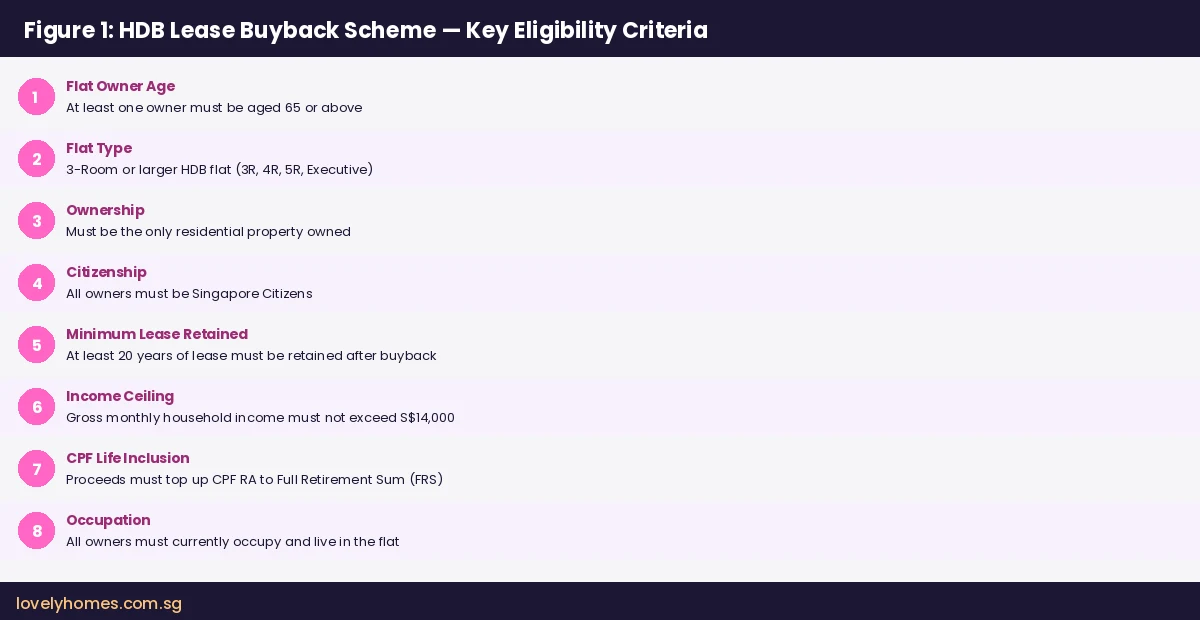
To qualify for LBS in 2026, a flat owner must meet all of the following conditions set by HDB:
| Criterion | Requirement | Notes |
|---|---|---|
| Age | At least one owner must be 65 or above | Spouse may be younger |
| Flat type | 3-Room flat or larger (3R, 4R, 5R, Executive) | 2-Room Flexi flats are not eligible |
| Citizenship | All flat owners must be Singapore Citizens | SPR co-owners disqualify |
| Sole property | Flat must be only residential property owned | Overseas property also disqualifies |
| Occupation | All owners must live in the flat | No subletting of entire flat |
| Income ceiling | Gross monthly household income not exceed S$14,000 | Average last 12 months |
| Lease retained | Minimum 20 years retained after buyback | HDB will cap proceeds accordingly |
| CPF RA top-up | Proceeds must first top up CPF RA to FRS (or BRS if property pledged) | Mandatory, not optional |
| No outstanding judgments | No bankruptcy proceedings, court orders on flat | HDB checks SLA records |
The income ceiling of S$14,000 per month is assessed on the gross monthly household income averaged over the 12 months preceding the LBS application. If the income ceiling was recently breached due to a one-time event (such as a bonus or redundancy payment), applicants should clarify the position with HDB directly.
How Much Will You Receive?
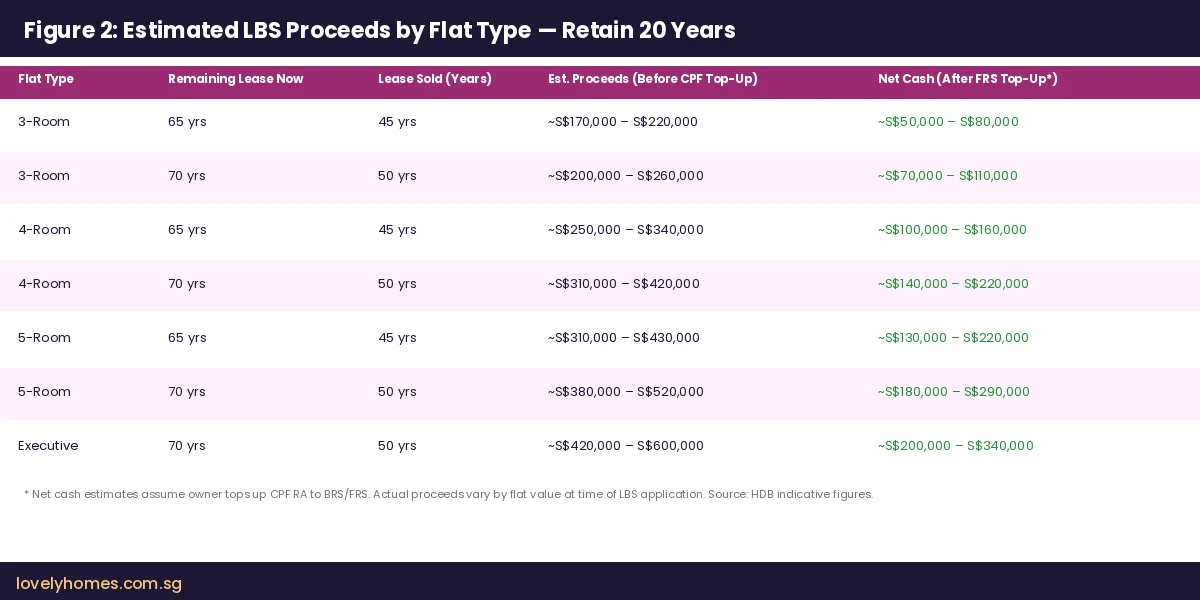
The proceeds from the LBS depend on two variables: the current market value of your flat (assessed by HDB’s appointed valuer) and the number of lease years you choose to sell. A flat valued at a higher market price will generate more proceeds from selling the same number of lease years than a flat in a lower-value estate.
HDB uses a straightforward proportional calculation: the proceeds from selling N years of lease is approximately N ÷ Total Remaining Lease × Market Value of the flat. For example, a flat with 65 years remaining lease and a market value of S$600,000 would generate proceeds of approximately 45 ÷ 65 × S$600,000 ≈ S$415,385 for selling the tail 45 years (retaining 20 years). This is a simplified illustration; HDB uses actuarial tables and discount factors in practice, so actual proceeds may differ.
How Proceeds Are Distributed
The LBS proceeds are not paid as a single lump sum to the flat owner. HDB directs the proceeds in a specific order mandated by the scheme rules:
- Refund any outstanding HDB housing loan — if the flat has a remaining HDB loan balance, this must be cleared first from the sale proceeds.
- Top up CPF Retirement Account to FRS — the mandatory retirement top-up. If the owner has pledged the property to HDB (opted for BRS instead of FRS), only the Basic Retirement Sum top-up is required. For 2026, the FRS is approximately S$213,000 for those turning 55 this year (the FRS adjusts annually at approximately 3.5%).
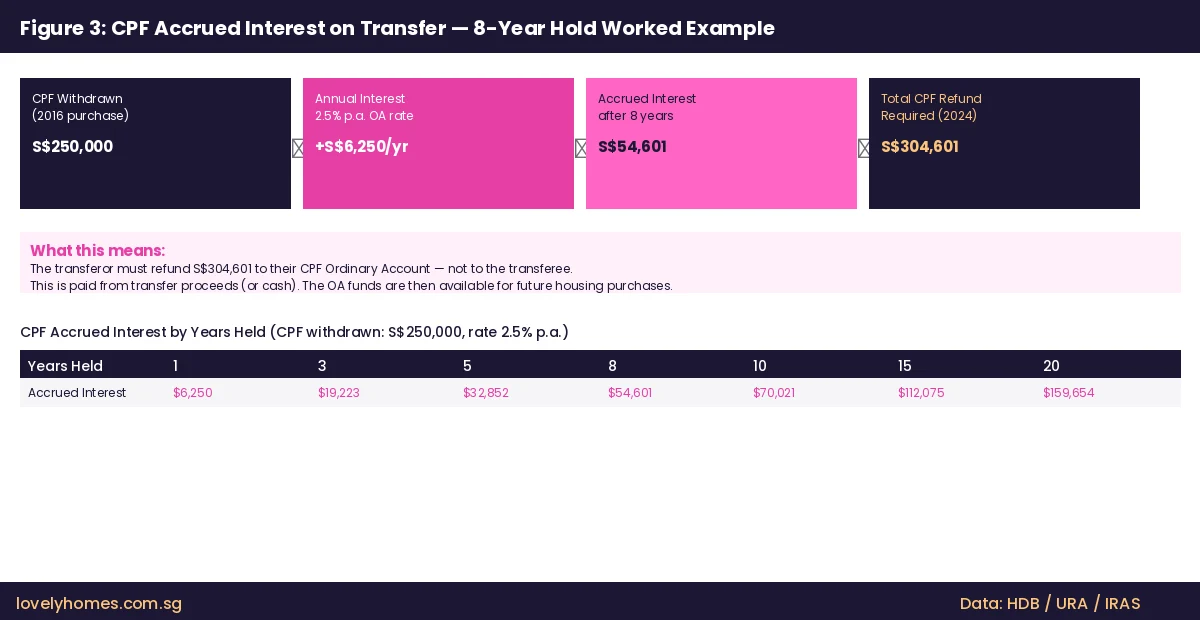
- Refund any CPF used for the flat plus accrued interest — CPF used in the original purchase (including accrued interest at 2.5% per annum) is refunded to the CPF OA from the proceeds.
- Remaining cash — any balance after the above deductions is paid to the flat owner as a cash lump sum. This cash is not locked into CPF.
The mandatory CPF RA top-up is then converted into CPF LIFE payouts — monthly income for the rest of the owner’s life, with amounts depending on the CPF LIFE plan selected (Standard Plan or Basic Plan).
The 5-Step Application Process
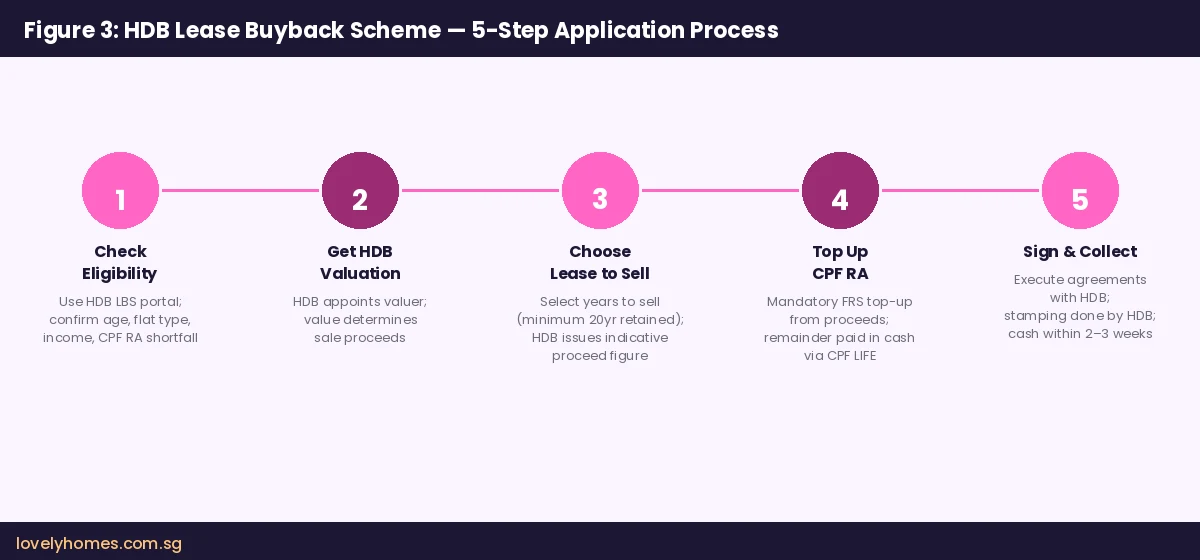
Applying for LBS is done entirely through HDB’s My HDBPage portal or at any HDB Branch Office. The process typically takes 2 to 3 months from initial application to receipt of funds. HDB’s officers will guide applicants through each stage, and there is no conveyancing fee or legal fee payable by the flat owner — HDB absorbs all transaction costs.
Worked Example — LBS in Action
Case Study: Mr and Mdm Lim, Sengkang 4-Room Flat
Profile: Mr Lim, 68, and Mdm Lim, 65, Singapore Citizens, co-own a 4-Room HDB flat in Sengkang. The flat has a remaining lease of 68 years and is valued by HDB’s appointed valuer at S$560,000. They have no outstanding HDB loan. Both live in the flat. Combined monthly income S$3,200. CPF RA balance (Mr Lim): S$80,000. FRS for their cohort: S$210,000.
Lease Years to Sell: Mr and Mdm Lim decide to sell 48 years of lease, retaining 20 years.
Estimated Proceeds (proportional illustration): 48 ÷ 68 × S$560,000 ≈ S$395,294 (subject to HDB’s actuarial computation; used as illustration only).
Distribution of Proceeds:
- Outstanding HDB loan: S$0 (none)
- CPF RA top-up to FRS: S$210,000 − S$80,000 (current balance) = S$130,000 to be topped up to CPF RA
- CPF OA refund (original CPF used S$120,000 + accrued interest 15yr @2.5% ≈ S$56,000): S$176,000
- Net cash received directly: S$395,294 − S$130,000 (CPF RA top-up) − S$176,000 (CPF refund) = ~S$89,294 cash lump sum
CPF LIFE payouts: With the CPF RA topped to the FRS of S$210,000 on the Standard Plan, Mr Lim (68 at application) would receive approximately S$1,200 – S$1,400 per month for life, depending on payouts at that age (indicative; actual payouts depend on CPF LIFE tables).
Summary: The Lims stay in their flat, receive ~S$89,294 in cash immediately, and enjoy around S$1,300/month CPF LIFE income. The flat remains their home for 20 more years, well past average life expectancy for a couple their age.
LBS vs Outright Sale — What Is Right for You?
| Factor | Lease Buyback Scheme | Outright Sale and Right-Size |
|---|---|---|
| Continue living in same flat | Yes | No — must move out |
| Maximum proceeds | Moderate (tail lease only) | High (full flat value) |
| Disruption to lifestyle | Minimal | Significant |
| New flat or rental needed | No | Yes |
| Eligible flat types | 3-Room and above | Any HDB flat |
| CPF RA top-up required | Yes (mandatory) | Yes (if right-sizing to 2-Room Flexi under SHB) |
| Silver Housing Bonus (SHB) | Eligible (up to S$30,000 bonus) | Eligible under separate SHB scheme |
| Reversible | No — permanent once executed | Typically irreversible once flat sold |
Silver Housing Bonus — Additional Incentive
Eligible flat owners who participate in the LBS may also receive the Silver Housing Bonus (SHB), an additional government grant to incentivise right-sizing and retirement monetisation. Under the SHB for LBS participants, the maximum bonus is S$30,000 for 3-Room flat owners and S$20,000 for 4-Room flat owners, subject to the income ceiling and CPF RA top-up requirements. The SHB is deposited into the CPF RA, not paid as direct cash. It is not available to owners of 5-Room or Executive flats.
What This Means for Singapore’s Ageing Society
The LBS exists because a large proportion of Singapore’s elderly population holds significant housing wealth locked in HDB flats but has insufficient liquid retirement savings. A 4-Room flat in a mature estate is often worth S$600,000 to over S$1,000,000, yet its owner may have only S$100,000 in CPF RA and minimal cash savings. LBS offers a structured way to extract some of that housing value without displacement.
Industry figures suggest fewer than 10,000 households have utilised LBS since its introduction, which is low relative to the estimated 200,000+ elderly HDB households that would qualify. HDB continues to refine the scheme — the 2019 enhancements expanded eligibility to all flat types 3-Room and above and lowered the minimum owner age from 65 to 65 (maintained). As Singapore’s resident population ages — by 2030 approximately one in four residents will be aged 65 or older — schemes like LBS are expected to become increasingly central to national retirement planning policy.
What Might Come Next
The government periodically reviews the LBS parameters including the income ceiling, minimum retained lease, and CPF top-up requirements. Policy observers expect that the income ceiling (currently S$14,000) could be raised further to extend eligibility to a broader group of middle-income elderly households. There is also industry discussion about whether the scheme could eventually be extended to 2-Room Flexi flat owners who reached the minimum occupation period — HDB has not indicated this is imminent. The FRS amount (the mandatory top-up target) rises each year in line with CPF adjustments; applicants should verify the current FRS directly with CPF Board at the time of application. The Silver Housing Bonus quantum may also be adjusted in future Budget statements.
Frequently Asked Questions
Can I apply for LBS if my spouse is a Singapore PR and not a citizen?
No. One of the hard eligibility requirements is that all flat owners must be Singapore Citizens. If your spouse is a Permanent Resident and is listed as a co-owner of the flat, you would not qualify for LBS. In this scenario, alternatives include transferring the flat solely to the citizen spouse (subject to stamp duty considerations) or exploring other monetisation options such as subletting the flat (if eligible) or outright sale. If the SPR spouse is not on the title and is merely a resident, LBS eligibility is not affected by the SPR’s presence in the flat.
What happens to the flat when I pass away — do my children inherit it?
After an LBS, the flat owner retains the balance of the lease they kept (typically 20 years). If you pass away before the retained lease expires, the remaining lease forms part of your estate and can be inherited by your beneficiaries. However, the beneficiaries would then own a flat with, say, 10 to 15 years of lease remaining. Given HDB’s rules on minimum lease for financing and CPF usage, a flat with fewer than 20 years of lease has very limited marketability. Beneficiaries should factor this into estate planning. If the lease expires before the last owner passes away, the flat reverts to HDB with no compensation.
Is the LBS a loan, and do I owe HDB money?
No. The LBS is not a loan. HDB is purchasing the tail end of your lease outright — it is a sale transaction. You receive proceeds (channelled through CPF RA top-up and cash) and there is no repayment obligation. You do not owe HDB anything after the LBS is completed. The flat simply has a shorter remaining lease than before — the portion sold to HDB is HDB’s property. There are no monthly repayments, no interest charges, and no negative equity risk.
Can I still sublet my rooms after LBS?
Yes, subject to HDB’s existing subletting rules. HDB flat owners may sublet spare bedrooms (not the entire flat) with HDB’s approval. LBS does not remove this right — the flat is still yours for the duration of the retained lease. You must continue to occupy the flat yourself, as owner-occupation is required both under LBS eligibility and under HDB subletting rules. Income from subletting is taxable as rental income and should be declared to IRAS.
How does LBS interact with my existing HDB loan?
If you still have an outstanding HDB housing loan at the time of the LBS application, the outstanding loan balance must be fully repaid from the LBS proceeds before any other distributions are made. This is the first priority in the proceeds waterfall. If the outstanding loan is large relative to the LBS proceeds, the net cash available to you (and the CPF RA top-up) will be reduced accordingly. Applicants with significant outstanding HDB loans should model this carefully before proceeding — in some cases, the net proceeds may be insufficient to generate a meaningful cash lump sum or CPF RA top-up.
Is there a deadline to apply for LBS?
There is no fixed deadline — LBS is an ongoing programme, not a time-limited offer. However, the scheme parameters (income ceiling, FRS top-up amount, SHB quantum) are reviewed periodically and may change. Flat owners who are eligible today should not assume the same eligibility conditions or proceeds will apply in future years, particularly as the FRS increases annually and market values fluctuate. Applying sooner rather than later is generally advisable for those who have decided to proceed, as the flat’s lease shortens each year, which mechanically reduces the proceeds achievable from selling the same number of tail lease years.
Will proceeds from LBS affect my MediShield Life or ComCare assistance?
The CPF RA top-up from LBS does not count as income for means-testing purposes for ComCare or other social assistance schemes — it is a retirement savings contribution, not earned income. The cash lump sum received, however, may be considered as an asset when assessed for means-tested schemes. Flat owners relying on ComCare or other income-tested benefits should declare the LBS transaction and consult the relevant agency (MSF for ComCare, CPF Board for Silver Support) to understand any impact on their assistance. MediShield Life premiums are not directly affected by LBS participation.
Click anywhere outside to close